
Original briefings. Zero spin.
Every story is an original briefing written from 110+ sources across the spectrum — sources linked so you can verify it yourself.
 politics
Major Story (7/10)
Event date: August 19, 2026 at 07:22 AM
politics
Major Story (7/10)
Event date: August 19, 2026 at 07:22 AM
Lagarde Says Europe's Postwar Growth Model Is Eroding as U.S. Pulls Back
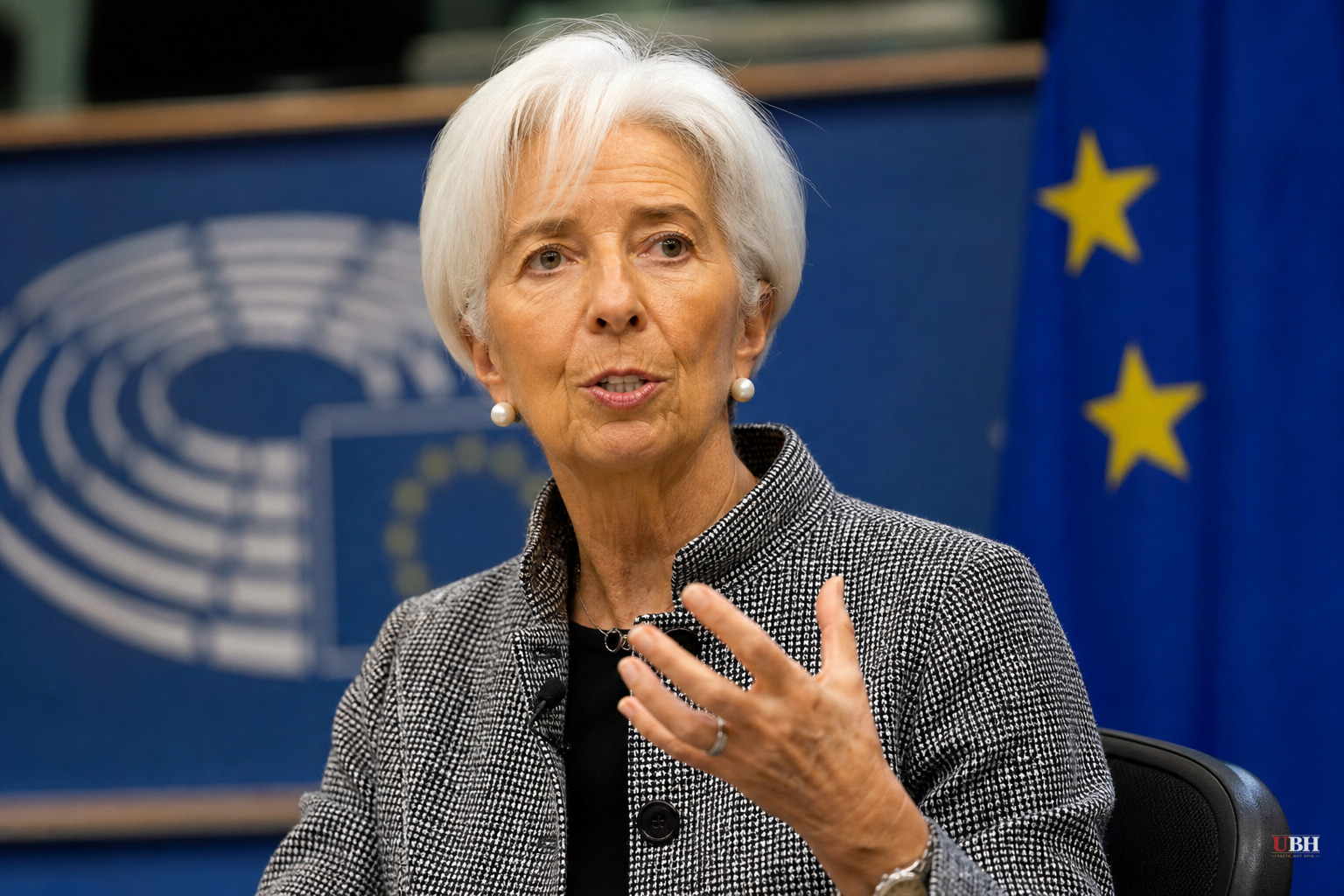
Christine Lagarde stood in Geneva on Wednesday and told Europe's business elite something American voters have heard from Donald Trump for a decade: the free ride is over.
Speaking at the World Economic Forum's International Business Council, the European Central Bank president laid out three pillars that built Europe's postwar prosperity. Cheap energy. Open global trade. And a "stable, rules-based global order, underpinned by a U.S. security umbrella," according to CNBC.
All three, Lagarde said, are cracking. "It is unlikely to return to the form we once knew," she told the audience, a remark carried nearly word-for-word by CNBC and PrimeXBT.
The Numbers Behind the Warning
Lagarde cited more than 2,500 trade restrictions imposed globally last year, per both CNBC and PrimeXBT. She pointed to the Trump administration's 20% baseline tariff on EU goods, later cut to 15% under a trade deal, with steel tariffs still unresolved.
She also put a number on Europe's tech gap. Europe's 34 most valuable listed tech companies carry a combined market value of roughly €1.37 trillion, about $1.59 trillion. America's Magnificent Seven alone are worth more than $23 trillion, according to PrimeXBT's reporting on her remarks.
Lagarde's fix: an "EU Inc." structure letting companies incorporate once and operate under a single rulebook across the bloc, plus faster defense integration so Europe doesn't miss the AI wave the way it missed the dotcom boom.
ZeroHedge's Take, and Where It Overreaches
ZeroHedge framed the speech as proof the WEF's globalist project is collapsing and that European elites are panicking because "the US might walk away from the old post-war arrangements." Lagarde herself admits the U.S. security umbrella and rules-based order are weakening, and that European firms built decades of investment strategy assuming those things were permanent.
But ZeroHedge goes further, calling the WEF's quiet coverage of its own Geneva meeting evidence the "globalization projects" and "pandemic coup" agenda failed. That's speculation, not something Lagarde said or CNBC and PrimeXBT reported. The actual sourced content is narrower: a central banker describing eroding growth conditions, not a confession that a global cabal's plans fell apart.
Trump's Role, Stated Plainly
CNBC noted Trump has "long rebuked America's European allies for not spending enough on defense," and that his administration has issued threats about withdrawing from NATO or even bringing NATO territory under Washington's control by force. If accurate, it goes beyond ordinary burden-sharing pressure and into territory that unsettles allies who've built their defense posture around U.S. commitments for 75 years.
At the same time, the underlying complaint from Washington, that Europe free-rode on American defense spending for decades while lecturing the U.S. on politics, is not new and isn't wrong. NATO members have chronically missed the 2% GDP defense spending target for years. Trump's tariffs and rhetoric are blunt tools, but the imbalance he's pointing at is real and documented, not manufactured.
Europe's Response Is Already Underway
While Lagarde talks, Europe's defense-industrial base is moving. The European Defence Agency signed a memorandum of understanding with the European Commission's Joint Research Centre on June 5, 2026, opening JRC's civilian labs, including advanced materials testing facilities, to defense research for the first time, according to Janes.
In Italy, the space sector, long dominated by small and midsize niche engineering firms, faces pressure to consolidate as defense customers favor larger suppliers, the Japan Times reported August 19. The article frames this as part of a broader European push for "strategic autonomy," driven by Russia's invasion of Ukraine, tensions with China, and uncertainty over future U.S. security commitments.
Meanwhile, foreign capital is moving in to fill gaps European firms can't fill alone. EDGE Group, the UAE-based defense conglomerate with more than 35 subsidiaries and roughly $8 billion in 2025 order intake, is expanding its European footprint from a Paris headquarters, according to defence-industry.eu. It already owns Germany's Merkel and Haenel, Estonia's Milrem Robotics, and Switzerland's ANAVIA, and it's eyeing Nordic acquisitions next.
Nordic governments aren't waiting around either. Sweden allocated SEK 500 million for ammunition supply security in mid-August, Finland and Sweden joined the Pitch Black air exercise in Australia for the first time as observers, and NATO installed a new commander for its Ukraine support mission in Wiesbaden, according to Nordic Defence Sector's weekly roundup covering week 33 of 2026.
What's Unresolved
Lagarde didn't say the U.S. security umbrella is gone, only weakening. No formal NATO withdrawal has been announced by the Trump administration, and no source here confirms the alliance's Article 5 commitments have been altered. The steel tariff rate under the EU-U.S. trade deal remains undecided, per CNBC, and that's a concrete near-term flashpoint to watch. Whether Europe's defense-industrial consolidation and its growing reliance on non-European capital like EDGE produces real strategic autonomy or just new dependencies is a question nobody in these sources has answered yet.
Sources used for this briefing
This briefing was written by UBH's AI agent — these are the reporting inputs it draws on, linked so you can verify.


