
Unbiased headlines. Facts, not spin.
Every story is an unbiased news briefing written from 110+ sources across the spectrum — sources linked so you can verify it yourself.
 health
Major Story (7/10)
August 3, 2026 at 09:42 AM
health
Major Story (7/10)
August 3, 2026 at 09:42 AM
Kumamoto Death Toll Hits 38 as Prime Minister Takaichi Tours Shelters and Store Chain Admits Sending Workers Back Into Collapsed Mall
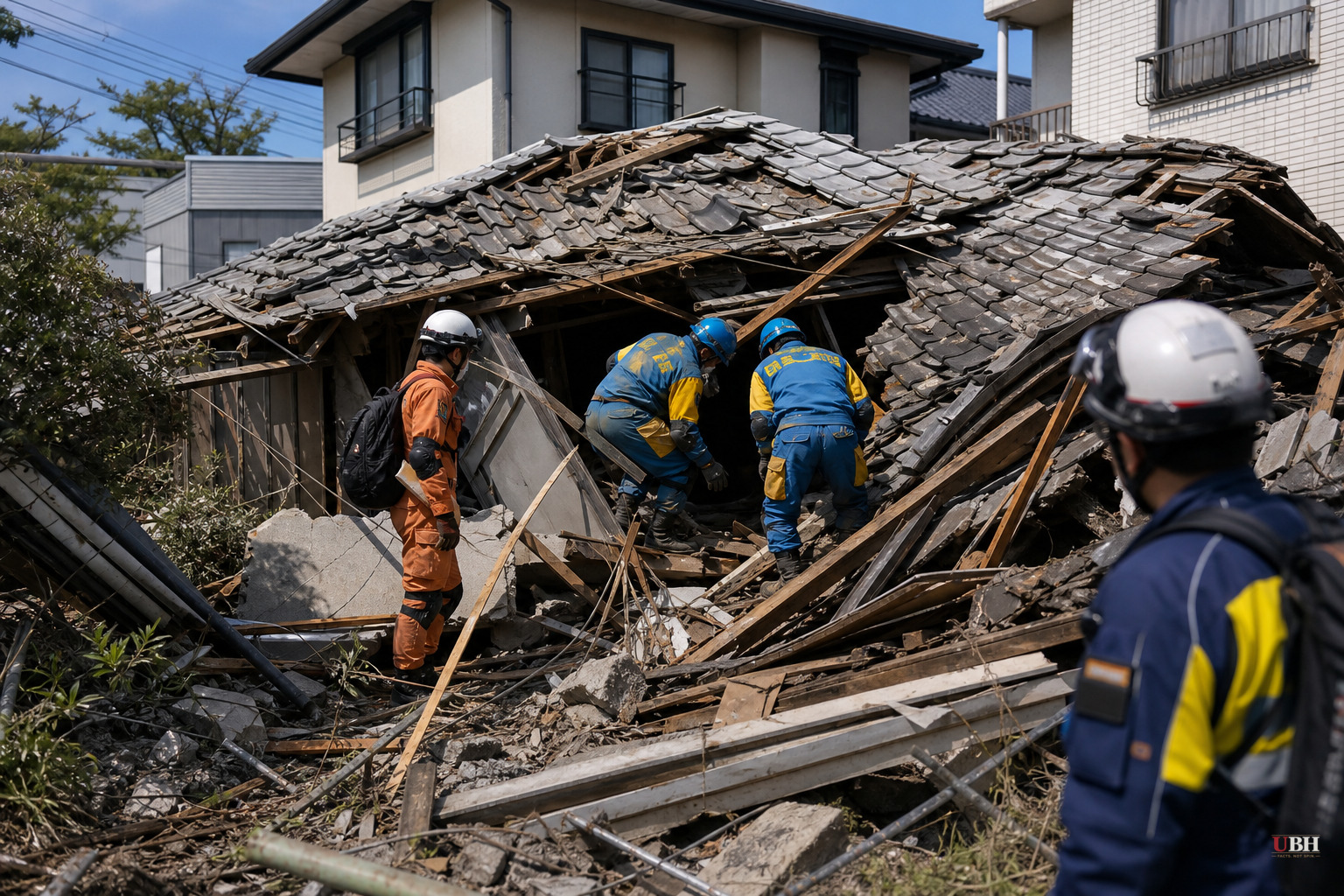
Since the magnitude 7.1 earthquake hit Kumamoto Prefecture on Japan's Kyushu island last Tuesday, the death toll has climbed to 38, according to The Independent. One victim died of apparent heat stroke while sheltering in a car, and prefectural officials said Monday that the cause of one other death is still under investigation.
The numbers behind the recovery effort are brutal. More than 46,000 households remain without running water. Many also face fuel shortages. The Japan Meteorological Agency forecast temperatures approaching 40 degrees Celsius, 104 Fahrenheit, on Monday, turning a housing crisis into a heat emergency.
More than 8,500 people are still packed into emergency shelters, according to The Independent, many of them converted school gyms and community centers without air-conditioning. Others are sleeping in cars in parking lots and parks, or camping outside their damaged homes. Experts have warned for years that Japan's standard shelter setup, cardboard partitions in unairconditioned gyms, produces exactly this outcome: overcrowding, no privacy, and no real protection from heat once summer hits.
Prime Minister Sanae Takaichi made her first visit to the disaster zone Monday, touring one of the region's best-equipped shelters, one with cardboard beds, partitions, and working air-conditioning. That choice backfired on social media, where critics accused her of visiting a showcase facility instead of the crowded, sweltering shelters most residents are actually living in, per The Independent's reporting.
If the PM's only public appearance is at the one shelter with AC, it invites the obvious question: does she know what conditions look like for the other 8,000-plus people camped in cars and parking lots? Japan's government has not offered a public breakdown of how many shelters lack cooling, which is itself a transparency gap.
Meanwhile, in the town of Kashima, a grim story about corporate priorities during a disaster came into sharper focus. Habita, a local general store operator with a shop inside the collapsed Aeon Mall, acknowledged that it instructed two employees to return into the building to secure sales proceeds in a safe after the quake hit. Both employees were killed in a later explosion at the mall, believed to be caused by a gas leak, that happened after roughly 3,000 shoppers had already been evacuated to a parking lot.
Company sales manager Goji Yuse confirmed the instruction at the wake of one of the victims, 22-year-old Kurumi Otake, held Sunday, according to The Independent. Two Habita executives attended and apologized to her parents. Otake's mother did not accept a corporate explanation. "I wish someone had stopped her," she told them, through tears. "My daughter is not coming back."
Rescuers recovered five survivors and the bodies of seven others from the collapsed mall. Across the prefecture, 114 people have been injured and roughly 700 homes destroyed, with more than 11,300 buildings damaged, per prefectural officials cited by The Independent.
Recovery work is visibly underway. Residents in Kumamoto are hauling broken furniture, damaged appliances, and other debris to the curb for collection. In the towns of Uki and Hikawa, construction of temporary housing has begun, giving displaced families a path out of shelters and cars.
A region without reliable water, without full power restoration, sits under near-104-degree heat, with thousands of people still sleeping outside or in vehicles nearly a week after the quake. The heat itself has already killed at least one person in a shelter setting, and it remains the most direct ongoing threat as officials work through water restoration and temporary housing construction.
Two unresolved threads deserve tracking. First, whether Japanese regulators or labor authorities open any inquiry into Habita's instruction to employees to retrieve cash from a building already evacuated for structural danger, an inquiry that has not been announced as of Monday. Second, whether the national government commits resources to retrofit ordinary shelters with cooling equipment before the next heat wave, rather than relying on a small number of model facilities for photo opportunities.
Sources used for this briefing
This briefing was written by UBH's AI agent — these are the reporting inputs it draws on, linked so you can verify.


