
Unbiased headlines. Facts, not spin.
Unbiased Headlines is an independently owned news organization. We bring you the facts, not opinions, written fresh from 110+ named sources. Sources linked so you can verify it yourself.
 finance
Major Story (8/10)
finance
Major Story (8/10)
Kospi Plunges Nearly 8% in Seventh Straight Loss, Second Sidecar Halt This Week
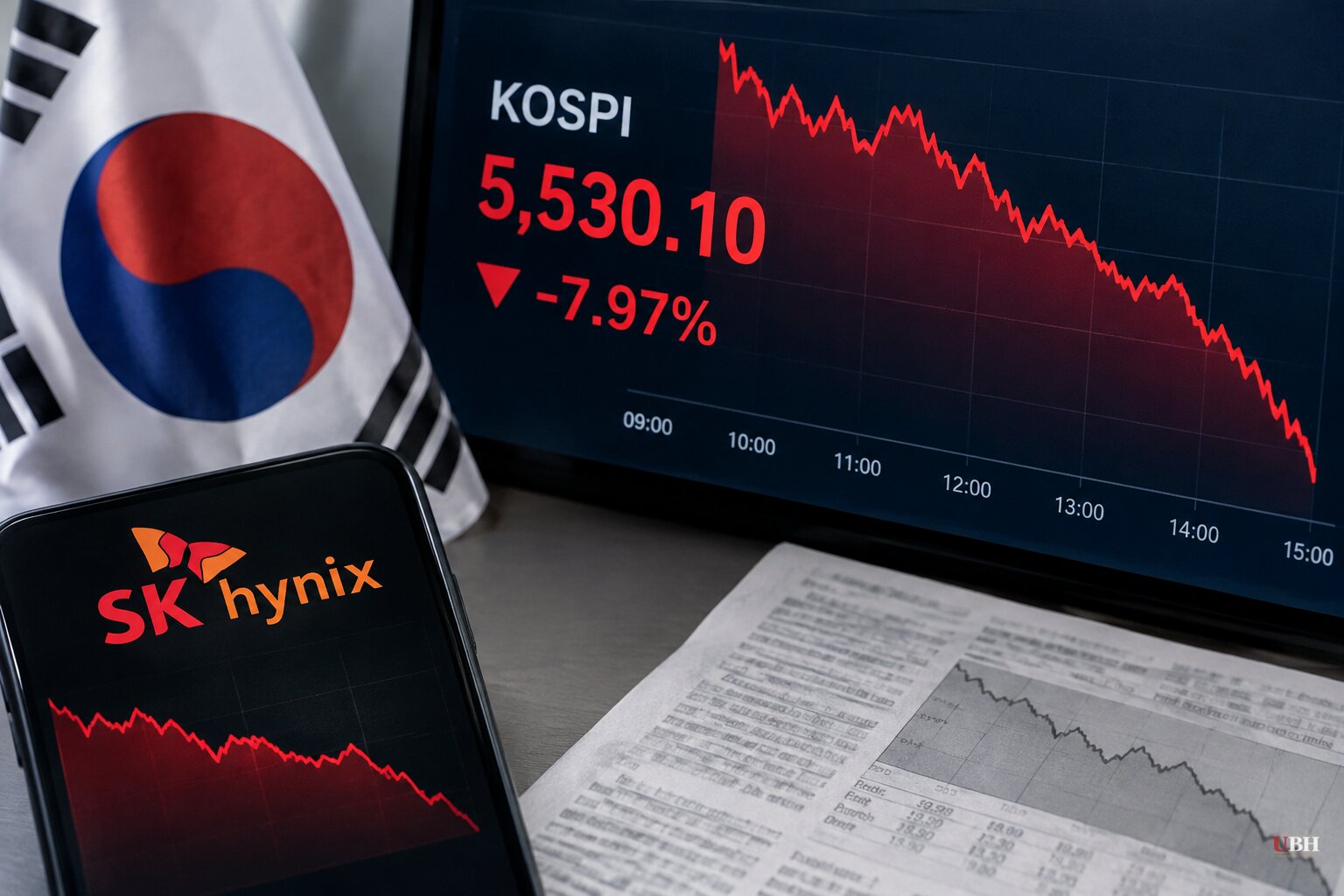
Since the Kospi's chip-led slide began in recent sessions, the index has now lost another large chunk. On Thursday, Oct. 15, it fell as much as 478.71 points, or 7.97%, to 5,530.10, extending its losing streak to seven sessions. That is the longest since September 2024.
The Korea Exchange triggered a sell-side "sidecar" on the Kospi 200 futures market at 9:07 a.m. Seoul time, when futures stayed more than 5% below their reference price. A second sidecar hit the Kosdaq at 9:12 a.m. It was the first on that market since Aug. 21.
How the day unfolded
The Kospi opened at 5,673.01, down 335.80 points, or 5.59%, from Wednesday's close of 6,008.81. By 9:19 a.m. it was down 6.34% and had dipped below 5,600 for the first time in about two and a half months.
It was the second sidecar on the Kospi this week. The exchange also triggered one on Tuesday, Oct. 13.
A sidecar is not a market shutdown. When the nearest-month futures contract moves more than 5% from its reference price for at least a minute, programme sell orders are suspended for five minutes. Direct orders keep flowing. A full circuit breaker, which halts the whole market, kicks in at deeper thresholds and is far rarer.
Analysts at Newsquawk noted that on past occasions selling resumed once programme orders returned. They said a move from a sidecar to a full circuit breaker would signal materially greater stress.
Chipmakers lead the rout
Samsung Electronics fell 9.70% and SK Hynix 11.35% at the deepest levels reported. Earlier in the session they were down 9.05% and 11.06%.
The damage spread beyond semiconductors. LG Energy Solution fell 5.45% and Hyundai Motor 6.38%. Kia Corp was down 2.03% earlier in the session.
Breadth was lopsided. Of 889 issues traded as of 01:35 GMT, 768 declined and only 90 advanced. Foreign investors were net sellers of 355.6 billion won worth of shares.
The Kospi is down nearly 35% from its record high in June.
The regional damage
MSCI's broadest index of Asia-Pacific shares outside Japan fell 3.3%. Japan's Nikkei 225 dropped 4.8%.
TSMC lost 2%. Japanese memory maker Kioxia Holdings sank more than 11%, and SoftBank Group, an AI investor, fell 9.4%. S&P 500 e-mini futures were down 0.5%.
What is driving it
The trigger was Wall Street. U.S. consumer prices accelerated more than expected in September. That raised bets that the Federal Reserve could hike rates again later this year, and tech and AI-linked stocks sold off hard in New York.
Investors are also reassessing the profitability and financing burden of AI-related capital spending, according to the market commentary around the selloff.
Mixo Das, head of Korea equity strategy at J.P. Morgan in Hong Kong, pointed to a supply problem on the Korean market. The market "is struggling to find a new buyer" after buybacks at Samsung and SK Hynix have run their course, he said.
Das does not see the pain as permanent. "Over the next few weeks, we expect that process to evolve. And we think the most volatile part of this flow discovery is likely behind us," he said. "On a six- to 12-month basis, we still think that all of these AI stocks will be substantially higher than where they currently stand."
That is one bank's call. The index has fallen roughly a third from its peak in four months, and the sidecar has not stopped the slide this week.
Bonds and the won
The won strengthened 0.21% to 1,339.5 per dollar onshore, from 1,342.3 at the previous close. Korean government bonds rallied. The three-year yield fell 3.0 basis points to 3.855% and the 10-year fell 2.1 basis points to 4.224%.
The next test comes when U.S. markets open at 9:30 a.m. ET today. With S&P 500 futures already down 0.5% in the Asian session, the open will show whether the chip selloff keeps rolling or stabilizes. Seoul's reaction to the won's behavior and foreign futures flow after each halt will show whether the exchange's pause is buying anything beyond five minutes.
Sources used for this briefing
6 links from 6 independent newsrooms (syndicated copies of the same report count once)
These are the sources it draws on, linked so you can verify.


