
Unbiased headlines. Facts, not spin.
Unbiased Headlines is an independently owned news organization. We bring you the facts, not opinions, written fresh from 110+ named sources. Sources linked so you can verify it yourself.
 finance
Notable (6/10)
finance
Notable (6/10)
Canada's $600 Billion U.S. Debt Pile Fuels Unconfirmed Talk of Hidden Chinese Holdings
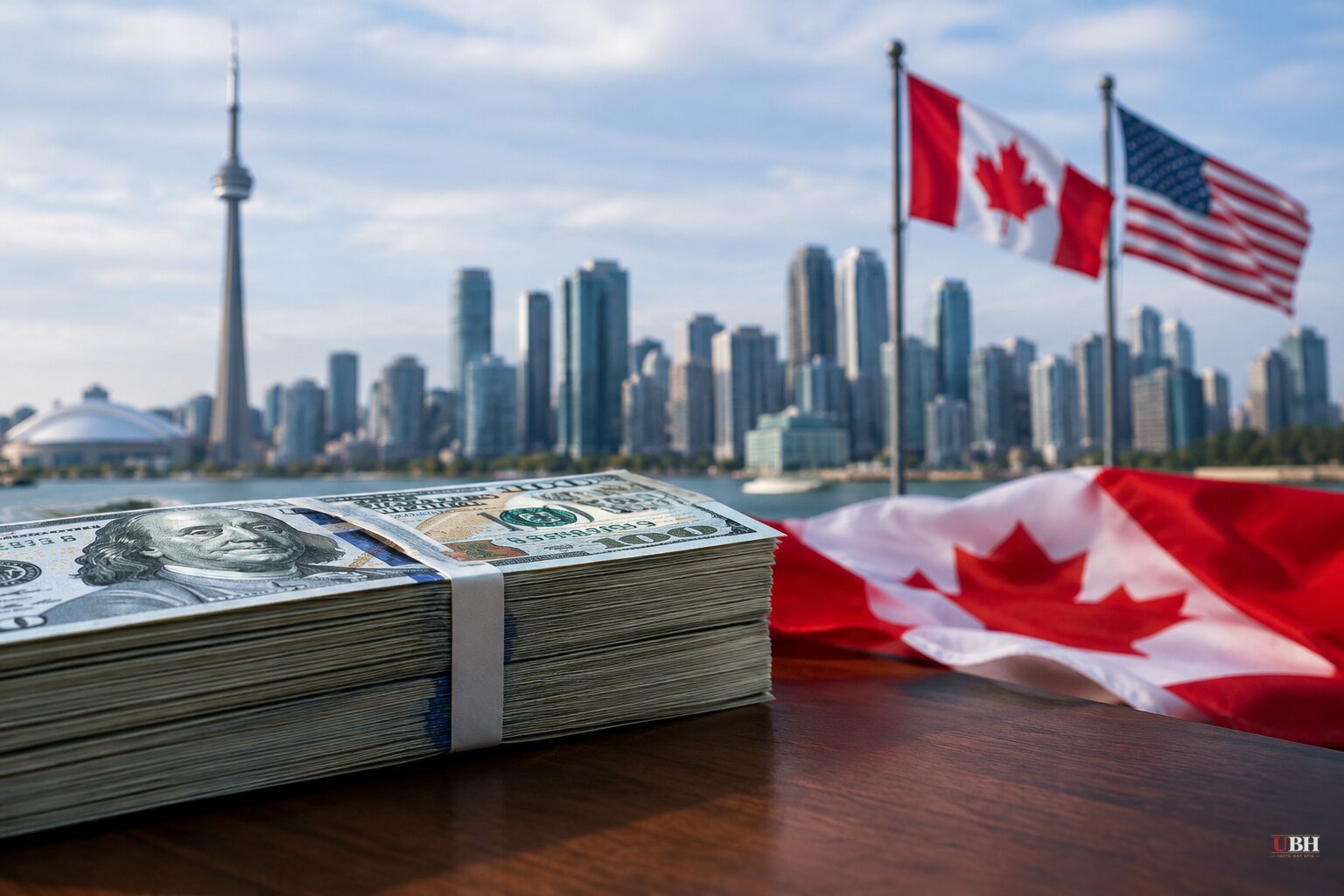
DoubleLine's Vitaliy Liberman tracks foreign ownership of U.S. debt, looking for any broad pullback in response to President Trump's trade policies. Month after month, one number stood out.
Canada's stockpile of Treasuries and bonds backed by federal housing agencies has grown to nearly $600 billion. That is more than four times its position five years ago. It happened while Canadians were boycotting American goods in a tariff fight with Washington.
According to Bloomberg's reporting, Liberman was told the increase was in fact China's doing: Beijing has been moving U.S. securities to custodian banks outside the United States. The claim is unconfirmed. Bloomberg's account cites no comment from Beijing or Ottawa.
How the data gets read
The theory rests on how Treasury compiles its foreign-holdings figures. Securities are generally recorded by the country where they are held in custody, not by the country of the ultimate owner. A bond owned by one government but held at a bank or clearing house in another can show up under the second country's name.
Analysts have long warned that this makes any single country's true position hard to pin down. Commentator Antonio Graceffo noted in the Epoch Times that analysts say China also holds Treasuries through third-party custodians such as Euroclear in Belgium and Clearstream in Luxembourg. U.S. data records those holdings under Belgium and Luxembourg, not China.
China's reported Treasury holdings have also fallen. Some investors and analysts believe the decline reflects a change of address rather than a real exit, giving the appearance of decoupling from the U.S. while the money keeps financing American deficits.
Beijing's version
Chinese officials describe the drop as diversification. In April 2025, People's Bank of China Deputy Governor Zou Lan said the country's foreign exchange reserve investments had been "effectively diversified." A Shanghai University of Finance and Economics professor told the state-run Global Times in January 2026 that the reduction reflected "optimization and diversification" of foreign assets.
Graceffo argues that this is diversification in name only. He writes that China has moved from one dollar-denominated asset to others. By his figures, between November 2013 and late 2023 China sold $183.1 billion in Treasuries while buying $543.5 billion in U.S. agency bonds, including debt backed by Fannie Mae and Freddie Mac.
He also cites estimates from Setser, who puts about $1.8 trillion of China's $3.3 trillion in official reserves in dollars. Setser further estimates that China's state commercial banks hold about $1.1 trillion in dollar assets, that its policy banks could hold close to $1 trillion in mostly dollar-denominated claims abroad, and that most of China Investment Corporation's $450 billion in foreign assets are in dollars. Setser's conclusion, as Graceffo relays it: China stopped adding to official reserves while its state banks and funds kept accumulating dollars. It could hold more dollars outside its official reserves than inside them.
Graceffo's broader point is that the "China is dumping Treasuries" narrative serves Beijing. He argues it portrays the dollar as weak, promotes the yuan as an alternative and strengthens China's bargaining position. Natixis chief Asia-Pacific economist Alicia Garcia Herrero has said China's intent is "mainly to show" the United States that it can sell large amounts of Treasuries.
What is and is not known
The Canada link is a theory. The $600 billion figure is a reported custody number, and nothing in it identifies the beneficial owner. No official from China, Canada or the U.S. Treasury has been cited confirming that any of it is Chinese-owned. Canadian investors hold U.S. securities too, and the data alone cannot sort one owner from another.
The design of the reporting system is what makes the question hard to settle. Custody-based figures can show where bonds sit but not whose they are, so a hidden position is difficult to prove and just as difficult to rule out.
China has historically been one of the largest foreign buyers of U.S. government debt. A real Chinese retreat would remove a source of demand while Washington keeps borrowing heavily. Hidden holdings would mean that demand is steadier than the monthly headlines suggest, and that a rival government still helps fund American deficits.
The yield gap shows why dollar assets stay attractive to Chinese holders. China's benchmark 10-year government bond yield touched 1.7% this year, its lowest level of 2026, according to Wall Street Journal reporting. The comparable U.S. Treasury note yields 5.3%. ING's Lynn Song told the Journal that China is "bucking the entire global trend." Chinese banks' bond portfolios reached 29 trillion yuan, roughly $4.4 trillion, by August, more than double their level three years earlier.
One market check is indirect bidder demand at Treasury auctions, a common proxy for foreign buyers. If it diverges from the custody data, that would lend weight to the theory. Investors are also watching the next monthly Treasury releases on foreign holdings for further unusual moves in custodial centers, and for any statement from Beijing or Ottawa.
Sources used for this briefing
7 links from 7 independent newsrooms (syndicated copies of the same report count once)
These are the sources it draws on, linked so you can verify.


