
Unbiased headlines. Facts, not spin.
Unbiased Headlines is an independently owned news organization. We bring you the facts, not opinions, written fresh from 110+ named sources. Sources linked so you can verify it yourself.
 finance
Notable (6/10)
finance
Notable (6/10)
Dell Shares Fall 11% After Barclays Downgrade as Oracle and CoreWeave Slide With It
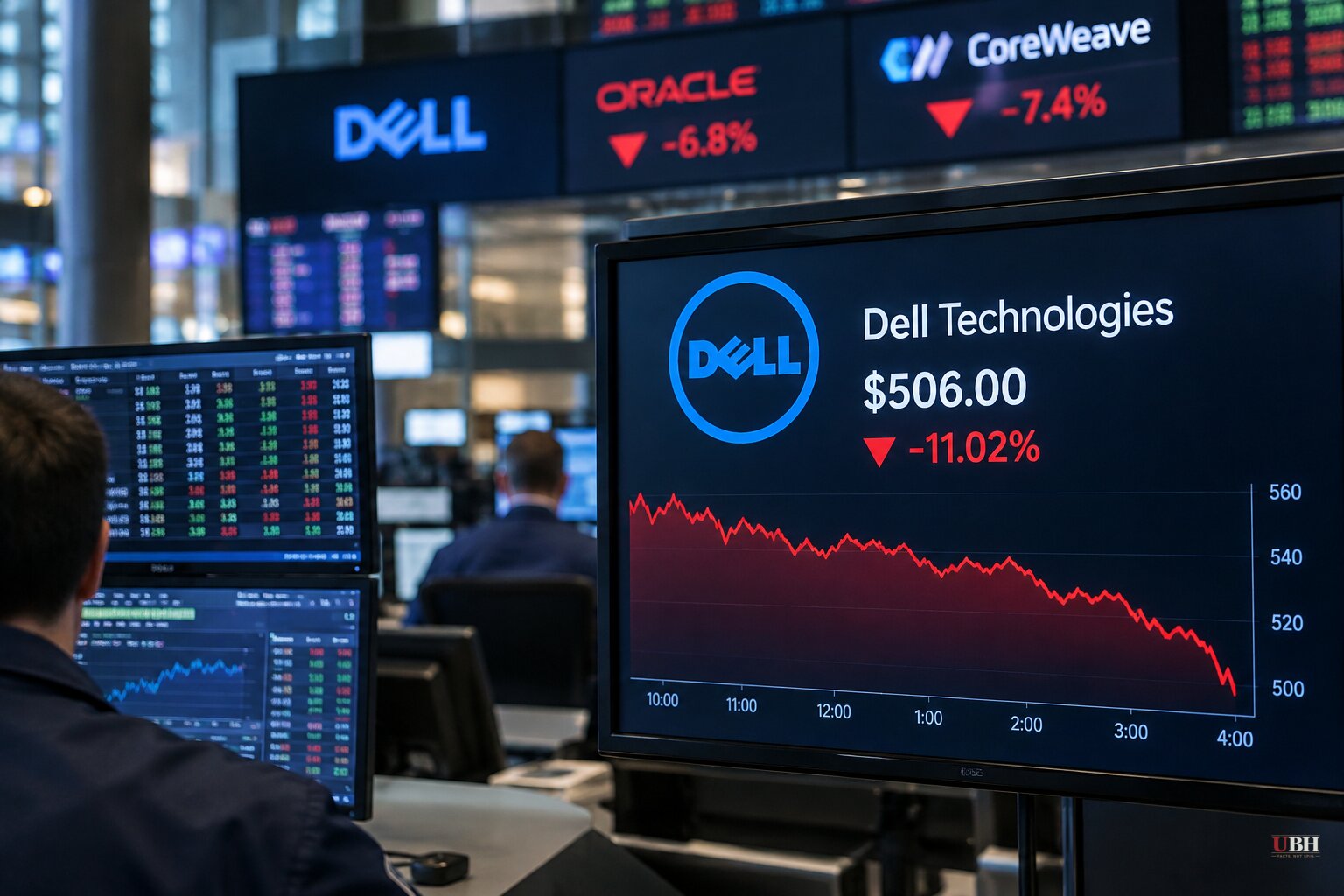
The selling in AI hardware has spread from chip names to the companies that build and finance AI data centers. Wednesday, Oct. 14, was the day it hit the server makers.
Dell Technologies shares dropped about 11.6% to roughly $506, leading the group lower. Hewlett-Packard Enterprise, Super Micro and Oracle all fell with it.
The Barclays downgrade
Barclays analyst Tim Long cut Dell from Overweight to Equal-Weight and trimmed his price target to $574 from $603. The bank made the same move on Hewlett-Packard Enterprise and NetApp, dropping each to the equivalent of a hold.
Long cited a stretched valuation after a big run. Dell is still up more than 300% this year, HPE about 160%, and NetApp has doubled.
The bank's core argument is about timing. Barclays said it has not seen a "meaningful AI inflection" in enterprise spending at the three companies. Businesses are typically putting just 5% of their IT budgets toward AI, the analysts wrote, and only about a quarter of enterprise AI spending goes to hardware.
The stronger revenue, in Barclays' view, comes from the global memory shortage. Infrastructure vendors have passed higher memory prices on to customers. "We believe the strong enterprise revenues are more of a function of memory costs than a move to enterprise AI at this time," the analysts wrote.
The flip side: if memory prices normalize and then decline, Barclays said, infrastructure revenue could suffer.
Memory stocks were already sliding
That memory warning landed in a week when memory names were already under pressure. China's ChangXin Memory Technologies, known as CXMT, reported progress over the weekend on a new chip structure.
Micron is down 11% for the week. SK Hynix has fallen 13% in U.S. trading, and Western Digital is off more than 8%. Memory is a notoriously cyclical business.
Debt-heavy names took the worst of it
The AI buildout leans heavily on borrowed money, and that is where the damage was sharpest. Oracle, a heavy borrower, fell 9% and is down 33% for the year. CoreWeave dropped 15%, erasing its 2026 gains.
Crypto Briefing reported that yields on CoreWeave bonds spiked, with one bond approaching 15%. It also reported a hot September Consumer Price Index print that stoked fears of higher borrowing costs, and put the combined loss across Dell, CoreWeave, Nebius and Oracle at an estimated $80 billion in market value.
The sentiment shift also reflects concerns about OpenAI's revenue figures, CNBC reported, along with fear that rising interest rates will hurt a buildout so dependent on debt.
Michael Dell's answer
The CEO took the opposite view in a Wednesday interview with CNBC. Michael Dell said demand for AI infrastructure continues to exceed supply and expects that to last through 2030.
His reasoning is physical. A new chip fabrication plant takes about four years to build, while AI models are improving much faster. More capable systems need newer chips, more memory and more computing capacity.
He said frontier AI labs and major tech companies drove the first wave of spending, and broader enterprise adoption is only beginning to emerge as another driver. That is largely the point Barclays contests on timing, not on direction.
The company's own numbers back the demand claim. Its most recent quarterly report showed a record $95 billion AI server backlog, and infrastructure solutions revenue rose 89% year over year. AI server revenue for the current fiscal year is expected to triple to $75 billion, an estimate, with a possible path to $100 billion by fiscal 2028.
Where the stock sits
Barclays did not dispute that AI demand exists. Its argument is that the stock already prices in extraordinary growth, and that the growth rate could cool toward merely strong once memory pricing settles.
Even after the cut, Barclays' $574 target remains above the roughly $506 level where Dell traded Wednesday. The consensus rating on Dell remains Moderate Buy, with an average target of around $598.
Two things will decide whether Wednesday was a one-day repricing or the start of something larger. One is the trajectory of memory prices, which Barclays says is propping up server revenue. The other is the cost of debt for the heavily leveraged data center builders, where CoreWeave's bond yields are the clearest warning light.
Sources used for this briefing
7 links from 6 independent newsrooms (syndicated copies of the same report count once)
These are the sources it draws on, linked so you can verify.


