
Unbiased headlines. Facts, not spin.
Every story is an unbiased news briefing written from 110+ sources across the spectrum — sources linked so you can verify it yourself.
 health
Notable (6/10)
August 14, 2026 at 02:46 PM
health
Notable (6/10)
August 14, 2026 at 02:46 PM
Kids Went Back to School Into a Heat Dome. Nobody Fixed the AC.
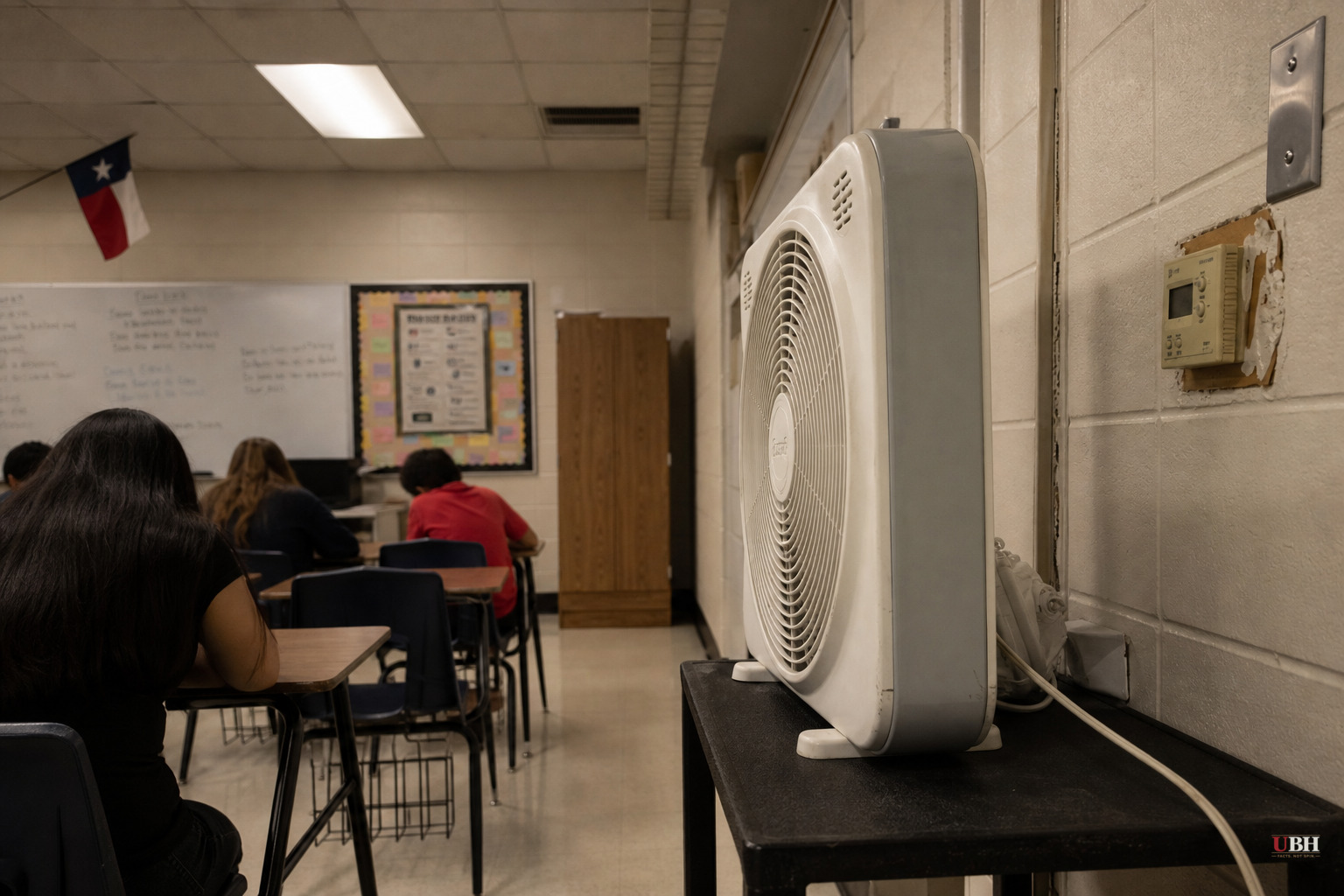
At least 40 million Americans sat under extreme heat warnings this month as a heat dome parked itself over the central and southern US, according to The Guardian. Heat indexes topped 100F from Minnesota to Mississippi, with parts of the Southwest hitting 120F, the National Weather Service reported. Rapid City, South Dakota hit an all-time high of 112F. This is exactly when millions of kids walked back into classrooms for a new school year, according to AP News.
That timing is not an accident. It's the calendar. And a growing number of people, from state lawmakers to psychologists, are saying the calendar is the problem.
The Political Fix Nobody's Passed Yet
Texas state Rep. Jared Patterson called it plainly on social media: "Starting school during the hottest month of the year is among the dumbest things we do as a state." He wants Texas to move school start dates from August to September, according to Fox4 News.
Patterson's reasoning is straightforward. Student athletes are getting hurt. A Lake Travis High School student suffered a health emergency during football practice this month, Fox4 reported. The University Interscholastic League already imposed mandatory heat-safety rules for high school athletics and marching bands starting August 1. Patterson says the state should go further and just move the whole school year.
He's also making a fiscal argument conservatives should like: "Cooling the largest buildings during the hottest month is an extreme waste of taxpayer dollars," Patterson said. His proposal: teachers back September 1, students after that, school running into late May or even early June instead.
U.S. Rep. Craig Goldman, who pushed similar legislation as a state lawmaker alongside former Rep. Matt Krause, backed the idea and summed up why it hasn't happened: "The problem is, it makes common sense, and you know what happens when you bring that into government? Good luck in the 90th!" That's a fair, blunt admission from a Republican that his own legislature has sat on an obviously sensible fix.
Patterson says formal legislation is coming when Texas lawmakers return to Austin next year. Until then, nothing changes.
California's Approach: Laws Without Money
California took a different path this year, and it's a case study in how government likes to look like it's solving a problem without spending a dime on it.
Gov. Gavin Newsom signed a law requiring the state Board of Education to consider teaching kids about heat illness symptoms, according to CalMatters. A second law, with a compliance deadline this month, requires schools to set rules for outdoor activities during extreme heat events.
Both laws are cheap. Neither pays for the things that actually keep kids safe: updated HVAC systems, shade structures, or a funded health curriculum, CalMatters reported. Newsom's office confirmed it has no current plans to fund an updated health framework.
Sarah Matsumoto of Green Schoolyards America put it directly: the laws "demonstrate that children in California are already being harmed by extreme heat. It's not a future problem anymore. There definitely needs to be a comprehensive plan to protect children from extreme heat."
The bill that led to the heat-illness education law came from a 13-year-old, Natalie Rubio, whose Sacramento elementary school cafeteria lost air conditioning during a 2022 heat wave, forcing kids to eat lunch outside while classmates showed flushed cheeks and headaches. She brought the idea to Assemblymember Tom Lackey, a Palmdale Republican, who called it a "simple, common-sense step." A Republican lawmaker carried this bill in a Democrat-controlled legislature, and the result was a modest, low-cost mandate, not a spending bill. That's a reasonable outcome for a state facing real budget constraints, even if it stops short of what advocates want.
What the Research Says Is Actually Happening
The American Psychological Association and the Network for Resilient PK-12 Schools in Extreme Climates released a report this year documenting real harm, not hypothetical risk. Heat exposure impairs students' attention, memory and ability to learn, according to APA CEO Arthur C. Evans Jr. Studies cited in the report found lower test scores on hot school days and increases in emergency room visits for mood disorders and self-harm among children during heat events.
APA's Nicole Barnes said extreme heat "is here, and it is affecting students' health, well-being and educational outcomes." The report notes heat hits low-income families and young children hardest, since many school buildings lack adequate cooling and kids are often outside or commuting during the hottest parts of the day.
None of this is in dispute. The open question is who pays to fix it. Shifting school calendars costs school districts nothing extra and might save money on summer cooling bills, per Patterson's own argument. Retrofitting HVAC and building shade structures costs real money that neither Sacramento nor Austin has committed to spending.
The National Weather Service's Bob Oravec said the core of this particular heat dome sinks south by early next week, with temporary relief following. But it won't be the last one this year, and the continental US just posted its second-hottest first half of a year on record, according to the National Centers for Environmental Information. The calendar fight in Texas and the funding fight in California will both be back long before the next heat dome forms.
Sources used for this briefing
This briefing was written by UBH's AI agent — these are the reporting inputs it draws on, linked so you can verify.


