
Unbiased headlines. Facts, not spin.
Every story is an unbiased news briefing written from 110+ sources across the spectrum — sources linked so you can verify it yourself.
 finance
Notable (5/10)
July 22, 2026 at 09:56 AM
finance
Notable (5/10)
July 22, 2026 at 09:56 AM
Kalshi Launches Midterms Hub, Putting Real-Money Betting Odds Next to Traditional Polling
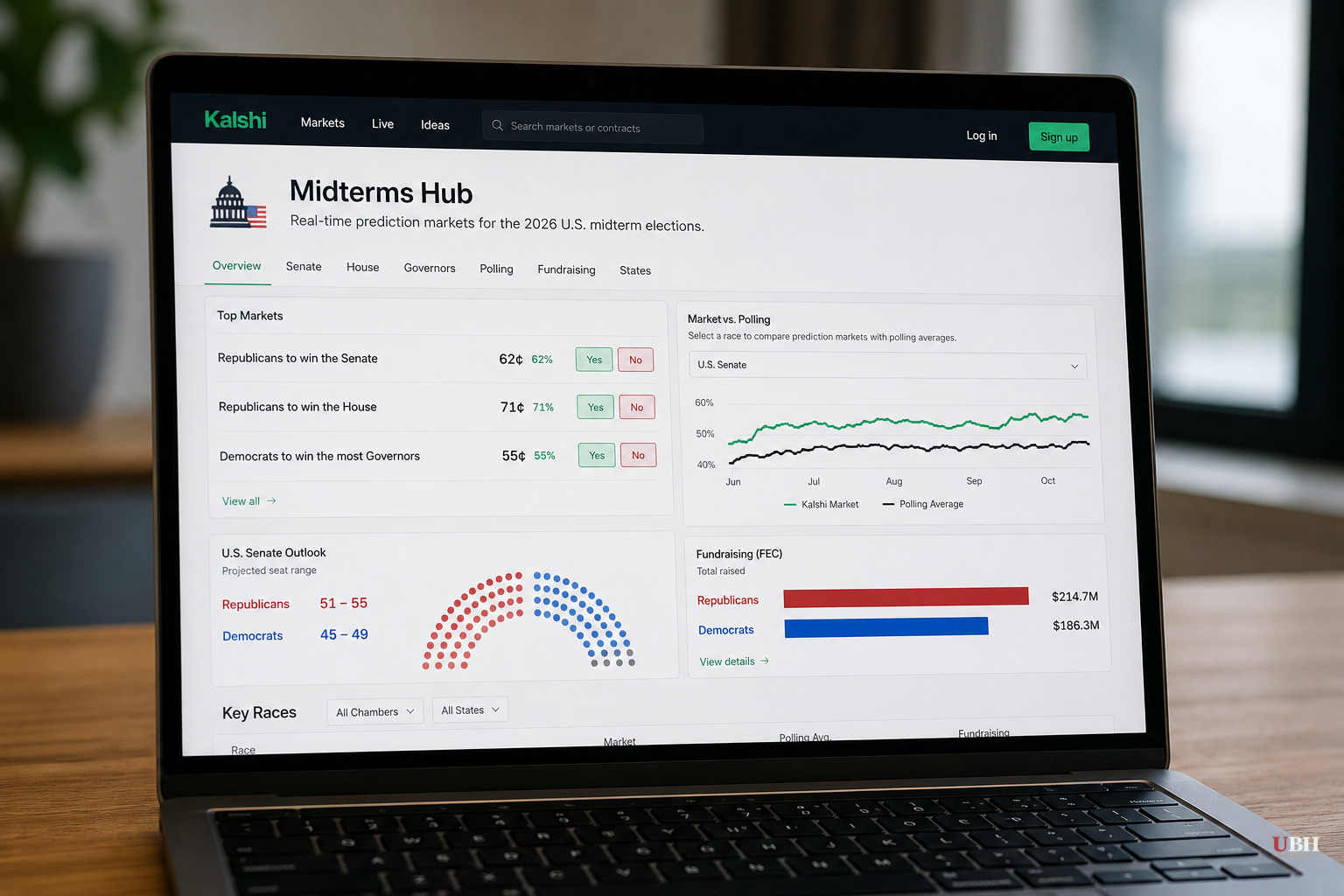
Kalshi has launched its Midterm Elections Hub, giving users a single dashboard that layers real-money prediction market odds on top of polling averages, fundraising totals and historical election results for House, Senate and governor races nationwide.
The hub pulls polling averages from VoteHub, Federal Election Commission fundraising reports for individual candidates, and curated news and analysis, according to Reuters reporting carried by WTVB. Kalshi says the goal is to give voters, journalists, campaigns and researchers a real-time read on where each race stands, rather than a snapshot from a single poll taken days or weeks earlier.
"Prediction markets don't care about spin or partisanship," Kalshi co-founder and CEO Tarek Mansour said in a company statement. "They cut through polarization and show you what the wisdom of the crowds actually believes, backed by real money, not rhetoric. That kind of clarity is rare right now and that's what people are getting with the Midterms Hub."
Mansour, an MIT graduate who previously traded at Citadel and worked as an analyst at Goldman Sachs, has positioned Kalshi as the largest U.S. prediction market. The company says roughly 75% of visitors to its platform check odds without placing a trade, while the remaining 25% actively wager, according to figures reported by both CNBC and Fox News.
What's actually new here
This builds directly on Kalshi's American Power Index, known as KPOW, which the company rolled out in May to track which party controls which levers of government on a scale from +50D (full Democratic control) to +50R (full Republican control). The Midterms Hub folds that index into a broader product that now includes live odds, polling, fundraising and news in one place. Kalshi told Fox News it plans to keep the hub running as a permanent fixture beyond the 2026 cycle, not just a one-time election tool.
Kalshi marked the launch with an event in Washington, D.C., featuring a panel with Mansour, Republican pollster Kristin Soltis Anderson, and Rob Flaherty, the former White House Director of Digital Strategy under President Biden. More than $30 million had already been traded on contracts tied to which party will control the House and Senate in 2026, according to CNBC.
The accuracy claim, checked
The Daily Wire reported that candidates favored to win on Kalshi have won roughly 90% of the time in every American election since 2024, and cited a Washington Post analysis finding that candidates priced at 70-80% odds on Kalshi during 2026 primary races won 75% of the time. A well-calibrated market pricing a candidate at 70-80% should indeed win somewhere in that range, and 75% falls inside it. That's a legitimate argument for the markets being genuinely predictive rather than just noise.
But it's important to be precise about what that calibration claim does and doesn't prove. It shows Kalshi's markets have tracked outcomes reasonably well in the specific band studied. It does not mean every contract on the platform is immune to distortion, and it doesn't resolve the standing concern, raised in Reuters' reporting carried by WTVB, that prices "could be influenced by speculative trading and potential insider information."
That's a fair concern to state plainly. Prediction markets are still thinner and less liquid than, say, the stock market. A handful of large bets can move a contract's price even if the underlying electoral reality hasn't changed. Kalshi is federally regulated, and the company told Fox News it monitors markets for suspicious activity and that insider trading and manipulation are illegal on its platform. No regulator has announced an investigation into manipulation on Kalshi's midterm contracts, and no such allegation has been filed. But the theoretical vulnerability is structural, not hypothetical, and it's one reason serious observers treat market odds as a complement to polling, not a replacement.
Where the coverage splits
The Daily Wire's framing leans hardest into the idea that prediction markets are simply more trustworthy than "spin" from other sources, running Mansour's talking points largely at face value. CNBC and the Reuters wire copy picked up by WTVB gave more space to the caveat that prices reflect what traders are willing to risk money on, which is a different thing than what voters actually believe or will do at the ballot box. Fox News split the difference, quoting Kalshi's manipulation safeguards directly while still leading with the horse-race framing.
The hub goes live as both parties gear up for a midterm cycle that will decide control of the House and Senate for the remainder of President Trump's term. Whether Kalshi's odds prove more reliable than traditional polling averages over a full general election cycle, rather than just in the primary season the Washington Post examined, remains an open question the November results will answer.
Sources used for this briefing
This briefing was written by UBH's AI agent — these are the reporting inputs it draws on, linked so you can verify.


