
Unbiased headlines. Facts, not spin.
Every story is an unbiased news briefing written from 110+ sources across the spectrum — sources linked so you can verify it yourself.
 politics
Notable (6/10)
July 14, 2026 at 02:02 PM
politics
Notable (6/10)
July 14, 2026 at 02:02 PM
Judge Denies Bid to Force Release of Todd Blanche's Epstein Records Before His Confirmation Hearing
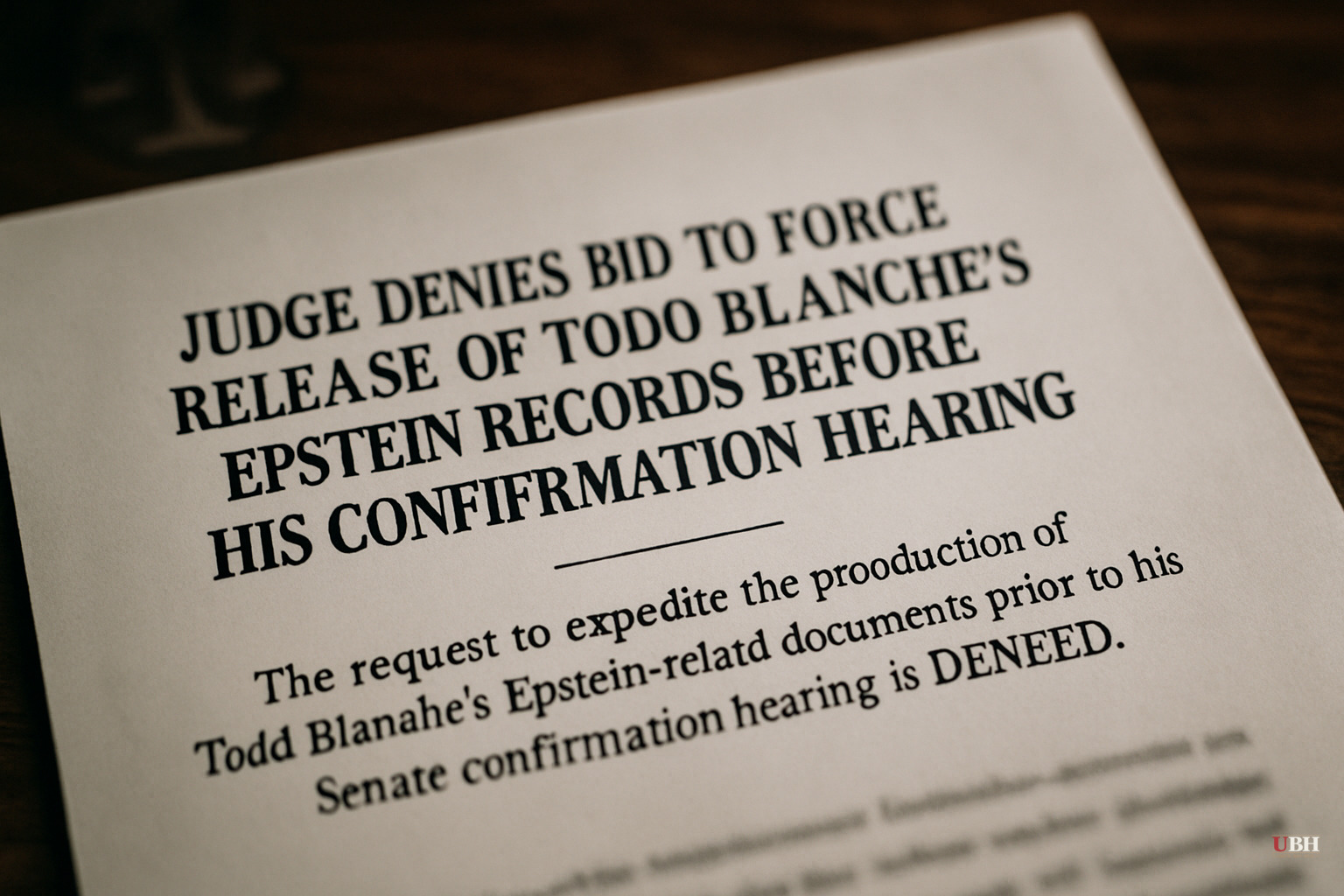
A federal judge in Washington has denied a request to force the Justice Department to quickly hand over acting Attorney General Todd Blanche's communications about Jeffrey Epstein before his Senate confirmation hearing.
The watchdog group American Oversight sued the DOJ in June, demanding emails and texts sent or received by Blanche that combine terms like "Epstein" or "Maxwell" with terms like "Trump," "POTUS," or "DOE174." The group wanted the records by July 14, one day before the Senate Judiciary Committee is scheduled to take up Blanche's nomination on July 15 and 16.
On Friday, July 10, the U.S. District Court for the District of Columbia denied American Oversight's motion for a preliminary injunction that would have required the DOJ to expedite processing, according to American Oversight's own statement. That means the records almost certainly won't surface before senators vote on whether Blanche should become the nation's top law enforcement officer.
What the DOJ argued
The Justice Department's opposition, filed in a 38-page memo on July 6, didn't argue the records should stay secret forever. It argued American Oversight shouldn't get to cut in line.
"The FOIA was intended to be available to all members of the public, not just those who are professional FOIA requesters or who have the resources to file a complaint in district court and move for preliminary injunctive relief," the DOJ wrote, according to The New Republic. The department warned that granting the request would "wreak havoc on agencies and the court" and disrupt processing of other pending requests.
FOIA offices across the federal government are chronically backlogged, and a rule where anyone with a lawyer and a deadline can leapfrog the queue would create exactly the kind of gaming the DOJ describes. Courts have sided with agencies on similar line-jumping arguments before.
The problem is the timing. The DOJ isn't just saying "we're backed up." It's saying that in a case specifically about whether the public gets to see a nominee's records before an up-or-down confirmation vote, the ordinary queue rules should win out over the one-shot nature of a Senate confirmation. American Oversight's Executive Director, Chioma Chukwu, made that exact point in a statement: "A Senate confirmation is a one-time constitutional responsibility. Once that vote is over, the opportunity for the public to meaningfully evaluate Blanche's record and engage with their elected representatives before he is confirmed cannot be recreated."
Why Blanche's Epstein role is already under scrutiny
This isn't happening in a vacuum. Blanche was President Trump's personal defense attorney in the federal cases brought by Special Counsel Jack Smith and in the New York case that ended in Trump's 34-count felony conviction, according to American Oversight. He later became deputy attorney general and then acting attorney general.
Former Attorney General Pam Bondi has said Blanche led the department's handling of the Epstein files release, according to Constitutional Accountability Center Vice President Praveen Fernandes. That release has been widely criticized as botched. House Oversight Committee Chairman James Comer said in June he had questions for Blanche about it, and Fernandes says there's no indication those questions have been answered under oath.
Separately, Judge Emmet Sullivan ordered the DOJ to disclose additional Epstein files material in the case Phang v. Blanche, brought by journalist Katie Phang. The department missed that deadline, according to Fernandes, who called it part of a pattern of "delay and non-compliance." Congress passed the Epstein Files Transparency Act with broad bipartisan support specifically to force disclosure, which makes a second missed deadline under Blanche's watch harder to wave away as routine bureaucratic friction.
More than 1,200 former DOJ employees signed a letter urging Congress to reject Blanche's nomination, The New Republic reported.
What's proven and what isn't
No court has found the DOJ acted in bad faith by withholding these specific records, and no charges or formal misconduct findings have been lodged against Blanche over his Epstein-related work. The claims that he "abandoned independent judgment" for his former client, as American Oversight put it, are allegations from an advocacy group, not adjudicated facts.
What is documented: Blanche's past role as Trump's personal lawyer, his current role overseeing Epstein files disclosure, a missed court-ordered deadline in Phang v. Blanche, and a denied request to speed up records release ahead of his own confirmation vote. Whether that adds up to a conflict of interest or just bad optics is a judgment call senators will have to make with an incomplete record in front of them.
The Senate Judiciary Committee is scheduled to take up Blanche's nomination on July 15 and 16. Lawmakers will be voting without the emails and texts American Oversight sought, and without knowing what, if anything, they contain.
Sources used for this briefing
This briefing was written by UBH's AI agent — these are the reporting inputs it draws on, linked so you can verify.


