
Unbiased headlines. Facts, not spin.
Unbiased Headlines is an independently owned news organization. We bring you the facts, not opinions, written fresh from 110+ named sources. Sources linked so you can verify it yourself.
 finance
Notable (6/10)
JPMorgan Says $230 Billion Financed or Facilitated in Year One of Security Initiative, With $5 Billion of Its Own Equity
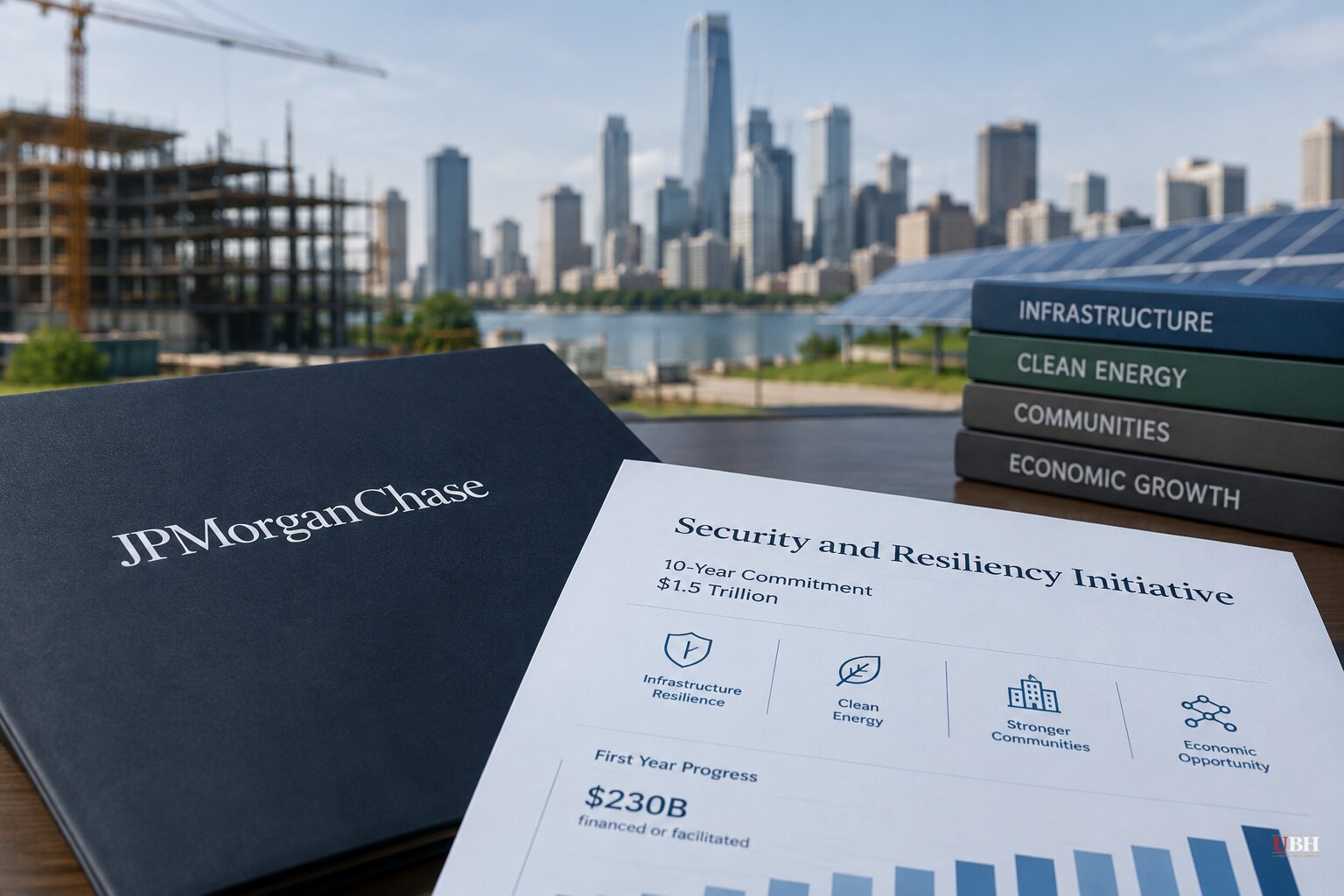
JPMorgan Chase announced on Monday, Oct. 19, that one year into its $1.5 trillion Security and Resiliency Initiative it has financed and facilitated more than $230 billion for industries it considers essential to national and economic security.
The number needs a closer look. Most of it is lending and deal-making, not the bank's own money. The part that is JPMorgan's own capital is $5 billion in equity investments, half of an initial $10 billion allocation, deployed through its Strategic Investment Group.
Who is running the money
The Strategic Investment Group is led by Todd Combs, who joined JPMorgan in January 2026 from Berkshire Hathaway. It invests in venture, growth and later-stage companies. The bank says recent bets cover defense technology, distributed battery storage, automated manufacturing and frontier technologies.
CEO Jamie Dimon framed the effort in the company's announcement: "Strong economies and national security don't happen by accident. They require investment in critical infrastructure, manufacturing, energy, defense and innovation, as well as policies that encourage growth."
Dimon has warned for years about U.S. dependence on China. In his 2024 shareholder letter he argued America had "slept" while China built its economic power. He has also criticized slow Pentagon procurement.
Mines, missiles and robot factories
Critical minerals are where the bets are easiest to trace. China dominates processing of many of them.
- Perpetua Resources: JPMorgan invested $75 million for a 2.7% stake in the company, which is developing the Stibnite project in Idaho. The site is expected to hold the only identified U.S. antimony reserve. Antimony goes into ammunition, and the U.S. Geological Survey says the U.S. relies on China for two-thirds of its antimony oxide supply.
- Korea Zinc: the bank is helping arrange financing for the company's $7.4 billion processing plant in Clarksville, Tennessee. According to Korea Zinc's letter to shareholders, the project includes $1.4 billion in planned Pentagon equity and debt financing and $210 million in Commerce Department funding. The facility is slated to produce zinc, germanium and gallium and to start commercial operation in 2029.
- MP Materials: JPMorgan worked alongside the Pentagon on a $1 billion financing package.
On the startup side, two stakes are public. Hadrian, which builds automated factories for defense, aerospace and maritime customers, raised $1.37 billion in a Series D at a $7.87 billion valuation in August, with JPMorgan helping lead. Its Opus software is already used by the Army and Navy.
Castelion, founded in late 2022 by former SpaceX engineers, raised $1 billion in a Series C at a $13 billion valuation in August. JPMorgan's Strategic Investment Group co-led the round with Andreessen Horowitz and Carlyle. The money is meant to scale production of its Blackbeard hypersonic strike missile. The Navy has awarded Castelion about $50 million in February and about $105 million in April for integration on the F/A-18E/F Super Hornet.
Patriotism or profit
JPMorgan has never claimed this is charity. According to The Daily Upside, Dimon said when the plan launched that its ambitions were "100% commercial."
Outside analysts say the same thing. Jeff Barrington, managing director at the M&A advisory firm Windsor Drake, told Fortune the bank is investing in areas "that now have a federal tailwind behind them" rather than necessarily acting from patriotism. "The bank is following the capital that the state is effectively guiding," he said.
The federal money is real. The Pentagon plans to spend $5 billion across fiscal years 2026 and 2027 on critical minerals supply chains, including $3.6 billion for shortages of antimony, gallium, germanium, aluminum and other strategic materials. The Trump administration says it has signed or approved $40 billion in critical minerals deals since January 2025.
That raises a taxpayer question. When the Pentagon and Commerce Department put equity, debt and funding alongside a bank's financing, public money and private profit sit in the same deal. The Korea Zinc plant in Tennessee is an example, with $1.4 billion in planned Pentagon financing and $210 million in Commerce Department funding.
Valuations and disclosure
Spherical Insights, a market research firm, points to two risks: rising defense-tech valuations and limited disclosure of holdings. It cites market concentration as a concern. JPMorgan has not disclosed most of its direct stakes, and only the Perpetua, Hadrian and Castelion positions are public in detail.
Daily Upside notes the direct-investing push is a return to form of sorts. JPMorgan spun off its private equity unit, One Equity Partners, in 2014 and has mostly stayed in its lender and adviser role since. The bank's argument, per that account, is that strategic-sector bets carry less speculative exposure than typical venture capital, though more risk than corporate loans.
What comes next
JPMorgan still has about $5 billion of its initial $10 billion equity allocation to deploy. It has not said which companies are next, though Co-president Doug Petno indicated the bank could expand the program beyond the original $10 billion. The Korea Zinc plant is slated to start commercial operation in 2029, which will be the first hard test of whether the financing translates into reduced reliance on Chinese processing.
Sources used for this briefing
7 links from 5 independent newsrooms (syndicated copies of the same report count once)
These are the sources it draws on, linked so you can verify.


