
Unbiased headlines. Facts, not spin.
Unbiased Headlines is an independently owned news organization. We bring you the facts, not opinions, written fresh from 110+ named sources. Sources linked so you can verify it yourself.
 finance
Notable (6/10)
RBI Rejects All Bids at Rs 23,000 Crore Treasury Bill Auction as Yields Climb
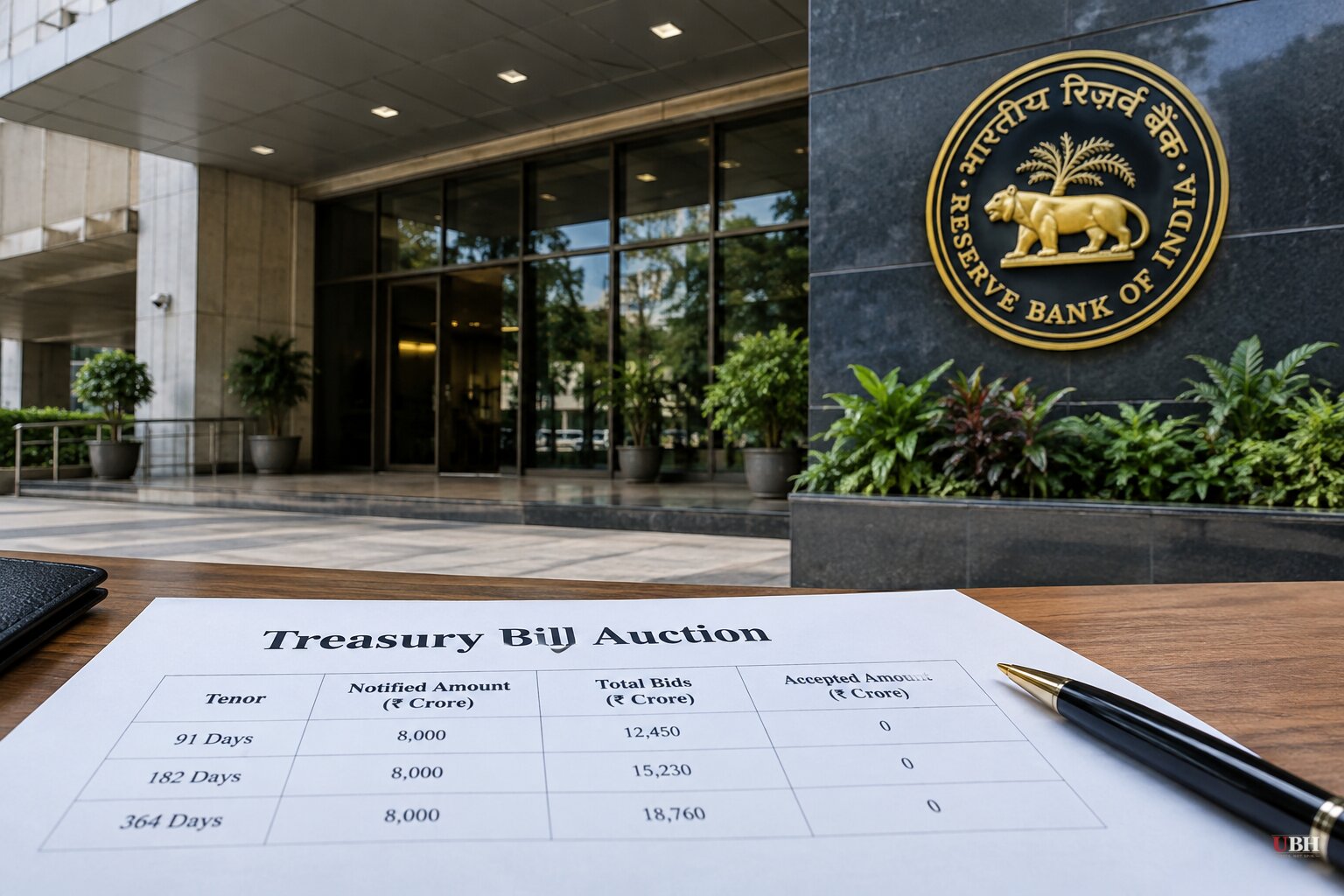
The Reserve Bank of India took no bids at all at its treasury bill auction on Wednesday, Oct. 21. The government had planned to raise Rs 23,000 crore (230 billion rupees, about $2.4 billion) across three maturities.
The RBI's auction results show nothing was allotted, competitive or non-competitive. No cut-off yields or weighted average yields were published.
The central bank gave no explanation.
Demand was there
This was not an auction that failed for lack of interest. Competitive bids exceeded the notified amount in every tranche.
- 91-day bills: Rs 8,000 crore offered. The RBI received 67 competitive bids worth Rs 15,366.60 crore, plus non-competitive bids of Rs 12,028.76 crore.
- 182-day bills: Rs 8,000 crore offered. The RBI received 63 competitive bids worth Rs 18,925.50 crore, plus non-competitive bids of Rs 1,712.42 crore.
- 364-day bills: Rs 7,000 crore offered. The RBI received 75 competitive bids worth Rs 11,352.50 crore, plus non-competitive bids of Rs 1,683.57 crore.
The RBI accepted none of it.
The price was the problem, traders say
Traders told Reuters the likely issue was price. They said cut-off yields probably came in above what the RBI wanted to pay.
The numbers fit that reading. Last week the RBI sold 91-day bills at a 5.73% yield, 182-day bills at 6.29% and 364-day bills at 6.49%. A Reuters poll on Wednesday had forecast cut-offs of 5.85%, 6.42% and 6.60%.
In the five weeks to Oct. 14, cut-off yields on the three maturities rose 64, 83 and 69 basis points. The gap between the 364-day yield and the RBI policy rate hit 99 basis points last week, a four-year high.
A trader at a private bank told Reuters that demand may have been weaker than expected. "With the government not in serious need of funds, cancellation was a better signal," the trader said.
Avnish Jain, chief investment officer for fixed income at Canara Robeco Mutual Fund, pointed to rate expectations. "Markets are expecting at least another 75 basis points of rate hikes and people are now on the negative side, which is leading to more cautious bidding for bills," he said.
Those are market participants' interpretations. The RBI, which manages the government's debt, has not confirmed any of them.
Longer-term yields are rising too
The pressure is not confined to the short end. The benchmark 10-year government bond yield rose about four basis points on Wednesday to around 7.44%.
That yield is up roughly 40 basis points over the past month and about 90 basis points over the past year, according to market data.
Bloomberg described the move as part of a bond selloff that has pushed borrowing costs to multi-year highs.
Not the first rejection this year
The RBI has done this before. It rejected bids for all three tenors at the end of March. In June it cancelled the 182-day and 364-day auctions.
Bloomberg put Wednesday's rejection as the first in seven months, which matches the March episode.
A central bank turning away bids that the market would clear at a higher yield is a choice about price. When a borrower refuses to pay the going rate, the next sale shows which side is holding firm.
What comes next
The government had planned to raise Rs 23,000 crore and did not do so on Wednesday. The trader's comment suggests the government is not in serious need of funds.
The next auction is the test. If bidders hold their yield demands near recent levels, the RBI will have to either accept them or reject again. The RBI has not said whether Wednesday's cancellation reflects discomfort with short-term yields, as traders suggested.
Sources used for this briefing
5 links from 5 independent newsrooms (syndicated copies of the same report count once)
These are the sources it draws on, linked so you can verify.


