
Unbiased headlines. Facts, not spin.
Unbiased Headlines is an independently owned news organization. We bring you the facts, not opinions, written fresh from 110+ named sources. Sources linked so you can verify it yourself.
 finance
Major Story (7/10)
JPMorgan Asset Management, Generali and Ninety One Add Emerging-Market Debt as U.S. Yields Hover Near 5%
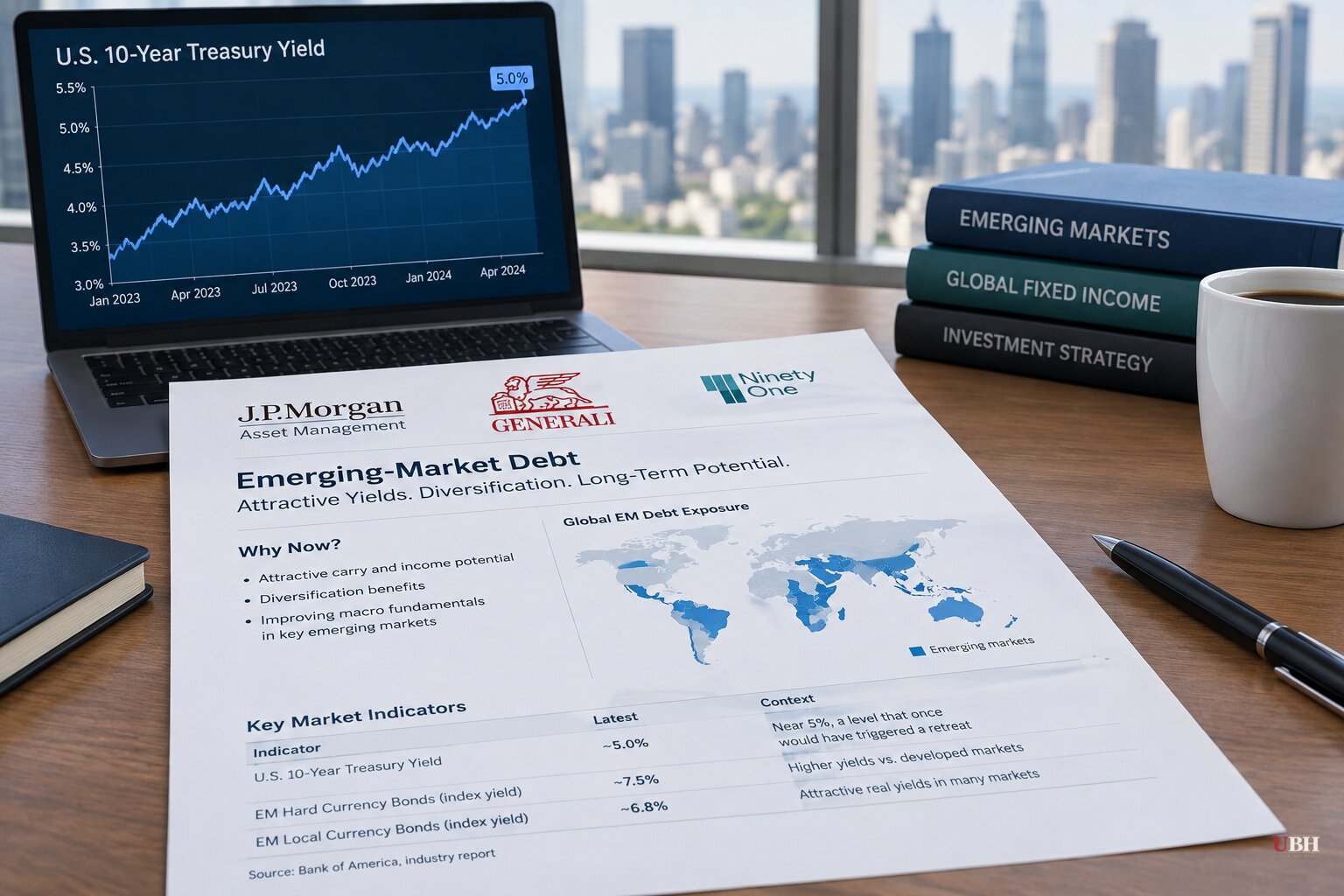
Some of the world's largest asset managers are adding to emerging-market debt while U.S. Treasury yields sit near 5%. That is the opposite of the old playbook.
JPMorgan Asset Management, Generali and Ninety One SA are all increasing exposure. Bank of America, using EPFR Global data, says emerging-market bond funds have taken in money for 12 consecutive weeks. BofA's latest investor survey also lists emerging-market equities among the most popular trades this month.
The old correlation is weakening
In past tightening cycles, rising Treasury yields and European debt scares hit emerging-market assets hard. Money went home.
This time, investors are treating those dips as chances to buy. By one comparison, EM bonds have returned nearly four times what U.S. Treasuries have since the start of 2025. Emerging stock and bond gauges have also beaten developed-market peers this year.
Iain Stealey, chief investment officer for fixed income at JPMorgan Asset Management, said in London that "I just don't think people own enough emerging markets." He called EM among the "most constructive allocations" across the firm's $4.3 trillion portfolios and said the firm will "continue to see assets deployed there." He expects more gains as "people are looking to find ways of getting, maybe, out of developed market governments."
Where the worry has moved
The fear driving this is not in Brasília or Jakarta. It sits in Washington, Brussels and Tokyo. Heavy debt loads and budget gaps in advanced economies are pushing up borrowing costs in the U.S., the euro area and Japan, while many developing countries look sturdier on their finances.
State Street Global Advisors made the same argument in an Oct. 6 outlook. Its emerging-market debt team, led by Jennifer Taylor, wrote that EM economies have shown better-anchored inflation, more credible policy and healthier fiscal positions than much of the developed world. It also said developed-market government bond markets are seeing the fiscal-driven risk it had flagged "materializing."
One analysis from hbwealth puts a number on it. On a debt-weighted basis, 10-year emerging-market sovereign debt yields 4.47%, against 4.58% for developed markets. That is an 11 basis point gap, inverted for the first time in the firm's records. Before the pandemic, EM 10-year yields sat 300 to 500 basis points above developed-market yields.
The same analysis found that all 20 developed markets it tracks saw 10-year yields rise over the past year. Only 11 of 15 emerging markets did. None of the EM countries it follows have 10-year yields at or near 10-year highs. Much of the gap reflects the U.S. and China: the Treasury 10-year has climbed from under 1% to more than 5% since its pandemic lows, while China's 10-year sits at 1.67%.
The analysis adds a caveat. Most weighting methods still show developed markets borrowing for 10 years at lower yields than emerging markets. The gap has just shrunk sharply.
Treasuries blinked this week
The U.S. market itself moved on Thursday, Oct. 22. After a sharp tech selloff, the benchmark 10-year yield fell about 18 basis points to 4.97%, its first close below 5% since Sept. 22. The 30-year dropped 12 basis points to 5.29%. The 2-year fell to a five-week low of 4.64%.
The Nasdaq Composite fell more than 650 points, or 2.4%, that day. The S&P 500 slipped about 1%.
Russell Thompson, chief investment officer at Hilbert Group, called it "a rotation of capital and a flight to quality," with money moving into Treasuries "to pick up the extra yield available at these levels."
The selloff followed renewed worries about AI spending. Nvidia CEO Jensen Huang said in a CNBC interview aired Oct. 22 that "there's a scarcity of capital" for the AI buildout and that demand for capital "is much greater than the availability of the capital." He said that "is going to get solved."
The risks the bulls acknowledge
Not everyone in the trade is declaring victory. State Street, which sells in this space, called performance "not uniform" across local and hard currency debt. It noted that tight spreads in hard-currency bonds make duration management and country selection critical.
Its team also pointed to the Middle East. The central question, it wrote, is whether renewed energy pressure reverses disinflation and repeats the aggressive tightening and market losses of 2021 to 2022. State Street does not expect that. Oil is elevated but below its 2022 high, and many EM central banks start with positive real rates.
Other analysts warn that a sharp dollar rally, a China growth shock or a geopolitical escalation could reverse the flows. Local-currency positions would carry the most currency risk if carry trades unwind in a disorderly way.
What comes next
The U.S. government is also a seller in this market. Treasury Secretary Scott Bessent announced a more aggressive buyback initiative in August, and the government often repurchases long-dated debt to pressure yields.
But Treasury is competing for the same dollars as the tech industry. Amazon and SpaceX are among the companies issuing billions in bonds to fund the AI buildout. If that competition continues, those companies may have to offer investors higher returns, and so may Washington.
Sources used for this briefing
7 links from 6 independent newsrooms (syndicated copies of the same report count once)
These are the sources it draws on, linked so you can verify.


