
Unbiased headlines. Facts, not spin.
Unbiased Headlines is an independently owned news organization. We bring you the facts, not opinions, written fresh from 110+ named sources. Sources linked so you can verify it yourself.
 tech
Notable (6/10)
Event date: November 24, 2026 ·
Jassy Says Amazon's AI Revenue Run Rate Tops $25 Billion, 440 Times Early AWS
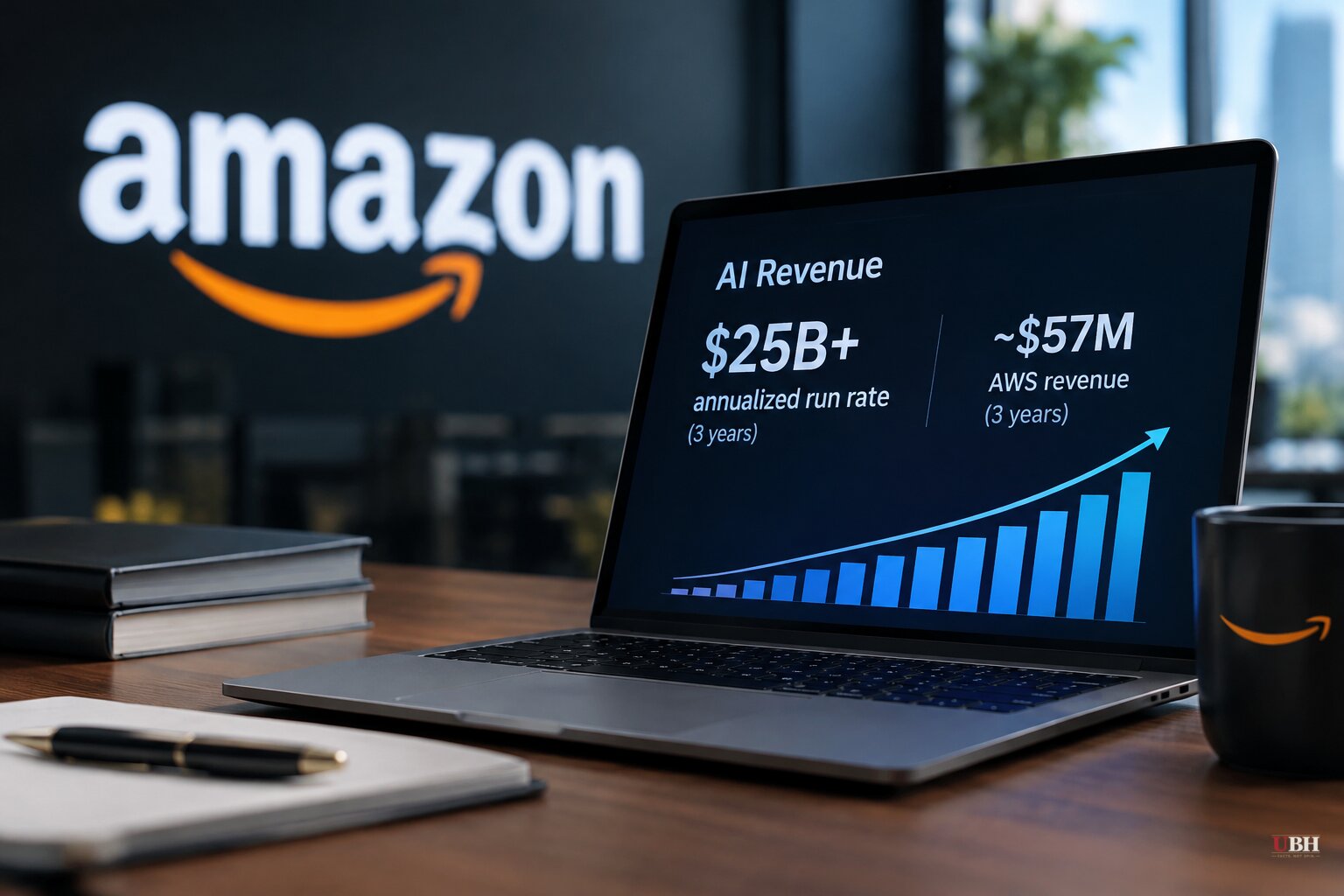
Amazon CEO Andy Jassy put a number on the company's AI business on Nov. 17: more than $25 billion in annualized revenue, three years into the generative AI wave.
He compared that with Amazon Web Services, which had about $57 million in annualized recurring revenue after its first three years. "So about 440x faster than the way we grew in AWS, and we thought we were growing fast," Jassy said at Semafor's Silicon Valley event. Jeff Bezos was in the audience.
The math checks out. $25 billion divided by $57 million is about 439.
What the number is, and is not
The $25 billion is a run rate. It takes current revenue and projects it across a year. It is not booked annual revenue.
It is also Jassy's own figure. Amazon has not broken out AI revenue as a line item, and the comparison pits a business launched on top of an existing global cloud customer base against one that started from nothing in a market that barely existed.
Jassy didn't hide from that distinction. His argument is about scale and momentum, not like-for-like startups.
The spending side
Amazon is guiding to about $220 billion in capital expenditures for 2026 and expects spending to increase substantially in 2027.
Jassy's defense is demand visibility. "Big chunks of capacity are largely reserved already in 27, much of it is reserved already in 28, and a good chunk in 29," he said. "We have very clear, very substantial demand signals that are unlike anything we have seen before."
The payoff, in his telling, comes later. "Once you get a few years out and you have all the data centers installed, and you are monetizing with the servers and networking gear you have in place, you really like the free cash flow and return on invested capital," he said. He called the market "incredibly early innings."
That leaves a gap between now and then. Revenue is climbing, but the capital going out is far larger, and free cash flow bears the near-term pressure. Reserved capacity shows customers lining up. It does not say how firm those reservations are. Jassy did not say in these remarks how much of the booked capacity carries take-or-pay commitments, a question a commenter raised publicly after his remarks circulated.
AWS growth and the trillion-dollar target
AWS posted $46 billion in third-quarter 2026 revenue, up 39.3% from a year earlier. That was its fastest growth in nearly five years.
Jassy also said AWS could reach a $1 trillion annualized revenue run rate within the next five to 10 years. Earlier forecasts had pegged the opportunity at a few hundred billion dollars.
One report of the event, from BigGo Finance, put AWS's order backlog at about $580 billion. That figure appears in only one account of his remarks and Amazon's own filings would be the place to confirm it.
Nvidia and the chip competition
Jassy was also asked about the recent controversy surrounding Nvidia and founder Jensen Huang. He said he did not have all the details but understood the parties were in discussions to resolve it.
Asked whether Amazon might someday not need Nvidia chips, he answered: "I don't see a day when we're not partners with Nvidia."
Amazon and Nvidia announced an expanded collaboration in August. Under it, the companies plan to deploy an additional 2 million Nvidia GPUs across AWS infrastructure between 2027 and 2028.
Amazon is also building its own silicon. It bought chip designer Annapurna Labs in 2015 and now sells Trainium for AI training and inference and Graviton for general-purpose computing. Amazon's third-quarter results showed its chip business growing triple digits year over year, with revenue commitments for Graviton and Trainium each up more than 20-fold. Jassy said Trainium has a clear price-performance advantage. In October, Amazon open-sourced TorchNeuron, which helps developers move PyTorch code onto Trainium.
Data centers and China
Jassy argued the United States should not halt data center construction because of community opposition. Doing so, he warned, could cede AI leadership to China.
That puts a political edge on a capital plan already measured in the hundreds of billions. Local fights over power, land and water are the practical obstacle to the capacity Amazon says customers have already reserved.
What comes next
The test arrives in Amazon's next quarterly results. Investors will look at whether AWS growth holds near the 39.3% pace, whether 2027 capital spending guidance puts a number on the "substantial increase," and whether Amazon discloses more about how much of the reserved capacity is contractually committed.
Sources used for this briefing
6 links from 5 independent newsrooms (syndicated copies of the same report count once)
These are the sources it draws on, linked so you can verify.


