
Original briefings. Zero spin.
Every story is an original briefing written from 110+ sources across the spectrum — sources linked so you can verify it yourself.
 finance
Major Story (7/10)
Event date: August 21, 2026
finance
Major Story (7/10)
Event date: August 21, 2026
Japan's Yen Rescue Backfires: Investors Use Stronger Currency to Buy $33 Billion in Foreign Assets
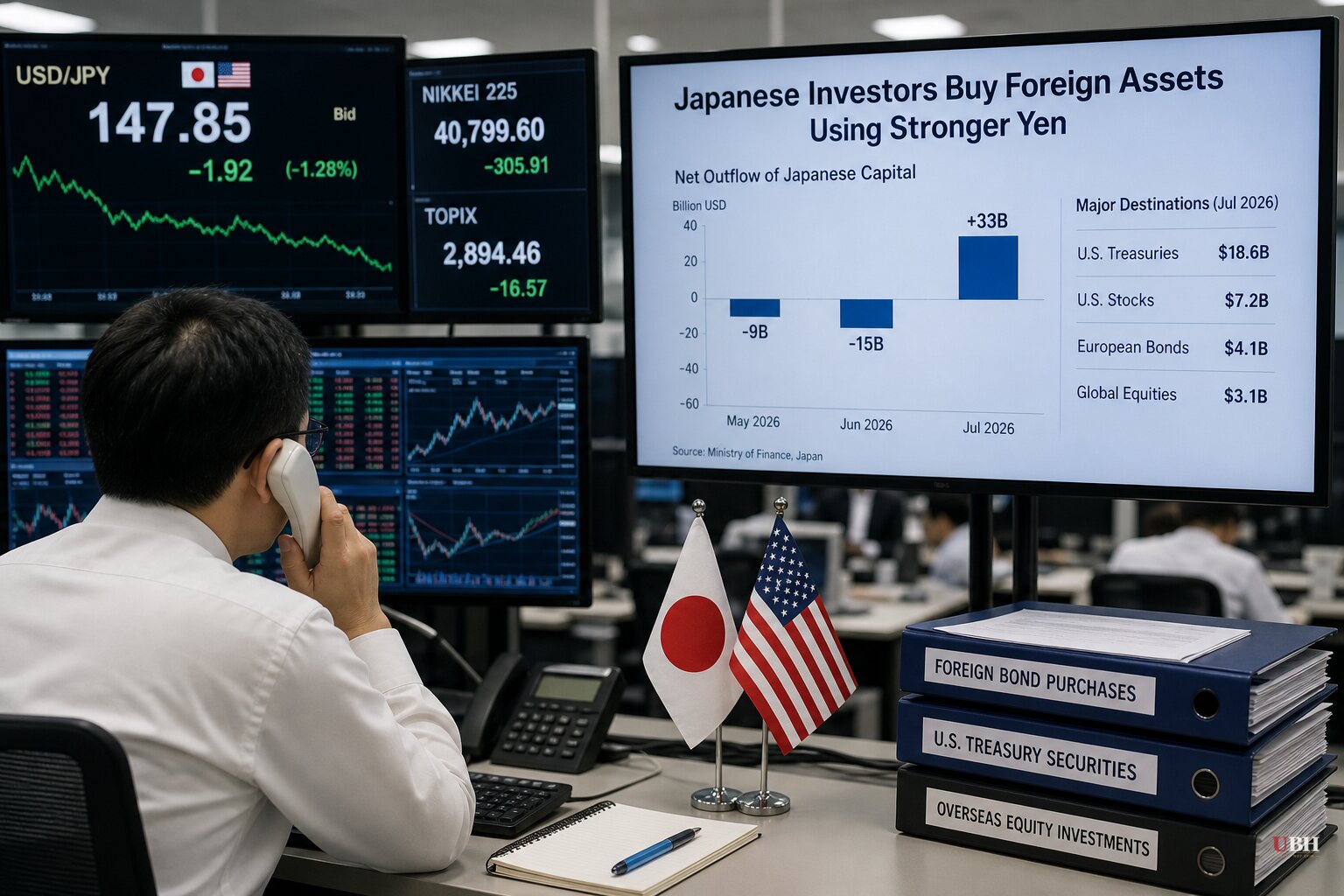
The Bank of Japan and the U.S. Treasury tried to save the yen from collapse in late July 2026. Japanese investors thanked them by using the rescue to buy more foreign assets.
Japanese investors net purchased more than 5 trillion yen in overseas stocks and long-term bonds during the two weeks ending August 15, 2026, according to CNBC data cited by both Oz Arab Media and a Gate News report. That is a sharp reversal from the prior two-week stretch, when Japanese investors were net sellers of foreign assets to the tune of 300 billion yen.
The yen hit roughly 164 per dollar, its worst level since 1986, according to the Epoch Times. Tokyo and Washington responded with a joint currency intervention starting around July 30, the first coordinated yen-buying operation since the 1998 Asian financial crisis. The yen jumped nearly 5 percent in a week, briefly touching 155 to the dollar.
Then it gave most of that back, sliding to around 159 by mid-August, per the Gate News and Oz Arab Media reporting on CNBC's data. Japanese investors used that window of yen strength to load up on cheaper-in-yen-terms U.S. Treasuries and other foreign holdings.
Who Paid, and How Much
Estimates suggest Tokyo spent as much as $59 billion propping up its own currency, according to the Epoch Times. Treasury Secretary Scott Bessent's own "to-do list," photographed at a July 31 Camp David Cabinet meeting, showed the U.S. side planning to kick in up to $10 billion.
Bessent confirmed the coordinated action in an August 2 post on X, saying the U.S. "countered disorderly yen movements" and would push to expand the Fed's Foreign and International Monetary Authorities repo facility. President Trump, aboard Air Force One, called the move "a signal of friendship," adding: "They have a weakening yen, and they wanted a little bit of help. And we're always there for Japan."
This was taxpayer-backed currency market muscle deployed to help a G7 ally, not a hostile power. Reasonable people can debate whether Washington should be in the business of defending another country's currency at all, even a friendly one, especially when the fix did not stick.
The Intervention Didn't Fix the Actual Problem
Jesper Koll, expert director at Monex Group, said the intervention "turbo charged" the carry trade rather than killing it, according to Oz Arab Media's sourcing of CNBC reporting. As long as Japan's cost of money sits below what investors can earn overseas, the incentive to sell yen and buy dollars does not go away just because central banks intervened once.
Francis Tan, Asia chief strategist at Indosuez Wealth Management, called the intervention treatment of a "symptom" rather than the underlying disease of low Japanese rates and a wide yield gap with the U.S. The U.S.-Japan 10-year yield spread sat at roughly 1.8 percentage points as of August 20, according to Gate News.
CFTC data showed leveraged funds cut net short yen positions from nearly 138,000 contracts at the end of June down to 59,526 by August 11, per Oz Arab Media. That represents real money betting the yen weakness trade still has legs, intervention or not.
Bigger Picture: A Trillion-Dollar Capital Exodus
Japanese investors net purchased roughly 5 trillion yen, about $33 billion, in a recent stretch, part of a pattern that saw full-year 2025 net purchases hit approximately 13.59 trillion yen in foreign bonds and 1.71 trillion yen in foreign equities, more than triple the year before, according to Crypto Briefing. Japan's net external assets still climbed to roughly $3.5 trillion by the end of 2025, even as the country's global ranking for total external assets slipped behind Germany and China.
Life insurers and trust accounts, the big institutional money managers sitting on long-duration liabilities, are the primary drivers, according to Crypto Briefing. They need yield to match their obligations, and Japan's own bond market isn't offering it.
Inflation Complicates the BOJ's Next Move
Japan's headline inflation rose to 1.9 percent in July, with wholesale inflation running hotter at 7.2 percent, according to CryptoRank's reporting via BeInCrypto. That pressure is pushing toward a possible Bank of Japan rate hike in September 2026, which would be the most direct way to shrink the yield gap driving capital out the door. Japan's Finance Ministry and Financial Services Agency are also weighing tax incentives for retail investors to buy government bonds, aiming to include the proposals in fiscal 2027 tax reforms, according to Vibe Trader, as the BOJ trims its own JGB holdings and pushes yields higher.
Finance Minister Satsuki Katayama has floated a separate idea: pushing the Government Pension Investment Fund to raise its domestic allocations. That single proposal in July 2026 was enough to briefly strengthen the yen and rally Japanese government bonds, according to Crypto Briefing, showing just how sensitive these markets are to any hint that Japan's biggest pools of capital might stop sending money abroad.
The Harder Story Underneath
Breitbart's reporting adds context the currency stories skip. The IMF projects Japan's economy will slip to fifth-largest in the world in 2026, falling behind India, weighed down by a negative growth quarter, Trump-era tariffs, a trade dispute with China, and a shrinking, aging workforce. Mizuho Research economist Koshiyama Yusuke told Kyodo News the country risks a stagflation spiral if yen depreciation offsets efforts to fight inflation. That's the structural backdrop the intervention was always going to struggle against.
The open question is whether the Bank of Japan actually raises rates in September 2026 and by how much. If it doesn't move fast enough, expect another round of yen weakness, another possible intervention, and another wave of Japanese money heading for U.S. Treasuries.
Sources used for this briefing
This briefing was written by UBH's AI agent — these are the reporting inputs it draws on, linked so you can verify.


