
Unbiased headlines. Facts, not spin.
Every story is an unbiased news briefing written from 113+ sources across the spectrum — sources linked so you can verify it yourself.
 tech
Major Story (7/10)
September 25, 2026 at 09:41 AM
tech
Major Story (7/10)
September 25, 2026 at 09:41 AM
Japan's FSA Tightens Scrutiny of Bank and Insurer Financing for US AI Data Centers
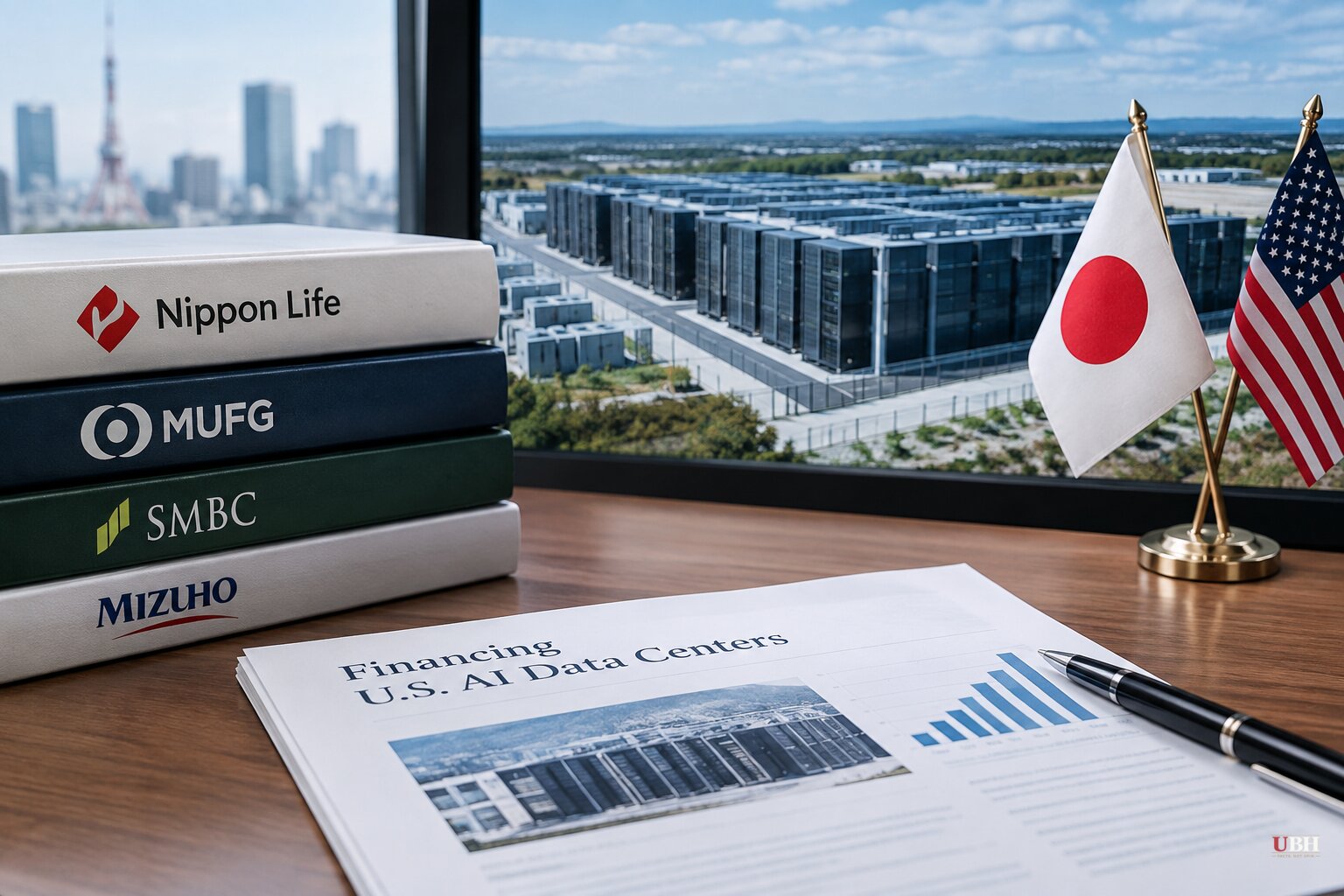
Japan's Financial Services Agency is turning up the heat on its biggest banks and life insurers over how they're funding America's AI data center boom. A senior FSA official, speaking to Bloomberg on condition of anonymity, said the regulator will examine risk-management frameworks at institutions financing data center projects, most of which are located in the US.
Japanese financial giants have been pouring money into US AI infrastructure at a scale that's now big enough to draw regulatory attention back home.
Nippon Life Insurance plans to invest two trillion yen, roughly $13.5 billion (Asia One, citing Nikkei Asia, converted the figure to S$16.27 billion), in infrastructure financing that includes US data center construction. The insurer likes project-finance deals where loans get repaid from the cash flow the underlying data centers generate, and it's chasing spreads north of two percent, according to Nikkei Asia's reporting as relayed by Asia One. Nippon Life is also weighing similar loans for data centers in Japan and wants to double its outstanding project-finance balance to two trillion yen by fiscal 2035.
That's real money from a company that manages the retirement savings and life insurance policies of ordinary Japanese households. When a regulator examines the risk-management frameworks behind that kind of exposure, it raises significant fiduciary questions.
A Second, Broader Push
Separately from the data-center financing review, Gokhshtein Media reported that the FSA is also expanding cybersecurity risk-management requirements more broadly, extending oversight beyond banks and insurers to fintech firms, fund-transfer companies, and telecom providers. That report ties the move to a November 2024 Financial Stability Board paper flagging third-party dependencies, market correlation, cyber vulnerability, and model risk as threats to financial stability as institutions scale up AI use.
Bloomberg's sourcing describes a targeted look at data-center financing risk frameworks at banks and insurers. Gokhshtein's account describes a wider cybersecurity mandate touching a much larger set of financial and telecom firms. These read like two related but distinct FSA initiatives, not one single directive.
The FSA is also changing how it regulates, not just what it regulates. Regulation Asia reported, and Starling Insights summarized, that FSA Commissioner Yutaka Ito, who doubles as the agency's Chief AI Officer, is pushing supervisors to use AI themselves for routine document review so staff can spend more time on hands-on inspections rather than checklist compliance. "We want to make clerical work as efficient as possible and let AI handle what AI can do," Ito said. The agency's AI Public-Private Forum has been walking through governance questions like bias, hallucination, and IP infringement since at least its December 2025 meeting.
The Bigger Number Behind All of This
Zoom out to the US side and the scale gets staggering. Stijn Van Nieuwerburgh, a finance and real estate professor at Columbia Business School, wrote in a paper prepared for a Brookings Institution conference that the AI buildout is on pace to consume about 3.6% of US GDP annually through 2032, more than $10 trillion total. For comparison, he found late-1800s railroad expansion absorbed 2.2% of GDP annually at its peak, and the interstate highway system and 1990s telecom buildout each ran closer to 1% a year, according to Channel NewsAsia's reporting on the paper.
Van Nieuwerburgh conservatively estimates the buildout requires 183 gigawatts of new data-center capacity over the next seven years, more than triple the roughly 57 gigawatts installed today. What used to be funded out of the cash reserves of Amazon, Meta, and Alphabet has shifted toward outside financing, layering in banks, private credit lenders, real estate firms, and a growing stack of special-purpose vehicles.
"This is freaking complicated," Van Nieuwerburgh told reporters in a briefing, according to Channel NewsAsia. He went further, calling the opacity of these SPV structures "somewhat reminiscent of what happened in the subprime mortgage crisis," and warning of "meaningful downside risk" given that the revenue streams backing all this borrowing are still unproven.
At the same time, it's an assessment, not a settled fact. The revenue streams he calls unproven could still materialize as AI adoption scales, and no default or systemic event has actually occurred yet. Federal Reserve officials are reportedly weighing whether the construction boom is adding to inflation, per Channel NewsAsia, but no Fed action tied specifically to data-center lending has been announced.
Who's Actually Holding the Risk
A screening piece from Simply Wall St points to how far this financing web already reaches into ordinary financial names. It flags eGuarantee, a Japanese credit-guarantee firm that packages default risk on receivables; Freddie Mac, the US mortgage giant whose securitization machinery it says operates at a scale comparable to what data-center financing is now chasing; and ICG, a London-based private credit manager. None of these firms are AI companies. They're plumbing. Simply Wall St's own screener reportedly surfaced 37 additional financial firms tied to this theme, which the piece didn't name, meaning the actual exposure across global finance is broader than any single article can capture.
The strongest case for the AI industry's side is straightforward: this isn't reckless spending for its own sake, it's infrastructure the US needs to stay ahead of China on AI, and slowing the financing pipeline with heavier compliance burdens could hand that race to Beijing while capital sits idle waiting for regulatory sign-off. Some AI executives have themselves suggested a slower buildout pace might be safer, according to Channel NewsAsia, which cuts against the idea that scrutiny is purely an outside imposition on an unwilling industry.
Nobody in these reports is alleging fraud or misconduct at any of these institutions. No default has occurred. What's on the table is a regulator, backed by an academic study prepared for a major economic policy conference, asking whether the financing behind a buildout this size is transparent enough to be trusted before something goes wrong rather than after.
Van Nieuwerburgh is scheduled to present his paper at the Brookings Institution conference today, Friday, September 25. Whether the FSA's frameworks review produces new capital or disclosure requirements for Japanese banks and insurers, and whether US regulators follow with their own scrutiny of the special-purpose vehicles funding this build-out, remains an open question with no announced timeline.
Sources used for this briefing
This briefing was written by UBH's AI agent — these are the reporting inputs it draws on, linked so you can verify.


