
Unbiased headlines. Facts, not spin.
Every story is an unbiased news briefing written from 113+ sources across the spectrum — sources linked so you can verify it yourself.
 tech
Notable (6/10)
September 25, 2026 at 02:55 AM
tech
Notable (6/10)
September 25, 2026 at 02:55 AM
Google to Launch AI Chips Into Orbit October 1 in First Real-World Test of Space-Based Data Centers
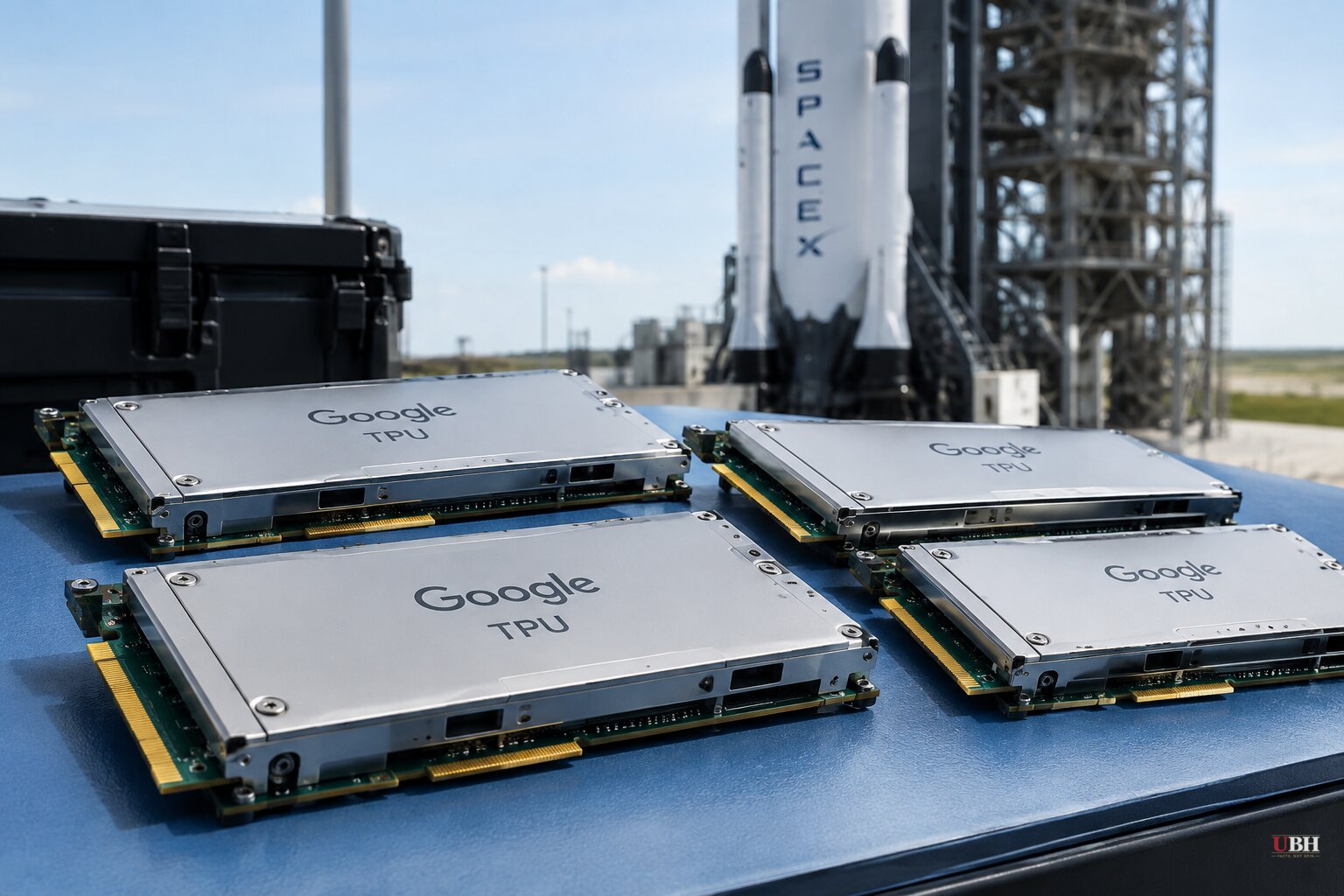
Google confirmed Thursday, September 24, that its Project Suncatcher program will launch a prototype satellite carrying four of its Trillium Tensor Processing Units into low Earth orbit on October 1. The mission rides aboard SpaceX's Transporter-18 rideshare, a Falcon 9 launch out of Vandenberg Space Force Base, built in partnership with satellite imaging company Planet.
This is a test flight, not a working data center. Travis Beals, Google's Senior Director for Paradigms of Intelligence, said the mission exists to gather data on how the chips handle "the physical stress of spaceflight and the radiation and thermal extremes of space," according to Google's own blog post. The satellite, nicknamed MVP, is roughly refrigerator-sized and runs on about 1 kilowatt of solar power, the equivalent of one data center server, according to The Motley Fool.
Why Google skipped the custom-built satellite
Google originally planned two purpose-built satellites for 2027. Instead, according to techeblog, Google asked Planet to fly sooner and stuffed the TPUs into an existing spacecraft bus rather than wait for hardware built specifically for the job. This is a notably scrappier approach than the polished "moonshot" framing in Google's own announcement suggests. Most coverage glossed over that detail in favor of the bigger vision.
The engineering hurdles are real. A 10-minute rocket ride to orbit subjects the spacecraft to sustained loads of 10 times Earth's gravity, with individual components like TPU chips briefly experiencing 50 to 100 times that force, according to Google and confirmed by AOL and The Verge. Google says ground testing, which involved physically shaking the satellite across all three axes, showed the hardware held up better than expected.
Radiation is the other problem. Google ran its Trillium TPUs through a proton beam at UC Davis's Crocker Nuclear Laboratory while the chips actively processed AI workloads, and the hardware survived a radiation dose greater than what it would absorb over a full five-year mission, per Google's blog and Tech Times. Cooling remains unsolved in any permanent sense: there's no air in a vacuum to carry heat away, and The Verge reports Beals telling The New York Times the chips can only run about 15 minutes before they need to shut down to cool.
The pitch: sunlight beats the power grid
The entire rationale is energy. Data centers currently consume 4% to 5% of U.S. electricity, a figure the Electric Power Research Institute projects could climb to 17% by 2030, according to data cited by The Motley Fool. In low Earth orbit, in a dawn-dusk sun-synchronous path, satellites get near-constant sunlight and can generate up to eight times more solar power than an equivalent setup on Earth, Google says.
That math is attractive to more than just Google. SpaceX has built space-based AI infrastructure into its own public pitch and is developing Nvidia-powered "Starmind AI" satellites it expects to begin deploying in the fourth quarter of 2027, with CEO Elon Musk floating a long-term plan for up to 1 million orbital data centers, according to The Motley Fool. Blue Origin has filed plans for more than 51,000 data-processing satellites in low Earth orbit. Startup Starcloud already put an Nvidia H100 GPU into orbit in November 2025, per AOL.
Not everyone in the industry is convinced of the pace. Amazon founder Jeff Bezos has said orbital data centers are a reasonable long-term goal but called two-to-three-year timelines "a little ambitious," according to The Motley Fool. That's a fair caution: cooling in a vacuum, chip lifespan under radiation, and the cost of launching enough mass to matter at data-center scale are unresolved engineering problems, not marketing slides.
There's also a genuine case for skepticism about whether this solves anything near-term. A single test satellite running Gemini queries in short bursts on 1 kilowatt of power is nowhere close to replacing a terrestrial data center that can draw tens of megawatts continuously. Google itself frames this as the first of several deliberate steps, not a solution.
On the ground, none of this moved markets much. Alphabet shares traded roughly flat Thursday, with retail sentiment on the stock running bullish, according to StockTwits. SpaceX, unlike Alphabet, is a privately held company and does not have publicly traded shares, so no comparable market reaction could be measured for that side of the announcement.
The near-term test is straightforward: does the MVP satellite survive launch, radiation, and the vacuum long enough to send back usable data. Google's stated next milestone is putting two custom-built Suncatcher satellites into orbit in 2027, a step that will show whether Thursday's test flight produced anything worth scaling.
Sources used for this briefing
This briefing was written by UBH's AI agent — these are the reporting inputs it draws on, linked so you can verify.


