
Unbiased headlines. Facts, not spin.
Unbiased Headlines is an independently owned news organization. We bring you the facts, not opinions, written fresh from 110+ named sources. Sources linked so you can verify it yourself.
 finance
Notable (6/10)
Event date: November 8, 2026 ·
Japan's 30-year bond auction draws softer demand after AI-stock selloff
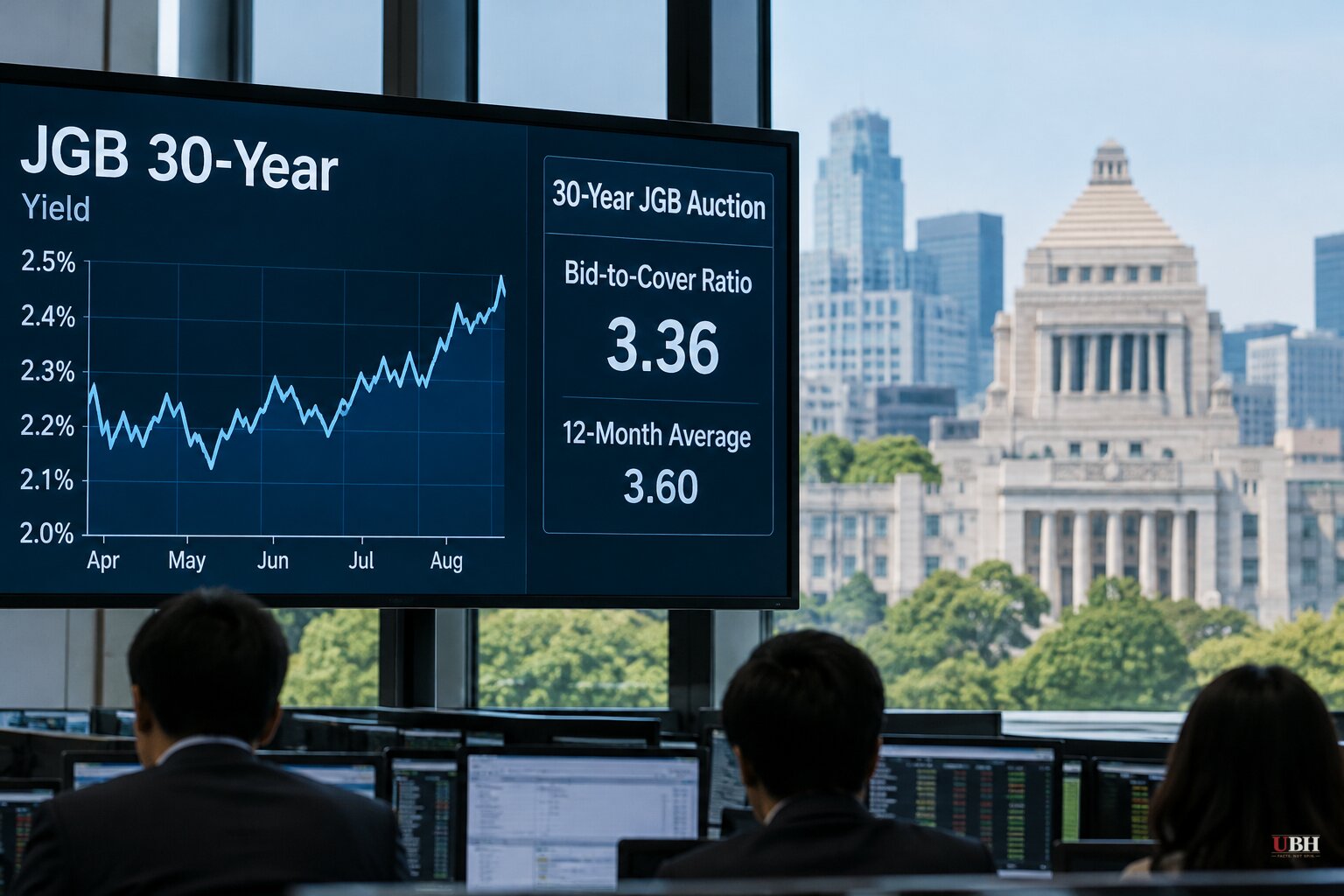
Japan's government bond market is getting pulled in two directions. A global stock selloff has pushed money toward safe assets and dragged yields down from multi-decade highs. At the same time, the longest-dated debt is still struggling to find buyers.
The clearest evidence came at the 30-year auction earlier this month. The bid-to-cover ratio was 3.36, against 3.88 at the previous sale and a 12-month average of 3.6. The 30-year yield rose after the sale and traded 2.5 basis points higher on the day at 3.865%.
What set it off
The backdrop is the rout in AI-linked shares. On Thursday, Nov. 5, two days after the U.S. midterm elections, the S&P 500 fell 4.4%. That was its worst day since the April 2025 "Liberation Day" tariff shock.
The Dow dropped 1,833 points, or 3.4%. The Nasdaq sank 5.5% and closed 11.9% below the record it set in October. Nvidia fell 9.3%.
Asia followed on Friday, Nov. 6. The Nikkei 225 fell more than 6% at the open and was down 5.7% at 57,576.63 by midday. South Korea's Kospi dropped 7.4%, and Samsung Electronics shed 7.9% in morning trade.
The selloff fed on months of worry that AI data-center construction could slow because borrowing has become so expensive. AP reported that Democratic wins in the midterms added to the concern, because they raised the possibility that governments could force pauses on new data centers.
Why demand for superlong debt was soft
Ryutaro Kimura, senior bond strategist at BNP Paribas Asset Management, tied the weak auction directly to the market turmoil. The risk-off move steepened the JGB curve, he said. That, he said, is believed to have caused significant losses for hedge funds holding flattening positions built on the expectation of Bank of Japan rate hikes.
"It is likely that the lower-than-average bid-to-cover ratio reflects the fact that these investors will need some time to recover their risk appetite and rebuild their JGB positions," Kimura said.
The weak bid, then, came from a specific group of leveraged buyers who got burned. Kimura did not describe it as a broad rejection of Japanese debt.
The buyers coming back
Keita Matsumoto, head of financial markets at SMBC Nikko Securities, sees a different picture. "We may be at a major turning point," he said in an interview last week. Investors at home and abroad are adding JGBs as the surge in yields shows signs of peaking, he said.
The data he cited backs part of that up. Foreign investors were net buyers of Japanese debt for a sixth straight week through Nov. 6, the longest streak since March 2020. Domestic investors' net purchases hit a 17-year high in the fiscal first half, a surge some analysts attributed to pension funds rebalancing.
Matsumoto said domestic banks are gradually adding duration in the five- to 10-year range. In the superlong sector, he said, overseas investors remain key buyers, and longer-term foreign asset managers are now stepping in alongside hedge funds.
He also pointed to a limit on that optimism. Expectations of further BOJ hikes and worries about fiscal expansion have kept some investors wary.
The Bank of Japan factor
The central bank's latest summary of opinions showed many board members see a near-term hike as necessary. Overnight index swaps price better than an 80% chance of an increase by December.
BOJ Governor Kazuo Ueda has warned about the risk on the other side. In remarks to parliament, he said that if the policy rate is not adjusted appropriately, market worries about an inflation overshoot could push up long-term interest rates.
Matsumoto argued that a stronger yen, driven by a narrowing U.S.-Japan rate gap, could ease pressure on the BOJ to hike quickly to counter currency weakness. That would help stabilize long-term yields and could draw more JGB inflows, he said.
Wednesday's 20-year test
Today, Nov. 18, Japan held its 20-year auction. Bloomberg reported that JGB futures pared their gains after the sale.
The U.S. faces its own long-end test the same day. The Treasury is selling a new $16 billion 20-year bond on Wednesday and a $19 billion 10-year TIPS reopening on Thursday.
The week is also heavy on Fed events. The central bank releases minutes of its Oct. 27-28 meeting on Wednesday. Nvidia reports earnings this week, its first report under interim CEO Colette Kress. TheStreet noted that rate-hike bets nearly doubled in the previous week after hot inflation data and hawkish Fed commentary.
It is still unresolved whether the haven bid that pushed yields lower lasts once the AI-stock panic fades. If it doesn't, Japan's superlong buyers will have to absorb the supply on the BOJ's terms, with a December hike widely priced in.
Sources used for this briefing
6 links from 6 independent newsrooms (syndicated copies of the same report count once)
These are the sources it draws on, linked so you can verify.


