
Unbiased headlines. Facts, not spin.
Unbiased Headlines is an independently owned news organization. We bring you the facts, not opinions, written fresh from 110+ named sources. Sources linked so you can verify it yourself.
 finance
Notable (5/10)
Bank of England Finalizes Up-to-12-Month Live Testing Path for New Clearing Houses, Blockchain Firms Included
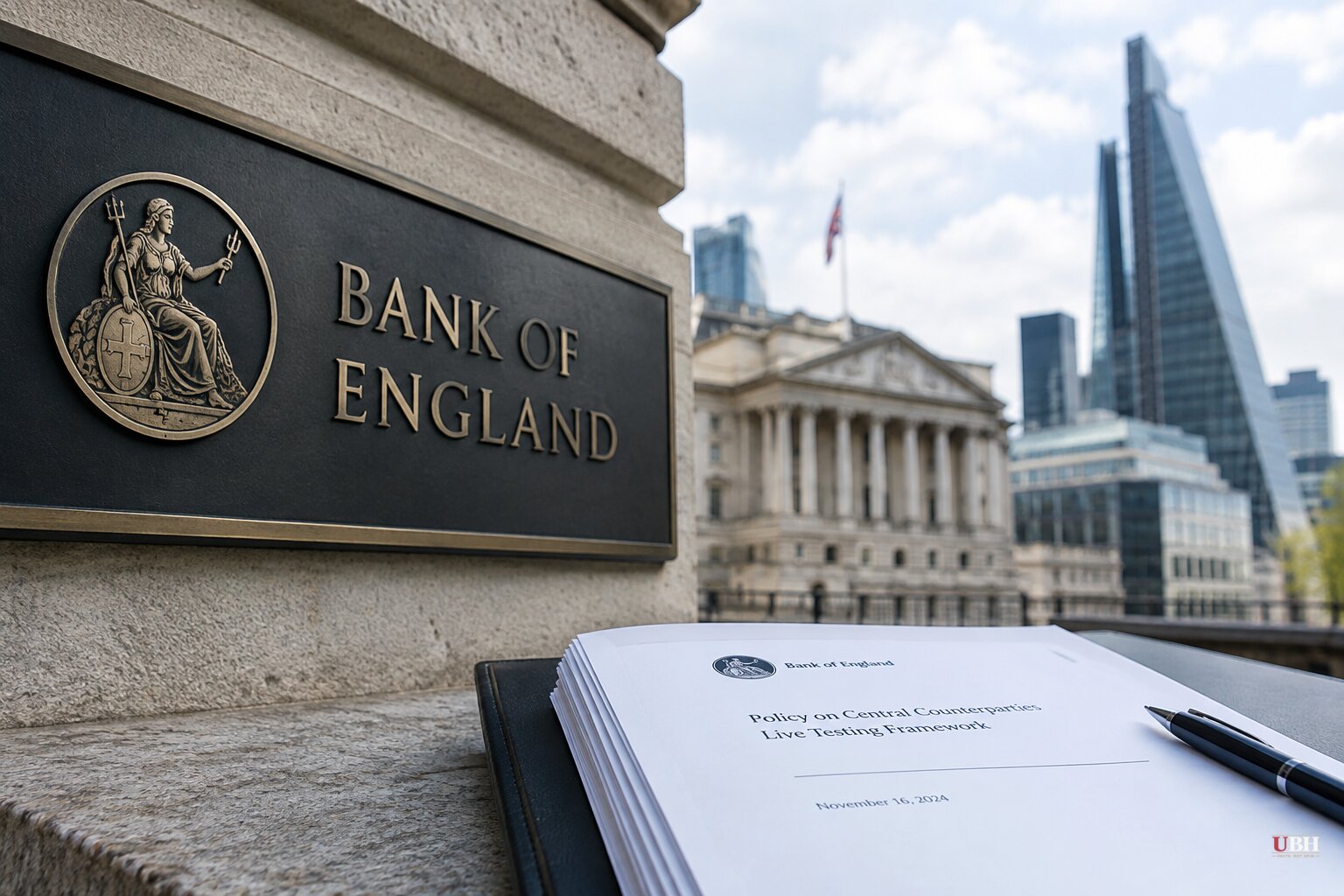
The Bank of England has finalized how a brand-new clearing house can start operating before it is fully built. The policy, published Nov. 16 alongside a Statement of Policy on mobilisation, creates an optional stage between recognition and full operations.
During that stage, a prospective central counterparty (CCP) can clear real trades at minimal volumes under supervision. The Bank expects the period to last up to 12 months, though it can be shorter. It may consider an extension only in exceptional circumstances.
A CCP sits between buyer and seller on a trade. If one side defaults, the CCP is the party that makes sure the other still gets what it was owed. That is why the Bank does not let newcomers run at full scale on day one.
How the mobilisation stage works
The framework runs on two levers. First, the Bank will use its requirements powers to impose "de minimis" limits on a new CCP's activity. Second, it can use a permissions power to temporarily modify or waive certain rules.
The limits are set case by case. The Bank said it will weigh each firm's business model and risk profile, and it does not plan a single numerical threshold for everyone. The stated aim is live testing with business and risk exposure kept at minimal levels.
A firm applies for mobilisation alongside its application for recognition. The Bank assesses the two together and decides on mobilisation when it decides on recognition.
Every applicant must file a detailed mobilisation plan showing how it will meet each unmodified rule by the end of the period. To exit, it has to meet all original requirements and finish its operational build-out. Any waived or modified rule comes back in full.
The Bank said it does not expect to approve changes to a large number of rules. Permissions will be time-limited. It generally expects a firm to have first taken on a voluntary requirement (VREQ) to operate within the de minimis limits before it gets any rule relief.
The flexibility has a fence around it. The broader CCP Rulebook is open to waivers or modifications. The Fundamental Rules are not.
Blockchain-based clearing houses are covered, with no special rulebook
The Bank confirmed the regime applies to all new CCPs, including those built on distributed ledger technology (DLT). It described its approach as "technology-neutral" and focused on "achieving the same regulatory outcomes."
That means a DLT-native clearing house now has a defined route to begin live operations in the UK. It faces the same standards as a conventional one.
Not everyone wanted that. During the consultation, one respondent asked the Bank to include specific supervisory expectations for DLT-based clearing houses. The Bank declined and introduced no DLT-specific requirements. It said it will look at whether firms deliver the required regulatory outcomes, not at the underlying technology.
The announcement does not name any DLT-based applicant or authorize a particular blockchain network.
When it takes effect
The new rule-permission framework does not start yet. It takes effect alongside the Bank's final CCP rules, after HM Treasury confers the relevant permission power through a statutory instrument. The Bank expects that legislation to be in force by the end of the first quarter of 2027.
Until then, prospective CCPs can seek mobilisation through the Bank's existing onboarding approach. The new rule permissions will not be available to them in that window.
The wider tokenization push
The policy sits inside a broader Bank program on digital market infrastructure. The Digital Securities Sandbox, which allows live testing of DLT-based financial services, is expected to run until at least January 2029. It has 16 participants, including HSBC and LSEG B3 Limited. The Bank also launched a Synchronisation Lab in 2026 to test atomic settlement between DLT platforms, where both legs of a trade complete together or neither does.
A separate Bank consultation covers tokenized collateral. It addresses tokenized versions of collateral already eligible under the proposed CCP Rulebook, and asks for views on a wider range of tokenized assets for possible future policy. It does not add any collateral type to the eligible list. Responses are due Feb. 12, 2027.
The Bank's own principle is "same risk, same regulatory outcome." If a new technology carries the same risks as an old one, it gets the same rules.
The unresolved legal questions
Regulators elsewhere are flagging that the technology's legal footing is unsettled. Federal Reserve Governor Christopher Waller said in prepared remarks at The Clearing House annual conference in New York today, Nov. 17, that unresolved liability questions could slow institutional adoption of tokenized markets. He pointed to lost keys, smart-contract exploits and assets stranded on failed networks. He said the legal treatment of tokenized claims, custody, insolvency and resolution will decide whether institutions adopt the technology.
Waller also said central bank money must remain the foundation of the system, even if it does not appear in every transaction.
That is a different jurisdiction and a different regulator, but the questions he raised bear on a clearing house's core job of handling a default. The Bank's mobilisation plans are designed to show how a firm will meet each full rule, including on default management, before it leaves the testing stage.
The next concrete marker is the Treasury statutory instrument. Until it is made and the Bank's final CCP rules take effect, the waiver and modification powers at the center of this policy cannot be used. The Bank is aiming for the end of Q1 2027.
Sources used for this briefing
7 links from 7 independent newsrooms (syndicated copies of the same report count once)
These are the sources it draws on, linked so you can verify.


