
Unbiased headlines. Facts, not spin.
Unbiased Headlines is an independently owned news organization. We bring you the facts, not opinions, written fresh from 110+ named sources. Sources linked so you can verify it yourself.
 finance
Major Story (8/10)
Event date: November 16, 2026 ·
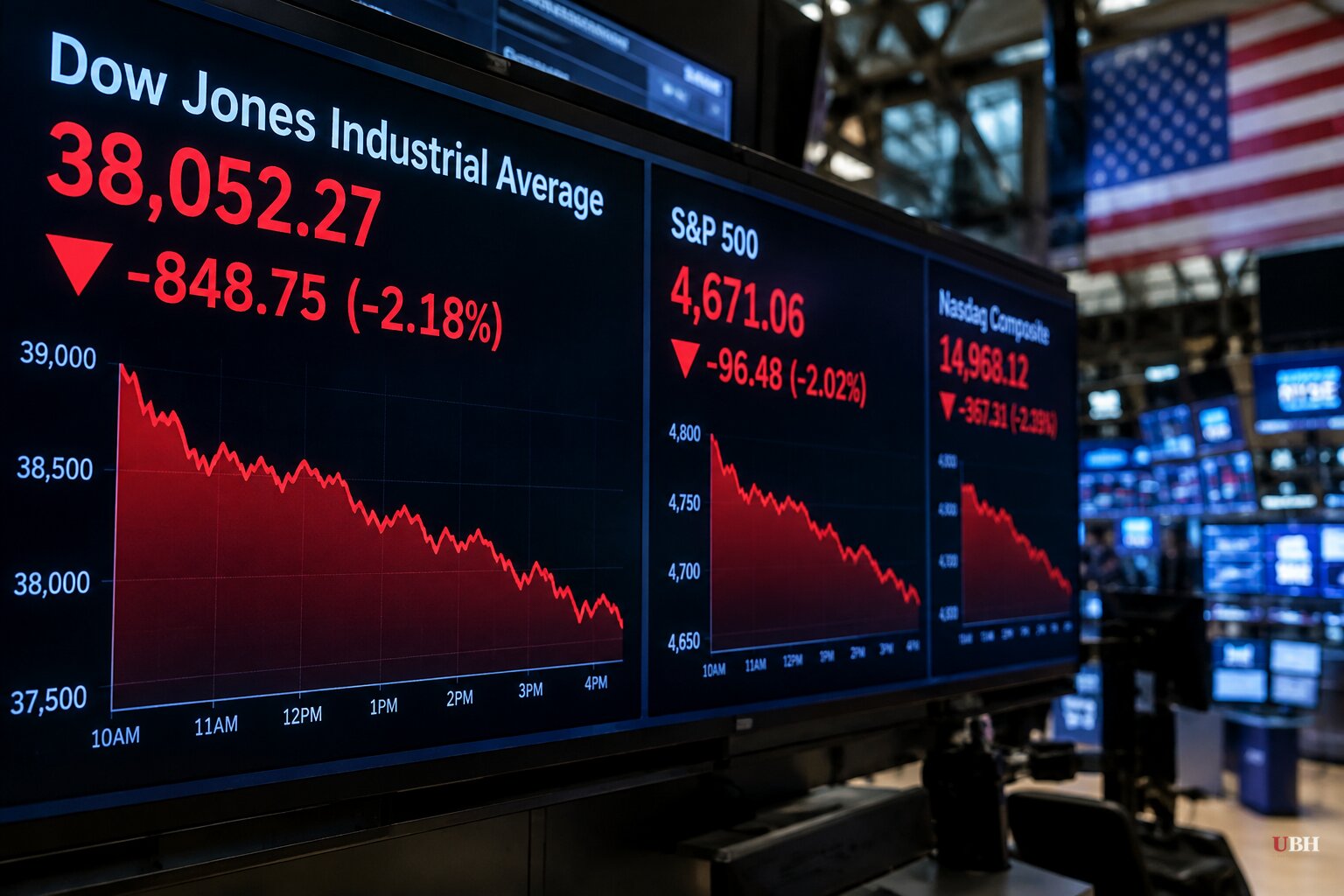
Dow Drops 849 Points and S&P 500 Closes at Lowest Level Since Late July Ahead of Nvidia Earnings
Since Jensen Huang resigned as Nvidia CEO on Nov. 12, the stock has dropped to its lowest close since July 2025 and the selling has spread well beyond chips. On Tuesday, Nov. 17, the damage got bigger.
The Dow Jones Industrial Average fell 848.75 points, or 1.64%, to 50,759.42. It was down more than 1,000 points at its session low. The S&P 500 slid 1.03% to 7,340.53, its lowest close since late July, after sinking as much as 1.7% earlier in the day.
The Nasdaq Composite ended down 0.74%. At its worst, it was off roughly 2.1%, touching its lowest level since April.
An NSA outage report adds to the jitters
The major averages hit their lows for the day after CNN reported that a classified network used by the National Security Agency had gone down. CNN cited six people familiar with the matter, who said there was no evidence of a cyberattack.
The NSA later issued a statement saying the agency "experienced temporary degradation during scheduled routine maintenance." It added that "mission-critical capabilities remain fully operational."
Traders told CNBC the report weighed on stocks, though losses were contained. It landed after a run of infrastructure scares: an FAA ground stop over the weekend, a Microsoft Outlook outage last week and recent problems with banking apps.
Huang says he'd consider a return
Nvidia shares closed 0.5% lower on Tuesday. They got a brief lift earlier in the session after Huang said he would be open to returning as CEO if the board decided that was in shareholders' best interest.
The board's position appears to differ. CNBC and The Wall Street Journal reported Monday that directors are not considering reinstating him. Colette Kress, the CFO, is serving as interim CEO while keeping her finance role.
Nvidia fell 4.12% to $156.14 on Monday, Nov. 16, its lowest close since July 1, 2025. That is about 35% below the record close of $239.24 on Oct. 6. Roughly $735 billion in market value has been lost since the leadership crisis began, according to Implicator.
Earnings after the bell
Nvidia's fiscal third-quarter report was scheduled for after the close, with Kress's first call as interim CEO set for 5 p.m. ET. In August, the company guided to revenue of $108.0 billion, plus or minus 2%. The Bloomberg consensus estimate is $109.15 billion in revenue and $2.47 in earnings per share. Those are estimates, not results.
Ross Mayfield, investment strategist at Baird, said Nvidia "should report strong results and guidance, but [it] is unlikely to be able to give investors solid answers to the questions heavily weighing on the stock [regarding] leadership and investigations around export controls." He added that "the next leg higher will need some clarification around the 2028 and beyond outlook."
Huang resigned after reports that he had an affair with a Chinese businesswoman whom U.S. authorities suspect of spying for Beijing. Fox News, citing The New York Times and unnamed sources, reported that U.S. intelligence agencies have conducted electronic surveillance on the woman for at least a year. Republican lawmakers have called for Huang to answer questions in a closed-door briefing.
Spillover across tech and Asia
Other tech names finished lower but well off their lows. Microsoft fell 2%, Micron 0.9%, Intel 0.5% and AMD 0.2%.
The neocloud stocks that rent out AI computing power took hits. Iren lost more than 3% and Nebius 1%. Investor Steve Eisman told CNBC these companies have the most to lose if the Huang scandal causes Nvidia to pull back its financing of the AI ecosystem.
Asian markets sold off Tuesday ahead of the U.S. session. South Korea's Kospi fell 1% to 5,051.93 and has lost more than 10% over the past month. Japan's Nikkei 225 lost 1.2% to 58,956.67, with SoftBank down 6.2%. Hong Kong's Hang Seng sank 1.2% to 23,458.87, and Australia's S&P/ASX 200 fell 1.5%.
On Monday, the Commerce Department issued a rule requiring licenses to ship advanced chips to Malaysia, Thailand, Indonesia, Singapore and Brazil. The rule aims to stop Chinese customers from reaching U.S. chips remotely through overseas data centers. U.S. technology companies could receive exceptions.
Data centers are a second worry
The AI sector also faces a political question after the midterms. Texas Gov.-elect Gina Hinojosa, a Democrat who beat Gov. Greg Abbott, told CNN last week that "we need to stop what we are doing with data centers until we have those protections." Several states also voted against data centers in ballot measures.
National Economic Council Director Kevin Hassett took the opposite view. He told CNBC that planned data center construction will go forward, saying "the data centers scheduled over the next couple of years aren't affected by these ballot initiatives" and "there's plenty of room in the U.S. for data center growth to continue."
Zhiwei Zhang, president and chief economist at Pinpoint Asset Management, said "the market was already worried about this risk before what happened at Nvidia. Now the risk has become even more serious."
The next test is Wednesday's session, when the market reacts to Kress's first earnings call and whatever she says about Nvidia's leadership search and export-control scrutiny.
Sources used for this briefing
7 links from 7 independent newsrooms (syndicated copies of the same report count once)
These are the sources it draws on, linked so you can verify.
More coverage: Nvidia


