
Unbiased headlines. Facts, not spin.
Unbiased Headlines is an independently owned news organization. We bring you the facts, not opinions, written fresh from 110+ named sources. Sources linked so you can verify it yourself.
 tech
Notable (5/10)
Event date: October 30, 2026 ·
Japanese Satellite Recorded Near-Light-Speed Electrons Inside Earth's 'Impenetrable' Radiation Barrier During May 2024 Storm
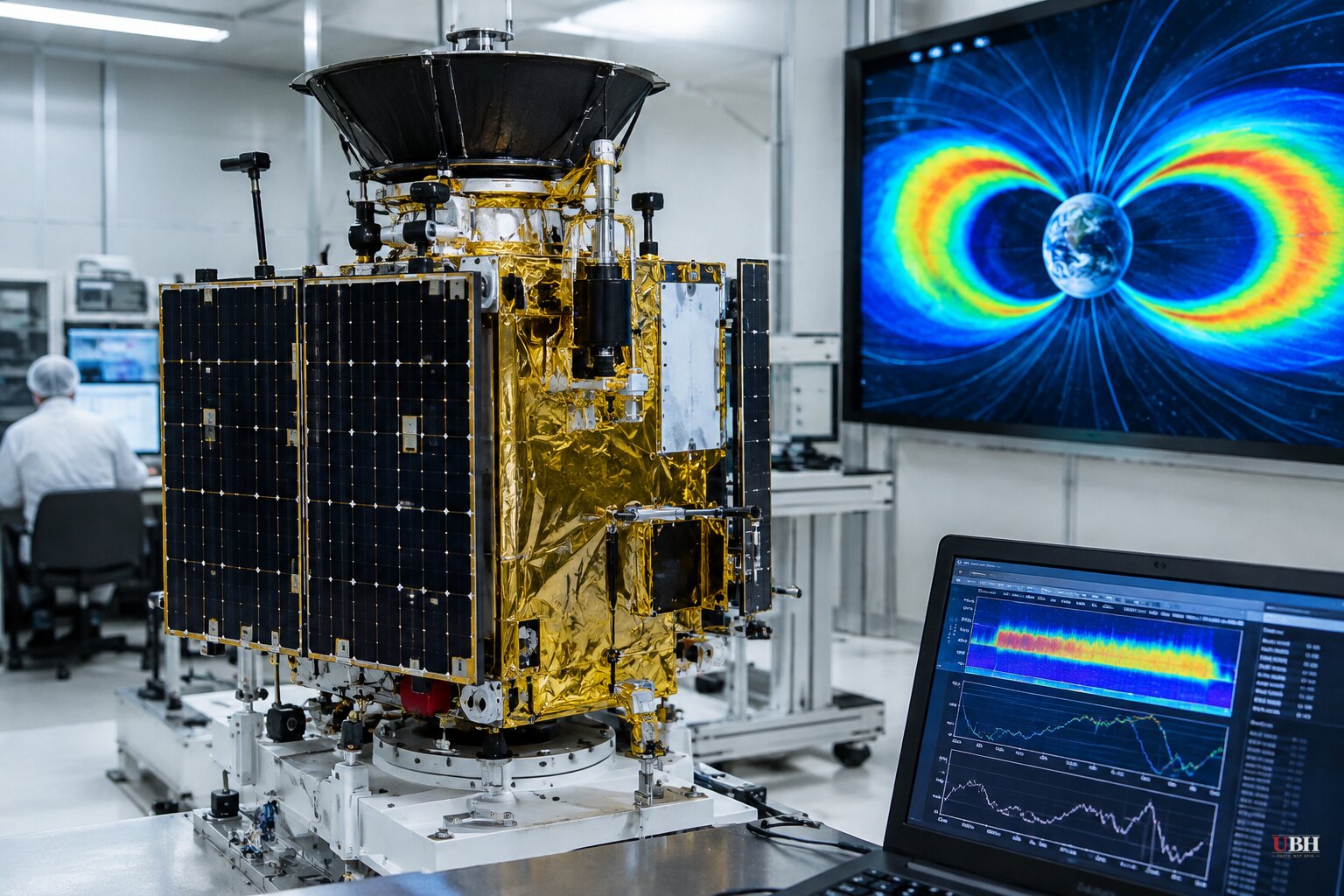
Scientists spent more than a decade calling it an "impenetrable barrier." One severe solar storm showed otherwise.
A team led by Yoshizumi Miyoshi, a professor at Nagoya University's Institute for Space-Earth Environmental Research, published findings in Geophysical Research Letters. They show that during the May 2024 geomagnetic superstorm, extremely energetic electrons appeared inside a region of near-Earth space where such particles had rarely been seen.
"Here we show that this barrier can be breached under extreme space weather conditions," the team writes.
What the barrier was supposed to be
Earth's magnetic field traps charged particles in two doughnut-shaped regions called the Van Allen belts. The outer belt is mostly high-energy electrons. The inner belt is mostly high-energy protons.
In 2014, NASA's Van Allen Probes revealed a sharp boundary at the inner edge of the outer belt, about three Earth radii from the planet's center. One Earth radius is about 6,371 kilometers, so the line sits just over 19,100 kilometers out.
The most energetic electrons, traveling near the speed of light, almost never crossed it. Researchers called it a wall, though it is not a physical structure. It is a persistent limit on how far those particles travel inward.
What creates it is still not fully understood. One proposed explanation is low-frequency radio waves called plasmaspheric hiss, which can scatter energetic electrons out of their orbits and into the atmosphere.
What Arase saw in May 2024
The storm of May 10-11, 2024 produced auroras at unusually low latitudes, including over parts of Japan. Meanwhile the Japan Aerospace Exploration Agency's Arase spacecraft, which has flown through the magnetosphere since 2017, recorded large numbers of electrons with energies above three megaelectronvolts inside the boundary.
That is enough to pass through some types of satellite shielding. Arase counted ultra-relativistic electrons at levels roughly 5,000 times above the typical background, according to the findings as relayed in the science press.
Such electrons are a known hazard. They can damage sensitive electronics, shorten a spacecraft's life and raise radiation exposure for astronauts.
Pushed in, or sped up on site?
The team asked a specific question. In Miyoshi's words: "Were they transported inward from the outer radiation belt, or were they accelerated locally within this region?"
They used electron phase space density, a measure of how particles are distributed by energy and motion. If electrons were simply migrating inward, density should fall steadily toward Earth. Instead, across multiple Arase orbits, the data showed a growing local peak near the old barrier.
That pattern points to local acceleration. The electrons were not necessarily crossing the wall. Electrons already inside were gaining energy.
The researchers concluded that chorus waves, natural electromagnetic waves that sound like birdsong when converted to audio, probably did the work. They transfer energy to electrons through resonance.
The storm cleared the way
The study ties the event to what the storm did to the plasmasphere, the region of cool ionized gas around Earth. The storm made it contract. That left the area around the barrier unusually empty.
Low density is the condition in which chorus waves thrive. In effect, the storm removed the plasma that normally helps keep the zone quiet and set up an environment where electrons could be boosted from within.
Earlier doubts about the wall
The finding lands on ground that was already shifting. As early as 2018, researchers proposed that the barrier was less a true wall than an illusion created by the limited duration of geomagnetic storms. Under that view, magnetic fluctuations can push energetic electrons inward, but storms usually end before the electrons get far.
A 2024 analysis of observations from 1996 to 2006 added to the doubts, per the ScienceAlert account of the research history. The Miyoshi paper takes a different angle. It argues the key issue may not be penetration from outside at all, but acceleration on site.
What remains open
The results come from one extreme event observed by one spacecraft. Nothing in the paper establishes how often conditions like these occur, and the team describes the breach as happening under extreme space weather.
The practical question is the one the paper raises for operators: a boundary that blocks radiation from outside is not proof against dangerous particles being created inside it. Whether satellite shielding assumptions change will depend on how often the plasmasphere empties out and chorus waves take over during the next major storm.
The Sun is still active. The next test will not wait on a research schedule.
Sources used for this briefing
7 links from 7 independent newsrooms (syndicated copies of the same report count once)
These are the sources it draws on, linked so you can verify.


