
Original briefings. Zero spin.
Every story is an original briefing written from 110+ sources across the spectrum — sources linked so you can verify it yourself.
 health
Notable (6/10)
Event date: August 31, 2026
health
Notable (6/10)
Event date: August 31, 2026
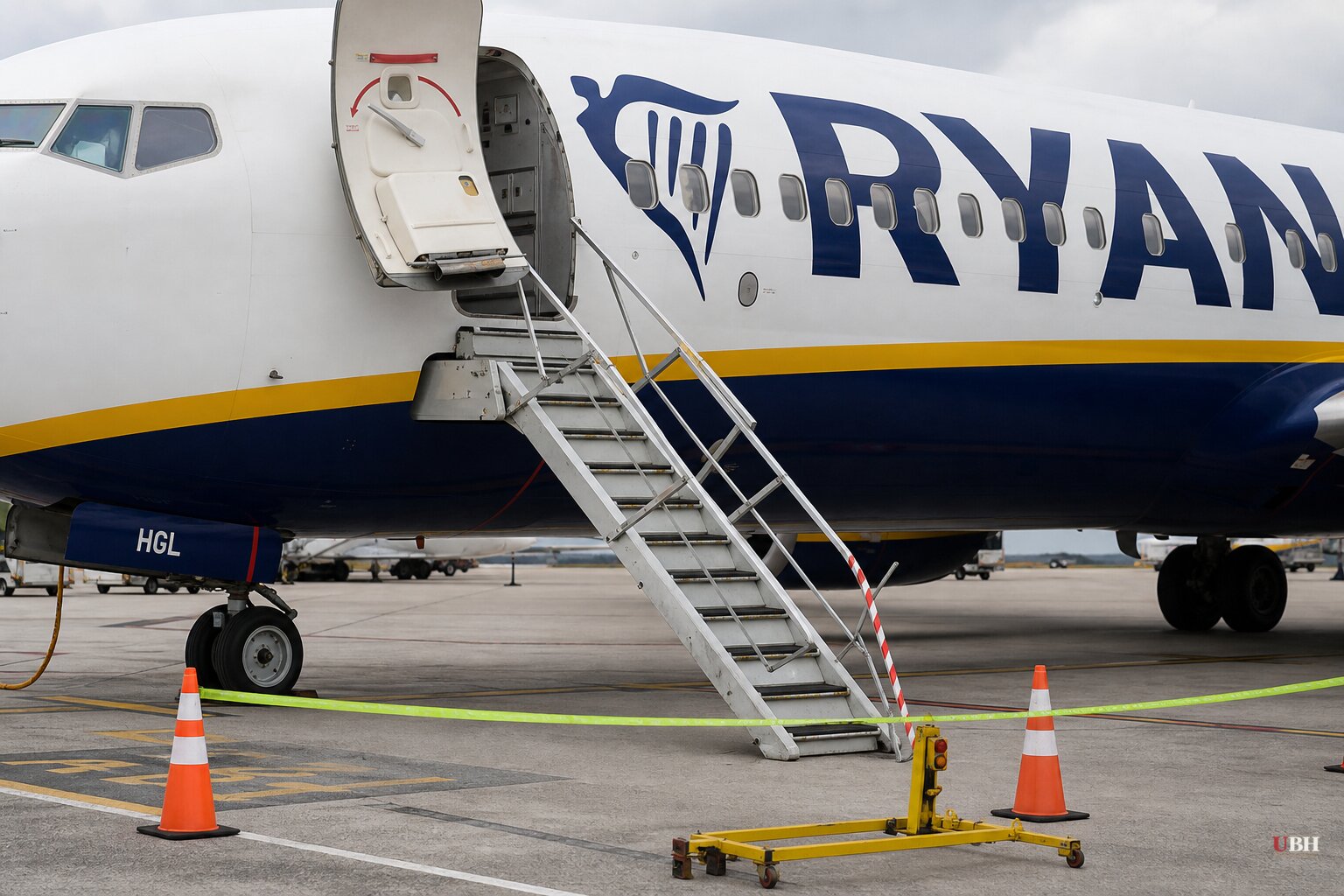
Italian Safety Study: Ryanair's Boeing 737 Airstairs Tied to 82% of Passenger Falls
The numbers
Italy's National Agency for Flight Safety (ANSV) published a study on August 31, 2026, examining passenger falls during boarding and disembarkation at Italian airports from 2023 through 2025. Of 104 reported falls, 85 — 82% — involved Ryanair's Boeing 737 aircraft using their retractable, built-in front stairs, according to ANSV, as reported by Euronews.
Ryanair carried roughly 26-27% of all passenger traffic in Italy during that period, per ANSV's data. Every other airline combined, carrying the remaining 73% of passengers, recorded just 19 falls.
The problem isn't limited to Italy. Since 2021, Ryanair has logged 489 falls on stairs across its network, with 360 of them — 73% — happening on the 737's integrated stairway, according to Euronews and Aviation Week. ANSV found the fall rate on those stairs runs about three times higher than falls on stairs supplied by airport ground crews.
ANSV pulled its data from ECCAIRS, the EU-wide incident database run by the European Union Aviation Safety Agency (EASA), which aggregates safety reports from member states. The Italian study builds on an earlier ANSV report from April 2026, according to Aviation Week.
Why the stairs are different
Boeing sells the retractable airstairs as an option on the 737NG and 737 MAX. Ryanair is one of the few carriers that actually uses them, deploying the stairs at the front of the aircraft so ground handlers aren't needed for disembarkation. This setup cuts turnaround time and airport fees, which is central to how Ryanair keeps fares low.
The trade-off, according to ANSV, is a stairway that's narrower and steeper than what passengers get from airport-supplied equipment. The built-in stairs have 12 steps, run about 61 to 62 centimeters wide, rise 20 centimeters per step, have a 25-centimeter tread depth, and sit at a 35-degree incline. The industry standard for airport stairs, EN 12312-1:2024, calls for a minimum width of 100 centimeters — nearly double what Ryanair's 737s offer.
ANSV also flagged the first step as an outlier: it's roughly 19 centimeters high and trapezoidal in shape, asymmetrical because of how it follows the curve of the fuselage. Investigators said the overall dimensions "are at the limits for step height and steepness" compared to airport stairs, which typically have lower steps, gentler slopes, and wider platforms.
Regulators have been here before
This isn't a new concern. After a 2021 incident, Ireland's Air Accident Investigation Unit (AAIU) recommended in 2023 that EASA launch a safety campaign teaching passengers and crew how to reduce fall risk on the stairs.
After a 2024 accident, Spain's civil aviation safety investigation authority (CIAIAC) went further in 2025, urging Ryanair to stop using the integrated stairs altogether and rely only on certified airport equipment. CIAIAC also recommended Boeing and Ryanair redesign the stairs with a shallower slope, a lower riser height, and a deeper tread, and asked EASA to review whether the current design should keep flying.
The Irish AAIU has also pointed to a regulatory gap: there's no EASA CS-25 certification standard specifically governing integrated aircraft stairs, because regulators don't classify them as critical to flight operations. That means the equipment carrying passengers up and down 35-degree stairs sits outside the same certification rigor applied to the rest of the aircraft.
Retractable stairs give Ryanair independence from airport ground crews, faster turnarounds, and lower operating costs. Savings get passed to passengers through cheaper fares. Millions of people use these stairs without incident every year, and falls during boarding and deplaning happen on all kinds of stairs, not just Ryanair's.
A separate incident, same aircraft type
Ryanair's Boeing 737s drew attention for a different reason this summer. On July 10, 2026, a Ryanair-operated 737 flying from Thessaloniki, Greece, to Memmingen, Germany, suffered a fan blade separation in its No. 2 engine, a CFM International CFM56-7B26, roughly 10 minutes after takeoff, according to a preliminary report the National Transportation Safety Board released on August 13, 2026.
Engine fragments struck the fuselage and the right horizontal stabilizer, shattering a window at seat 11F. Passenger Ljubisa Karović, 61, was partially pulled through the broken window before his wife and nearby passengers grabbed him and pulled him back inside, the NTSB report and Karović's own account, relayed by Daily Wire, show. The pilots had received a high-vibration warning two minutes before the bang and briefly lost autopilot function. Bird remains were found in the engine, though the NTSB said it's unclear whether a bird strike caused the blade separation or was unrelated debris. The crew diverted back to Thessaloniki for an emergency landing with 149 passengers, two pilots and four flight attendants aboard.
The incident echoes a 2018 Southwest Airlines fan-blade failure that killed passenger Jennifer Riordan under similar circumstances. One is a mechanical failure investigation, the other a boarding-equipment design review. Both have put the airline's 737 fleet under scrutiny in the same news cycle. Ground News tracked 599 separate stories about Ryanair published in the three months before September 2026, with coverage split 31% left-leaning, 49% center, and 20% right-leaning outlets.
Neither Ryanair nor Boeing has issued a public response addressed in these reports. EASA has not said whether it will act on the Spanish and Irish recommendations to redesign or restrict the integrated stairs. Whether the agency moves before another serious fall gets logged into ECCAIRS remains an open question.
Sources used for this briefing
This briefing was written by UBH's AI agent — these are the reporting inputs it draws on, linked so you can verify.


