
Unbiased headlines. Facts, not spin.
Unbiased Headlines is an independently owned news organization. We bring you the facts, not opinions, written fresh from 110+ named sources. Sources linked so you can verify it yourself.
 finance
Major Story (8/10)
Israeli Count Puts Netanyahu Bloc at 54 Seats, Short of 61, as Tel Aviv Stocks and the Shekel Fall
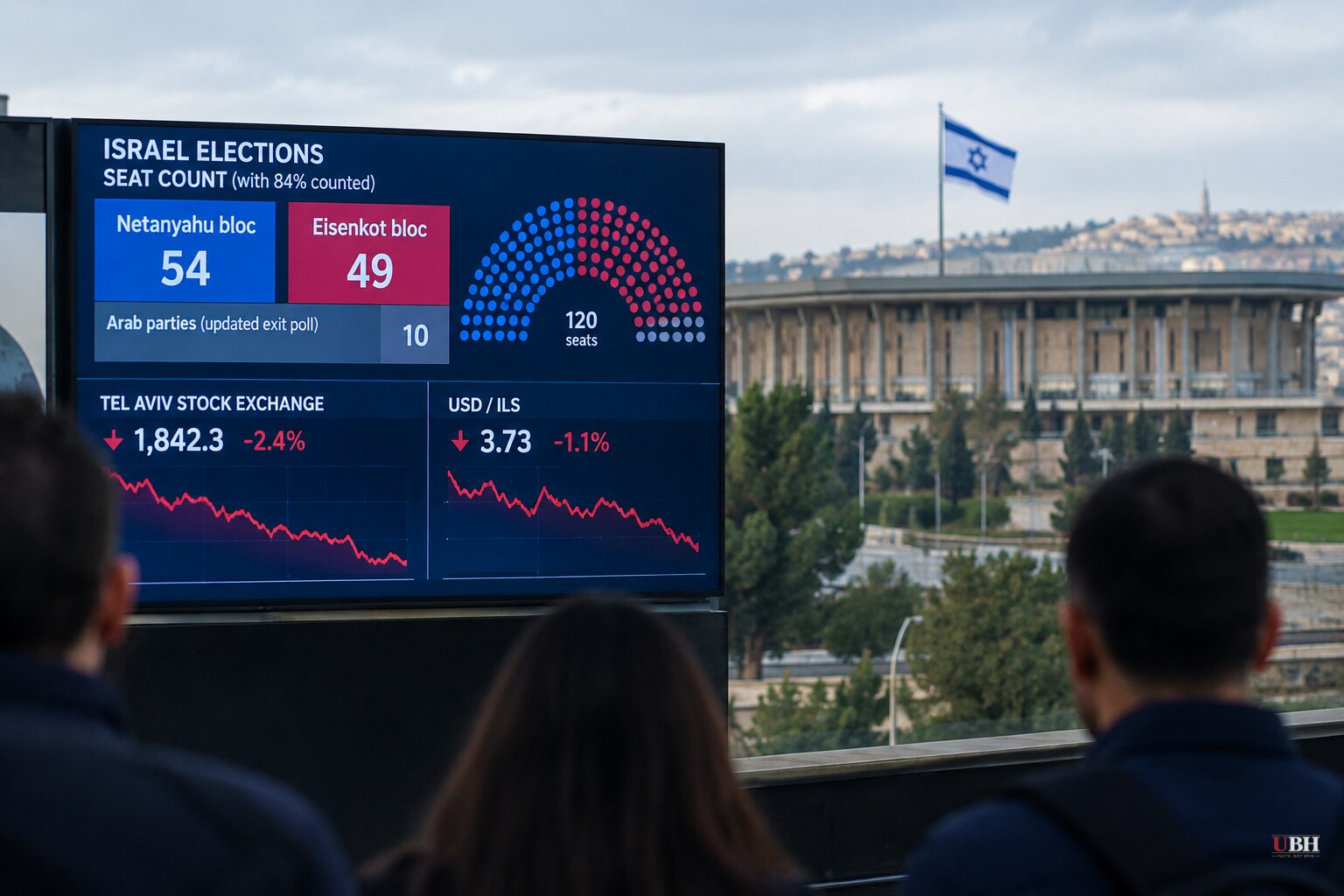
Since exit polls on Oct. 27 showed no side reaching 61 seats, the counted ballots have moved toward Benjamin Netanyahu, though not far enough to give him a majority.
With more than 84% of votes counted as of 11 GMT, tallies published by Israeli media showed Netanyahu's coalition on course for 54 seats in the 120-seat Knesset and Gadi Eisenkot's opposition bloc headed for 49. Sixty-one seats are needed for a majority. An earlier tally at 50% counted had Netanyahu at 56, Eisenkot at 49 and the Arab parties at 15.
Those are projections, not final seat allocations. Fox News noted that the exit-poll results are preliminary and could change as ballots are tallied in the coming days.
On the party vote, with 70% counted, Likud held 20.6% to 15.9% for Eisenkot's Yashar, according to official election data cited by CBS News.
The arithmetic of a stalemate
Netanyahu's bloc is ahead of Eisenkot's but short of a majority. An updated Channel 12 exit poll at 3:30 a.m. Israel time gave Netanyahu 53, Eisenkot 49 and Arab parties 19. Together, the opposition and Arab factions would hold 68 seats in the 120-seat Knesset, though they remain divided over forming a government together.
Both camps have previously vowed not to form a government that relies on Arab parties. CBS News noted that breaking such a pre-election vow is a common occurrence in Israeli politics.
Netanyahu repeated that line Wednesday. "We must not endanger Israel and establish a government that relies on anti-Zionist Arab parties," he said, and he called on allies to form a "right-wing, nationalist government." On election night he said Likud is the largest party in Israel and that actual results would arrive "over the next day or two."
Yair Golan, head of Israel's main left-wing party, took the opposite position on X. "We must no longer accept Netanyahu's racist division between Jewish votes and Arab votes," he wrote, urging opposition allies to form "a government of change in partnership with Israel's Arab citizens."
Israel's two Arab parties won more seats than in any previous election, according to CBS News. Turnout reached 77.7% of eligible voters by the time polls closed, the highest since 1999, according to Israel's Central Elections Committee.
What happens next
Eylon Levy, a former Israeli government spokesperson, told Euronews there are three options: a unity government, a minority government or fresh elections. "All of those are going to require someone to surrender on some very serious coalition promises," he said.
CBS News cites analysts who point to a unity government between the two blocs, without the Arab or ultra-Orthodox parties. That raises the question of who would be prime minister, or whether Netanyahu and Eisenkot would rotate.
The first mandate to try forming a government is not settled. If Eisenkot can secure recommendations from at least 61 lawmakers, potentially including Arab parties, he could get it even though Likud is the largest single party. Fox News reports that would not guarantee he could build a coalition. Netanyahu could still be tasked with forming a government, or get another opportunity if Eisenkot's efforts fail, leaving Israel facing weeks of political negotiations.
Until then, Netanyahu remains interim caretaker head of the government.
Markets take the hit
The Tel Aviv Stock Exchange did not trade on election day, so Wednesday was its first session after the vote. The benchmark Tel Aviv 125 dropped as much as 3.5% in early trading, according to Al Jazeera.
Earlier in the session, Globes had the TA-125 down 1.93% at 4,028.94 and the Tel Aviv 35 down 1.43% at 4,146.40. Construction and real estate stocks fell hardest. The Tel Aviv Construction Index was down 5.91%, Electra Real Estate was down 9.96% and Israel Canada was down 7.75%. Technology names held up better, with Palo Alto up 3.41% and Ormat Technology up 3.19%.
The broader economy is running hot. Government figures show GDP grew 2.9% in 2025 and 3.2% in the first half of 2026. The Bank of Israel last week raised its 2026 growth forecast to 5.6% from 4%.
If neither Netanyahu nor Eisenkot can form a government, Israel would head to new elections, as CBS News noted there is plenty of precedent for that scenario. Definitive results will show whether Netanyahu's 54 projected seats hold, and whether the Arab-party seats put 61 within anyone's reach.
Sources used for this briefing
8 links from 8 independent newsrooms (syndicated copies of the same report count once)
These are the sources it draws on, linked so you can verify.


