
Original briefings. Zero spin.
Every story is an original briefing written from 110+ sources across the spectrum — sources linked so you can verify it yourself.
 health
Notable (6/10)
Event date: September 10, 2026
health
Notable (6/10)
Event date: September 10, 2026
India's Supreme Court Pushes FSSAI Toward One-Step Food Warning Labels, Sets September 28 Deadline
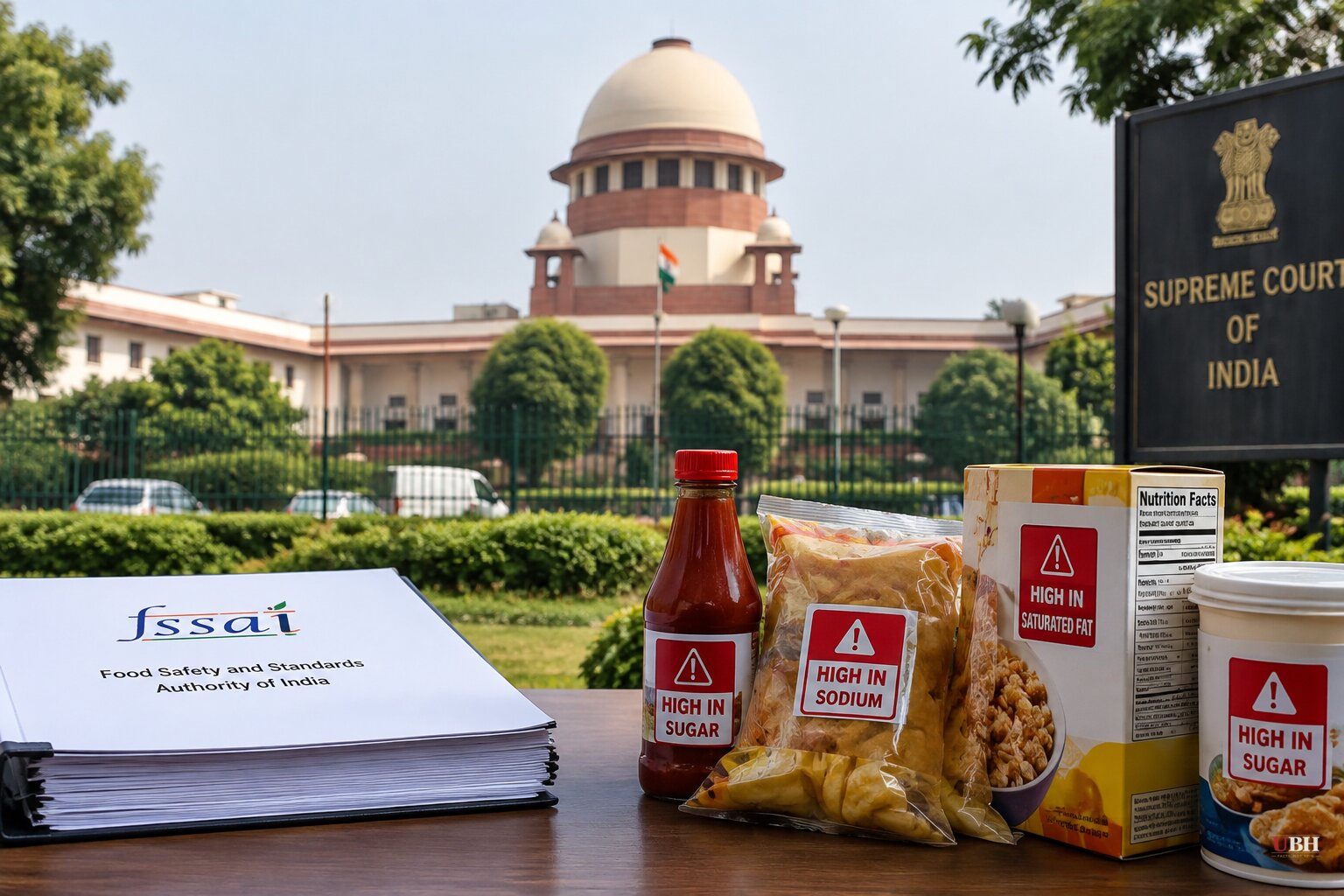
India's Food Safety and Standards Authority told the country's Supreme Court on Thursday, September 10, that it's open to imposing stricter red warning labels on packaged food right out of the gate, instead of phasing them in over time as originally planned, according to Reuters.
The about-face came during a Supreme Court hearing where Justice J.B. Pardiwala pressed a government lawyer on why the FSSAI wanted to delay the toughest rules. "It has to be sugar and salt. Only then will you ask them to put a label?" Pardiwala asked, according to Reuters, stressing the word "and" to highlight the flaw in the original plan.
Additional Solicitor General Brijender Chahar, representing the FSSAI, told the court the regulator would now consider rolling out both phases "in one go," Reuters reported. Under the FSSAI's original August proposal, a product would only get a red hexagonal warning label if it exceeded limits in at least two of three categories: added sugar, salt, or saturated fat. Products high in just one nutrient would have skated by until a vague second phase kicked in later.
Why the two-nutrient rule drew fire
Health researchers said that threshold gutted the whole point of the label. Barry Popkin, a nutrition professor at the University of North Carolina's Gillings School of Global Public Health, told The Hindu Business Line the two-nutrient approach "will be meaningless" and that "no other country uses the double nutrient approach."
More than 60 nutrition and public health scholars from 17 countries, including researchers affiliated with Harvard, Johns Hopkins, and Oxford, filed written comments with the FSSAI backing India's move toward warning labels while urging the regulator to drop the two-nutrient requirement entirely, according to The Times of India. Dr. Arun Gupta, founder of the Breastfeeding Promotion Network of India, said the scholars' position directly counters the All India Food Processors Association, which opposes warning labels altogether and wants per-serving nutritional disclosures instead.
The Hindu Business Line cited an example: a Kellogg's multigrain Chocos box sold in India lists 27 percent added sugar by weight but falls within limits on fat and salt, meaning it would have escaped a warning label entirely under the original two-nutrient rule.
The industry's case, and its limits
The All India Food Processors' Association, which represents dozens of Indian and multinational food companies, argues the stricter one-nutrient standard would slap warnings on a sweeping range of everyday staples, including traditional Indian foods, and "tarnish the image of Indian food globally," according to Reuters. The association has called for a review of the labeling plan and favors clearer per-serving labeling over blanket front-of-pack warnings. That's a real concern for a food culture built around items like ghee, jaggery, and sweets that carry naturally high fat or sugar content, and the current proposal already exempts honey and jaggery, according to a draft submission from petitioner 3S and Our Health Society cited by The Hindu Business Line.
The debate occurs alongside concrete evidence about label effectiveness. Reuters reported last month that India's government had already opted for the weaker two-nutrient regime after lobbying from Coca-Cola and groups backing Nestle and PepsiCo, who argued warning labels don't change behavior. Chile's experience undercuts that argument: a 2016 law requiring separate black octagon warnings for each excessive nutrient was followed by a 23.7 percent drop in sugary drink purchases within 18 months, according to a study in the journal PLOS Medicine cited by The Hindu Business Line.
The scale of India's obesity problem is also driving the urgency. Prime Minister Narendra Modi's government has flagged that retail sales of ultra-processed food jumped 40-fold between 2006 and 2019, reaching $38 billion, and a study in The Lancet projected India's overweight and obese adult population could rise from 180 million in 2021 to 450 million by 2050.
What the court ordered
A bench of Justices Pardiwala and K. Vinod Chandran warned in its written order issued Thursday night that FSSAI's vague two-phase plan risked leaving the second, stricter phase "indefinitely postponed," according to The Hindu. The court told the regulator to instead consider tackling products with the highest nutrient levels first, then phasing in progressively lower thresholds, rather than splitting the rollout by number of flagged nutrients.
The bench also directed the central government to consider adding nutritional literacy to school curricula so children can learn to read the new labels themselves, and it asked FSSAI to clarify exactly which sweetened beverages would be covered and under what thresholds, The Hindu reported.
All parties, including FSSAI and the food industry, must submit their responses to the court's proposed alternative model by September 28, 2026, when the case returns for its next hearing, according to NDTV. Until then, the two-nutrient loophole that drew objections from Harvard- and Oxford-affiliated researchers remains on the table, not off it.
Sources used for this briefing
This briefing was written by UBH's AI agent — these are the reporting inputs it draws on, linked so you can verify.


