
Unbiased headlines. Facts, not spin.
Unbiased Headlines is an independently owned news organization. We bring you the facts, not opinions, written fresh from 110+ named sources. Sources linked so you can verify it yourself.
 health
Low Interest (4/10)
Event date: October 30, 2026 ·
India Has Run Public Cancer Screening Since 2016, Yet Many Patients Are Still Diagnosed Late
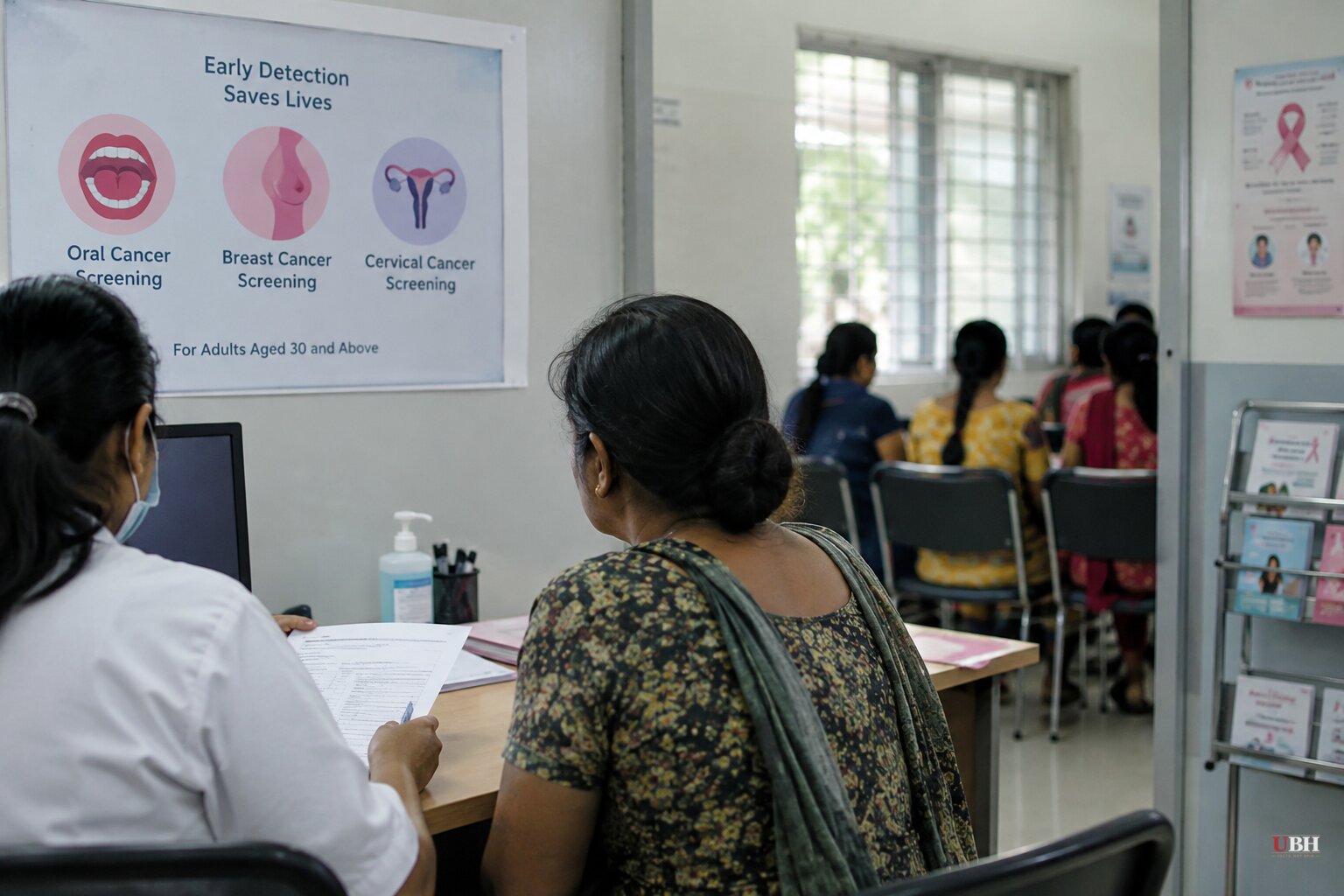
India has a national cancer screening program. Patients are still arriving at hospitals with advanced disease.
The Indian Council of Medical Research's National Cancer Registry Programme estimated 13.92 lakh (about 1.39 million) new cancer cases in India in 2020, up from 13.25 lakh in 2018. It estimated about 7.7 lakh cancer deaths in 2020. The Union Health Ministry placed those figures before the Lok Sabha.
Stage at diagnosis largely decides how treatable the disease is. Late detection means harder treatment and lower survival odds.
What the public program covers
The program began in 2010 as the National Programme for Prevention and Control of Cancer, Diabetes, Cardiovascular Diseases and Stroke, in 100 districts across 21 states. It is now called the National Programme for Prevention and Control of Non-Communicable Diseases (NP-NCD).
In 2016, population-based screening was added for everyone aged 30 and above. It covers hypertension, diabetes and three cancers: oral cavity, cervix and breast.
The design pushes screening into the community. Under Health Ministry guidelines, an ASHA worker first completes a Community Based Assessment Checklist.
People aged 30 to 65 are then offered an oral visual examination. Women also get a clinical breast examination and a visual inspection of the cervix with acetic acid. Each test is meant to be repeated once every five years.
The ministry's training module for staff nurses puts numbers on the target. In a population of 1,000, about 370 people are eligible for oral cancer screening. About 182 women are eligible for each of the breast and cervical tests. The cervical test is offered at the primary health centre level to begin with.
On paper, that is a reasonable system. A trained community worker flags the person, and a nurse does a low-cost visual or manual exam close to home.
A clinician's view: the tools exist, the action doesn't
Dr Madhavi Nair, an oncologist who writes the Onco Matters column in The Week, argues the failure is not technological. "The problem is not the absence of technology. It is the absence of action," she wrote on October 21.
Nair says she meets a woman almost every week in her clinic who noticed a lump months earlier and assumed it would go away. Such women are often educated, financially secure and aware that breast cancer exists. They arrive when the tumour has doubled in size or reached the lymph nodes.
Breast cancer is the commonest cancer among women in India, Nair writes. It is also one of the easiest to catch, because a painless lump, skin dimpling, nipple discharge or a change in breast shape can show up months before the disease advances.
Caught early, she says, treatment is simpler. Breast-conserving surgery is often possible, chemotherapy may be avoided in selected patients, and survival exceeds 90 per cent in many cases.
Nair names two main reasons for the delay. The first is cultural silence: many women are uncomfortable discussing breast symptoms even with close family. Lumps get brushed off as "a hormonal change." The fear of cancer, she writes, often delays the first hospital visit far more than the disease itself.
The second is misplaced priorities. A mother postpones her appointment until her daughter's exams are over. A grandmother waits until after a family wedding.
Nair also points to the better-resourced south. Tamil Nadu and Kerala have higher screening rates and greater awareness than the national average. Participation in breast screening there "remains disappointingly low," she writes, and late-stage presentation is still common.
Where the system and the habit meet
The two accounts point at different failures. One looks at how screening is organised. The other looks at what people do when they notice something wrong.
The program's design shows why both matter. It is built around offering a test, once every five years, to people the checklist identifies as eligible. That puts the burden on the person to show up and on a health worker to reach them. A woman who finds a lump between rounds, and waits, is outside the schedule altogether.
The numbers also show how much the program has to cover. By the ministry's training-module estimate, nearly 4 in 10 people in any given population are eligible for oral cancer screening alone. Every one of them needs a checklist, an exam and a follow-up visit within each five-year window.
The ministry's Lok Sabha figures count cases and deaths, and the most recent year they cover is 2020. The open question is how many of those 13.92 lakh cases could have been caught sooner, and how many of the eligible people in each district have actually been screened.
Sources used for this briefing
3 links from 3 independent newsrooms (syndicated copies of the same report count once)
These are the sources it draws on, linked so you can verify.


