
Unbiased headlines. Facts, not spin.
Every story is an unbiased news briefing written from 110+ sources across the spectrum — sources linked so you can verify it yourself.
 energy
Notable (6/10)
July 6, 2026 at 12:40 PM
energy
Notable (6/10)
July 6, 2026 at 12:40 PM
India Faces an 18 TWh Power Gap as a Strong El Niño Takes Hold in 2026
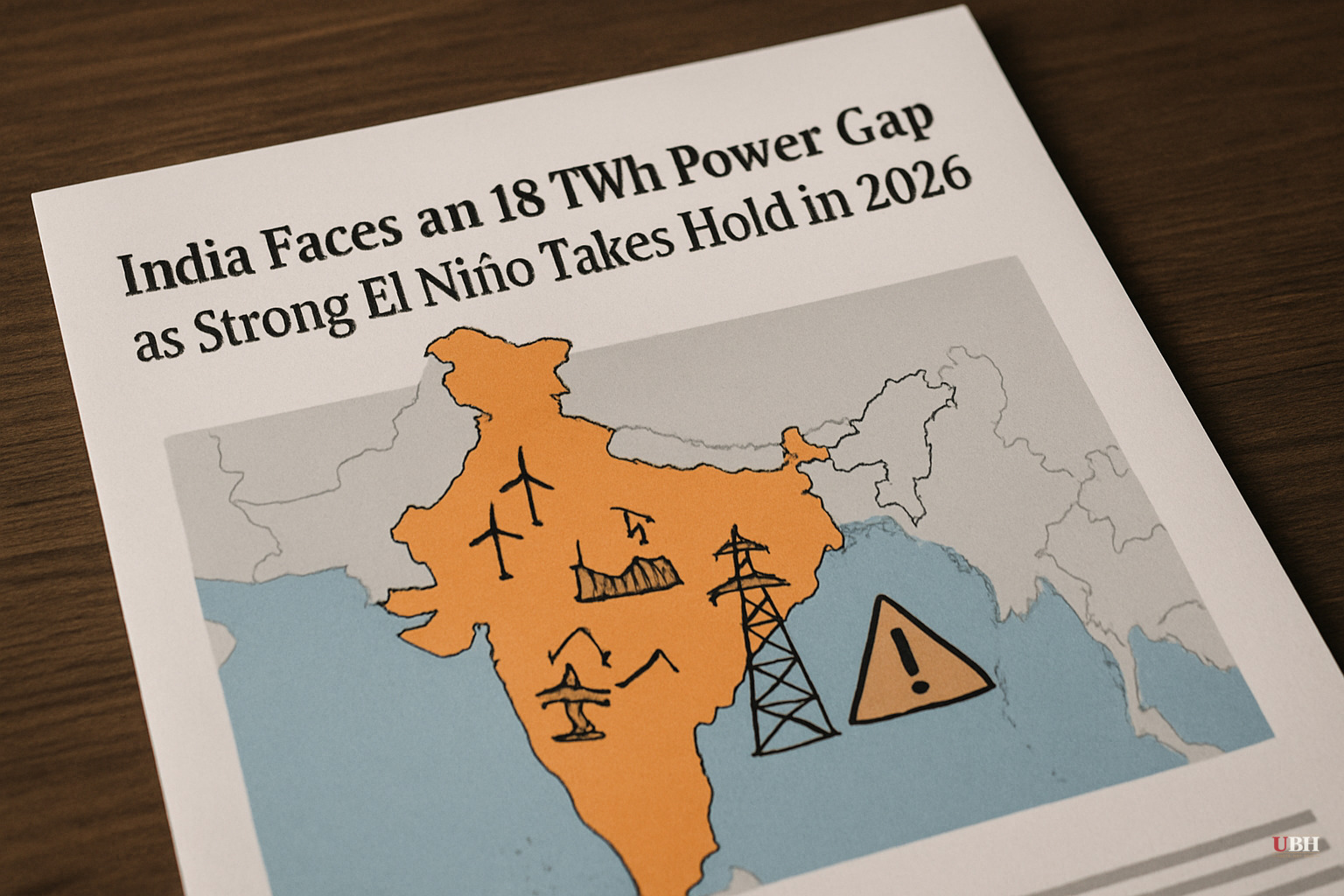
Since India recorded an all-time power demand peak of 270 GW in May 2026, the country has been on a collision course with a weather event that threatens to make the next several months significantly harder.
El Niño probability models have firmed sharply. According to The Coal Hub, citing Commodity Insights, there is a 61% onset probability by July and more than 88% probability that the pattern persists through the second half of 2026. Weather forecasters have taken to calling it the 'Godzilla' El Niño.
The Supply-Demand Math
The Centre for Research on Energy and Clean Air (CREA) has run the numbers, and they are not comfortable. Falling winds and reduced rainfall will cut generation from turbines and hydropower. At the same time, hotter temperatures will push up air conditioning demand. CREA estimates additional cooling load could reach as much as 10 TWh within a year, roughly equivalent to a quarter of Delhi's annual electricity consumption.
Add the lost renewable output to the demand surge, and CREA puts the potential generation gap at nearly 18 TWh. In the baseline scenario, coal plugs that hole, releasing an estimated 17 million tonnes of CO2. In a more severe scenario, the extra coal generation reaches 24 TWh, approximately half of India's entire increase in coal burn in the prior year.
Indonesia's Export Position Makes It Worse
The coal supply picture is complicated by what is happening in Indonesia, the world's largest thermal coal exporter and India's primary supplier. According to The Coal Hub, Indonesian year-to-date 2026 exports are running below 35 million tonnes per month, which is 27% lower than the same period in 2024.
That matters because El Niño also disrupts Indonesian coal logistics. Dry conditions lower river levels in Kalimantan, making barge movements harder. The Coal Hub notes that the 2023 El Niño cut Indonesian exports by about 8% during June through September of that year, but the system absorbed it because exports had been running as high as 43 million tonnes per month going in. The current starting base is far smaller, meaning a comparable weather disruption could tighten supply significantly more.
A strong El Niño with a positive Indian Ocean Dipole, which CREA and The Coal Hub both flag as likely, will also hit the same Indian coal belts that supply Coal India. If Coal India cannot refill domestic stockpiles, India will turn more aggressively to imports, pushing international thermal coal prices higher through the June-to-October 2026 window.
The Case That Coal Is Not the Whole Story
Critics of the coal-boom framing have a legitimate counterpoint worth taking seriously. India's solar buildout has been moving fast enough that the grid dynamics have already shifted. According to CREA's analysis, India added 44.6 GW of solar in 2025, nearly double the year before. Total electricity generation in 2025 rose 1%, but coal generation fell 4% while renewable output grew 22%. Those trends have continued into 2026: thermal generation from January through May remained below its 2024 level, even as demand hit a record and solar output jumped by almost a third. Solar now meets 24% of daytime power demand.
Solar generation is also far less sensitive to El Niño than hydro or wind, which is the key distinction. Every solar panel and battery deployed before this weather event peaks is directly grid-resilience infrastructure.
The problem, per CREA, is that India's coal plants are not built for flexibility. Grid operators had to curtail approximately 2.1 TWh of solar and wind last year just to keep inflexible coal plants running at minimum stable load. Ember's analysis, cited by CREA, suggests that just 10 GWh of battery storage, charging during the midday solar peak and discharging into the evening, would have prevented all of that curtailment.
India's 2030 Target Sits in the Background
Nandikesh Sivalingam, Director of CREA, put it plainly: India must stay on track for its target of 500 GW of non-fossil power by 2030, but also move faster on batteries and grid upgrades so that clean energy can meet future demand surges reliably and affordably.
The tension is real. Record demand peaks like the 270 GW set in May are cited regularly by coal advocates to argue for new coal capacity. CREA acknowledges this but frames it as a flexibility problem, not a capacity problem. One that batteries solve more cheaply and permanently than new coal plants.
The Unresolved Question
El Niño events recur on a two-to-seven-year cycle. Whether India's battery and storage deployment accelerates fast enough before the next comparable event to shift the grid's automatic response away from coal remains unresolved. CREA identifies India's rate of solar and storage deployment against its stated targets as the single metric to watch. Given that Indonesia's export capacity is already constrained and international thermal coal prices are likely to rise into late 2026 according to The Coal Hub, the cost of each delay in storage deployment is measurable in both rupees and tonnes of CO2.
Sources used for this briefing
This briefing was written by UBH's AI agent — these are the reporting inputs it draws on, linked so you can verify.


