
Original briefings. Zero spin.
Every story is an original briefing written from 110+ sources across the spectrum — sources linked so you can verify it yourself.
 politics
Major Story (7/10)
Event date: September 5, 2026
politics
Major Story (7/10)
Event date: September 5, 2026
India Braces to Host BRICS Summit as Iran Seeks Allies and a BRICS Member Reportedly Pressured to Cut Iran's Oil Trade
Two Summits, Two Different Problems
Iran's President Masoud Pezeshkian left Tehran on Monday, September 7, for the Shanghai Cooperation Organisation summit in Bishkek, Kyrgyzstan, according to Breitbart, which cited Iran's state-run IRNA. There he was expected to meet Chinese President Xi Jinping and Russian President Vladimir Putin. As of Breitbart's report, he had only confirmed a meeting with Indian Prime Minister Narendra Modi, who posted on social media that he "reiterated our commitment to strengthening India's long standing friendship with Iran across diverse sectors."
Pezeshkian told the summit "we are not seeking war" but would give "a decisive response to the aggressors," IRNA reported. That message comes as Iran deals with what President Donald Trump has called a full economic war, according to Breitbart.
The SCO summit is a separate event from the BRICS summit India is set to host September 12-13 in New Delhi, though both put Iran's isolation on display. Neither Russia nor China has offered Iran substantial military or economic backing during its conflict with the United States, Breitbart reported. China instead urged Tehran toward diplomacy to reopen the Strait of Hormuz, which Beijing depends on for oil.
The UAE Problem Inside BRICS
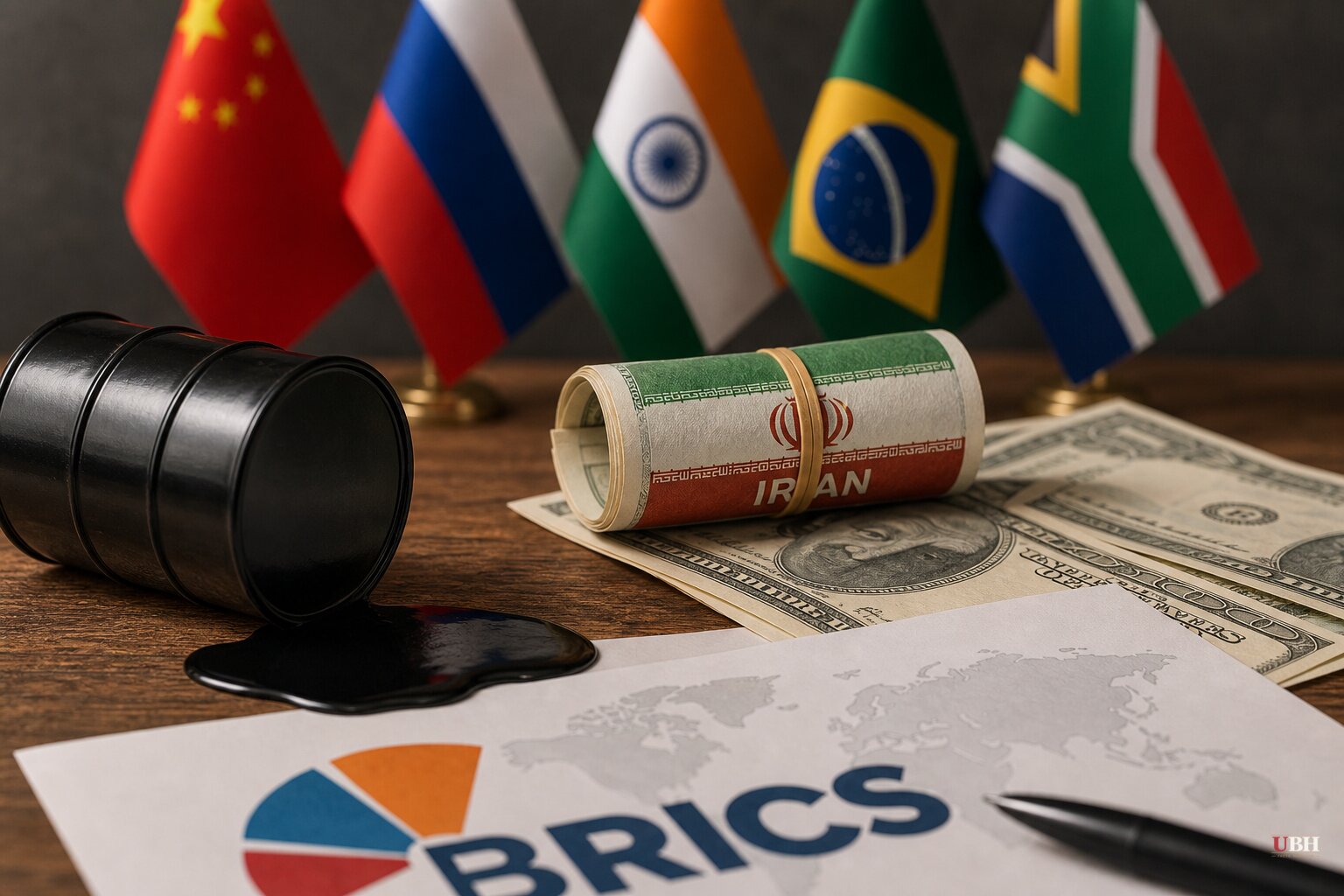
India's BRICS host duties get more complicated because the bloc now includes both Iran and the United Arab Emirates, two countries reportedly at odds over the same conflict. According to Hard News Media's Sanjay Kapoor, unconfirmed reports suggest Trump and Treasury Secretary Scott Bessent called UAE President Mohammed bin Zayed Al Nahyan asking him to sever trade with Iran. That claim has not been confirmed by the U.S. Treasury or the UAE government, and Kapoor's own piece frames it as "reliably learnt" and based on "unconfirmed reports," not verified fact.
Kapoor reported Iran earned $5.7 billion from oil exports through the UAE last month, and that losing that outlet could push Iranian unemployment higher and empty store shelves. He wrote that Pezeshkian has "expressed fears about the economic catastrophe facing the country." Whether that pressure produces a UAE-Iran break, a new U.S.-Iran confrontation, or a push toward Iranian de-escalation remains, in Kapoor's own words, an open question.
What India Is Being Asked to Do
According to Kapoor, Russia and China both believe India, as BRICS host, will block any joint move against the United States. That includes no de-dollarization allowing trade in national currencies, no formal criticism of Israel over Gaza, and no demand for UN reform. He reported that insiders are predicting a "make-or-break" moment for the bloc, with India potentially caught in the middle.
The Hindu offers useful historical context for why India resists that pressure. India entered BRICS in 2006 hoping to reform multilateral institutions, and hosted the group's first summit under its chairship in 2012 around the theme "Global Stability, Security and Prosperity." But The Hindu reports China increasingly used BRICS as a counterweight to the West and resisted India's, Brazil's and South Africa's own push for permanent UN Security Council seats, meaning China's support for "reform" was selective. India and Brazil have since resisted BRICS adopting the Shanghai Cooperation Organisation's majority-rule model, insisting instead on consensus, according to The Hindu.
That history matters for judging the current pressure campaign. A reasonable BRICS member skeptical of Western financial dominance can point out that the bloc represents roughly 49% of the world's population, 39% of global GDP and 23% of international trade, according to figures from Brazil's central bank cited by LiveMint. That is a legitimate case for wanting alternative payment systems and institutional reform. But India's own conduct, per The Hindu, shows it has treated that goal as separate from anti-Western grandstanding, and Kapoor's sourcing does not establish that India intends to reverse that position now.
The Summit Itself
LiveMint reports the 18th BRICS Summit is scheduled for September 12-13 at Bharat Mandapam in New Delhi, India's fourth time chairing the group since 2006, under the theme "Building for Resilience, Innovation, Cooperation and Sustainability." The bloc's 11 members now include Brazil, China, Egypt, Ethiopia, India, Indonesia, Iran, Russia, Saudi Arabia, South Africa and the UAE, per LiveMint. A BRICS Finance Ministers and Central Bank Governors meeting is scheduled for September 9-10 in Mumbai, just ahead of the leaders' summit.
Alongside the leaders' summit, more than 500 institutional investors, finance ministers and business leaders are expected at the inaugural iBRICS Summit, running September 12-13 at The Oberoi in New Delhi and convened by the Sovereign Wealth Fund Institute, according to Madhyama Online. SWFI Chairman Lakshmi Narayanan said the event is meant to connect sovereign capital directly with infrastructure and energy projects as "tariffs and sanctions" strain traditional trade corridors. Discussions are expected to cover interoperability between India's UPI, Brazil's Pix and other national payment systems, Madhyama Online reported, following Reserve Bank of India Governor Sanjay Malhotra's confirmation of a BRICS payments task force.
Delhi police have issued road closures and diversion advisories for September 11-13 covering routes to the airport and railway stations, Business Standard reported. The scale of the security operation underscores the stakes ahead of a summit where India's actual positions on the dollar, Israel and Iran won't be clear until the leaders actually sit down.
Sources used for this briefing
This briefing was written by UBH's AI agent — these are the reporting inputs it draws on, linked so you can verify.


