
Unbiased headlines. Facts, not spin.
Every story is an unbiased news briefing written from 110+ sources across the spectrum — sources linked so you can verify it yourself.
 politics
Major Story (8/10)
August 13, 2026 at 09:18 AM
politics
Major Story (8/10)
August 13, 2026 at 09:18 AM
Independent Report Puts ICE Death Rate Nearly Quadruple Biden-Era Levels, DHS Disputes the Math
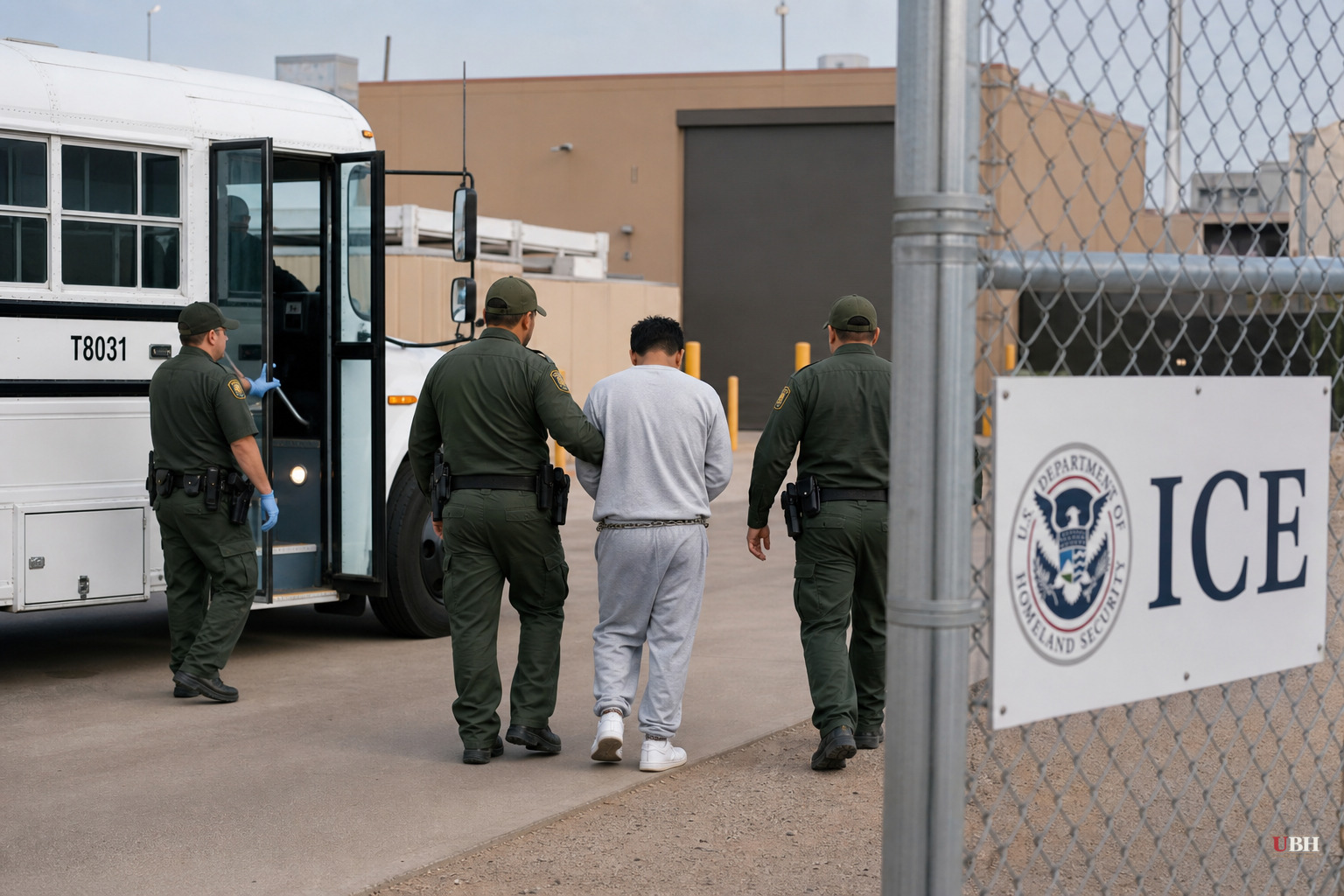
Since Edwin Lopez-Cornejo died at University Hospital in Newark on Aug. 1, becoming at least the third detainee death tied to New Jersey's Delaney Hall facility disclosed this month, a new independent tally has put a number on what's been a mounting pattern: 52 deaths in ICE custody in the first 500 days of Trump's second term, according to a joint report from Human Rights Watch and Physicians for Human Rights covering the period through June 4, 2026.
That report found the mortality rate over that stretch had more than doubled since the start of Trump's second term and reached nearly four times the rate recorded under the Biden administration. It was also more than two and a half times higher than during Trump's first term, a period that included the deadliest months of the COVID-19 pandemic, according to the groups.
The researchers say the death toll didn't just track the growing detainee population, it outran it. Between January 2025 and January 2026, the number of people in ICE custody rose 77%, but annual deaths more than tripled, producing a 138% jump in the mortality rate, per the report. Using a statistical smoothing method to cut through month-to-month noise, the researchers calculated the underlying death rate had climbed to 8.4 per 10,000 detainees by June 2026, nearly double the peak level recorded during the first year of the pandemic.
DHS flatly rejects this. A DHS spokesperson told TIME magazine "there has been NO spike in deaths," adding that "consistent with data over the last decade, as of May 29, death rates in custody under the Trump administration are 0.009% of the detained population." The spokesperson said ICE has "maintained a higher standard of care than most prisons that hold U.S. citizens" and that "for many illegal aliens this is the best healthcare they have received their entire lives."
Those two claims are hard to reconcile. A separate analysis published in the medical journal JAMA earlier this year found the fatality rate in ICE custody hit a 22-year high in the opening months of the current fiscal year, rising from 13 deaths per 100,000 person-years in fiscal 2023 to 47.5 per 100,000 in the period studied, according to TIME's reporting on that journal article. Only 3 people died in ICE custody in all of fiscal 2022. Between Oct. 1 and Jan. 19, JAMA counted 18 deaths. TIME reported at least 17 more occurred after that cutoff, through mid-2026.
DHS's 0.009% figure and the JAMA/Human Rights Watch per-100,000 figures aren't necessarily contradictory on their face. They use different denominators and different math. But neither DHS nor ICE has published a detailed methodology rebutting the outside researchers' numbers directly.
Paperwork problems, not just body counts
Physicians for Human Rights reviewed ICE's own public medical documentation for the 39 deaths recorded during the administration's first year and concluded the records themselves are part of the problem. Detainee Death Reports frequently omitted exact vital sign measurements, left unclear whether requested medical visits ever occurred, and failed to specify what treatment, if any, was given before someone died, according to the report.
ICE policy requires initial death notices within 48 hours and full reports within 30 days. Researchers found 64% of notices were posted late, and one report didn't surface until a full year after the death occurred, per the Human Rights Watch/Physicians for Human Rights findings.
The report highlighted specific cases. Maksym Chernyak, a 44-year-old Ukrainian man, suffered what doctors later diagnosed as a hemorrhagic stroke at the Krome North Service Processing Center in Florida. More than four and a half hours passed between the initial emergency call and his arrival at a hospital ER, and staff documented his pupils as nonreactive, a classic sign of brain herniation, without escalating care, the report found. His records showed elevated blood pressure at earlier clinic visits that went untreated.
Santos Banegas Reyes, a 42-year-old Honduran man, died 17 hours after arriving at the Nassau County Correctional Center in New York. He'd been flagged at intake for alcohol withdrawal symptoms and prescribed medication, but wasn't checked on again until he was found unresponsive the next morning, his attorney said.
Families are still waiting for basic answers in some of these cases. Parady La, a 46-year-old Cambodian American man and longtime Philadelphia resident, died three days after his arrest, in ICE custody at the Federal Detention Center in Philadelphia. ICE's own report says he was "found distressed and stuporous with ongoing vomiting and abnormal vital signs," then later "unresponsive and pulseless." More than seven months later, according to TIME, his daughter Jazmine La says the family still doesn't know what happened in his final hours or why help didn't come sooner. "There's obviously a lot missing, a lot we don't know, and the uncertainty of it all is really hard," she told TIME. "It makes it hard to move on or grieve properly."
What's proven, what isn't
The raw death counts and the lateness of ICE's own reporting are documented facts, drawn from ICE's own disclosures and cross-checked by outside researchers. What's contested is the rate comparison and whether DHS's 0.009% figure is measuring the same thing as the outside groups' per-10,000 or per-100,000 calculations. Neither DHS nor ICE has released a line-by-line methodology showing its math. Both Human Rights Watch and Physicians for Human Rights are advocacy organizations that have long pushed for reduced immigration detention.
Separately, in Chicago, ICE agent Adam Saracco pleaded guilty Wednesday to misdemeanor battery for throwing protester Robert Held to the ground at a gas station during Operation Midway Blitz, according to the Chicago Tribune. Saracco was sentenced to one year of supervision and is believed to be the only ICE agent charged in Cook County over conduct toward protesters during the operation. Cook County State's Attorney Eileen O'Neill Burke has said her office can only pursue charges for off-duty conduct or cases referred by police, limiting how many similar complaints can move forward.
None of this resolves the underlying dispute over the true death rate. Congress has received notifications on each individual death under ICE policy, but no independent, government-conducted audit of the disputed mortality statistics has been announced. Until DHS publishes its full methodology or an outside federal body reviews it, the gap between "no spike" and "nearly quadrupled" remains unresolved, and the reports that document it continue to arrive late.
Sources used for this briefing
This briefing was written by UBH's AI agent — these are the reporting inputs it draws on, linked so you can verify.


