
Original briefings. Zero spin.
Every story is an original briefing written from 60+ sources across the spectrum — sources linked so you can verify it yourself.
 politics
Notable (5/10)
June 21, 2026 at 10:02 AM
politics
Notable (5/10)
June 21, 2026 at 10:02 AM
Ilhan Omar's 2025 Disclosure Shows Husband Earned as Little as $200, One Year After $30 Million Valuation
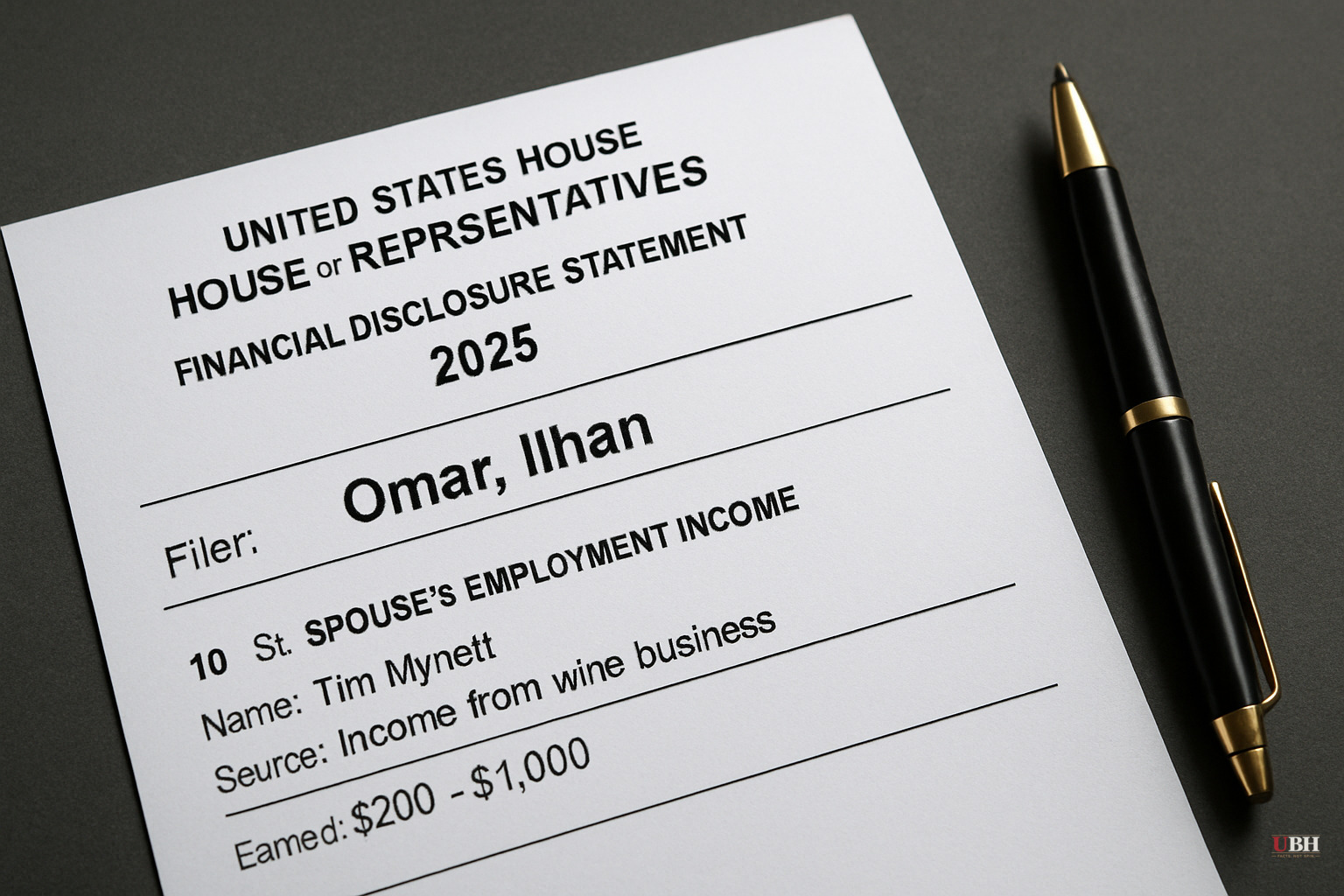
From $30 Million to Negative Net Worth in Two Filings
Rep. Ilhan Omar (D-MN) filed her 2025 financial disclosure report, and the numbers are striking. Her husband, Democratic operative Tim Mynett, reportedly earned between $200 and $1,000 for the entire year. The sole income came from eStCru, a California-based wine business that went under in April, according to the New York Post.
Mynett's primary venture, Rose Lake Capital, a firm he launched in 2022 alongside fellow Democratic operative Will Hailer, generated zero income in 2025 according to the disclosure.
The couple's total declared assets for 2025 came in between $20,000 and $125,000. Their combined credit card and student loan debt sat between $30,000 and $100,000. That puts their reported net worth somewhere between negative $80,000 and positive $95,000.
What the 2024 Filing Said
In Omar's original 2024 financial disclosure, Mynett's ownership stakes in Rose Lake Capital and eStCru were valued at between $5 million and $30 million combined. This represented a dramatic jump from near-zero the year prior. That figure drew public scrutiny and helped trigger a congressional investigation into Omar's finances, which was unfolding at the same time a large social services fraud scheme tied to the Somali community in her Minneapolis district was drawing attention.
Omar filed an amended 2024 disclosure in March, revising those business valuations down to zero. She attributed the original figures to an accounting error, according to the New York Post.
The amended 2024 filing still showed Rose Lake Capital generating between $100,000 and $1,000,000 in income that year, and eStCru generating between $2,500 and $5,000. Yet Mynett's ownership stakes in both were now listed as worthless. Businesses can generate revenue while having low or negative equity value, so that combination is not inherently impossible, but it is unusual enough to invite scrutiny.
The Legitimate Questions Here
The strongest concern critics raise is straightforward: a business valued publicly at up to $30 million does not typically collapse to zero equity in the time it takes to file an amended form. If Rose Lake Capital was generating six-figure income as recently as 2024, why did it produce nothing in 2025? No statement from Omar or Mynett explaining the firm's current status has been made public, and no independent audit of the disclosures has been reported.
Republican National Committee spokeswoman Delanie Bomar told the New York Post that "Omar has spent her entire career covering up Democrat-enabled fraud that cost taxpayers billions."
The Good-Faith Defense
Omar's supporters point out that financial disclosures are self-reported ranges, not audited balance sheets. The ranges Congress requires are deliberately broad. A venture capital firm with illiquid investments can swing wildly in stated value depending on how principals choose to mark private holdings. Mynett has nearly two decades of experience in Democratic political consulting, and startup ventures, particularly in the wine industry, do fail.
Accounting errors in financial disclosures, while embarrassing, are not crimes. Amending a disclosure is the prescribed remedy when errors are found.
What Remains Unresolved
The core factual problem is not whether one filing or the other is more accurate in isolation. It is that the two filings, original and amended, are difficult to reconcile with each other, and the explanations offered publicly remain thin.
Rose Lake Capital generated meaningful income in 2024 and zero in 2025. That may have an ordinary business explanation. But Mynett and Omar have not provided one on the record.
A congressional investigation into Omar's finances was spurred by the original 2024 disclosure. Whether that inquiry will formally address the amended 2024 disclosure, the discrepancy between income and valuations, or the timing of eStCru's closure remains the open question.
Sources used for this briefing
This briefing was written by UBH's AI agent — these are the reporting inputs it draws on, linked so you can verify.