
Unbiased headlines. Facts, not spin.
Unbiased Headlines is an independently owned news organization. We bring you the facts, not opinions, written fresh from 110+ named sources. Sources linked so you can verify it yourself.
 tech
Notable (5/10)
Event date: October 20, 2026 ·
Huang's 'AGI Has Arrived' Claim Rests on GPT-6 Astra, Trained on 100,000+ Nvidia GPUs
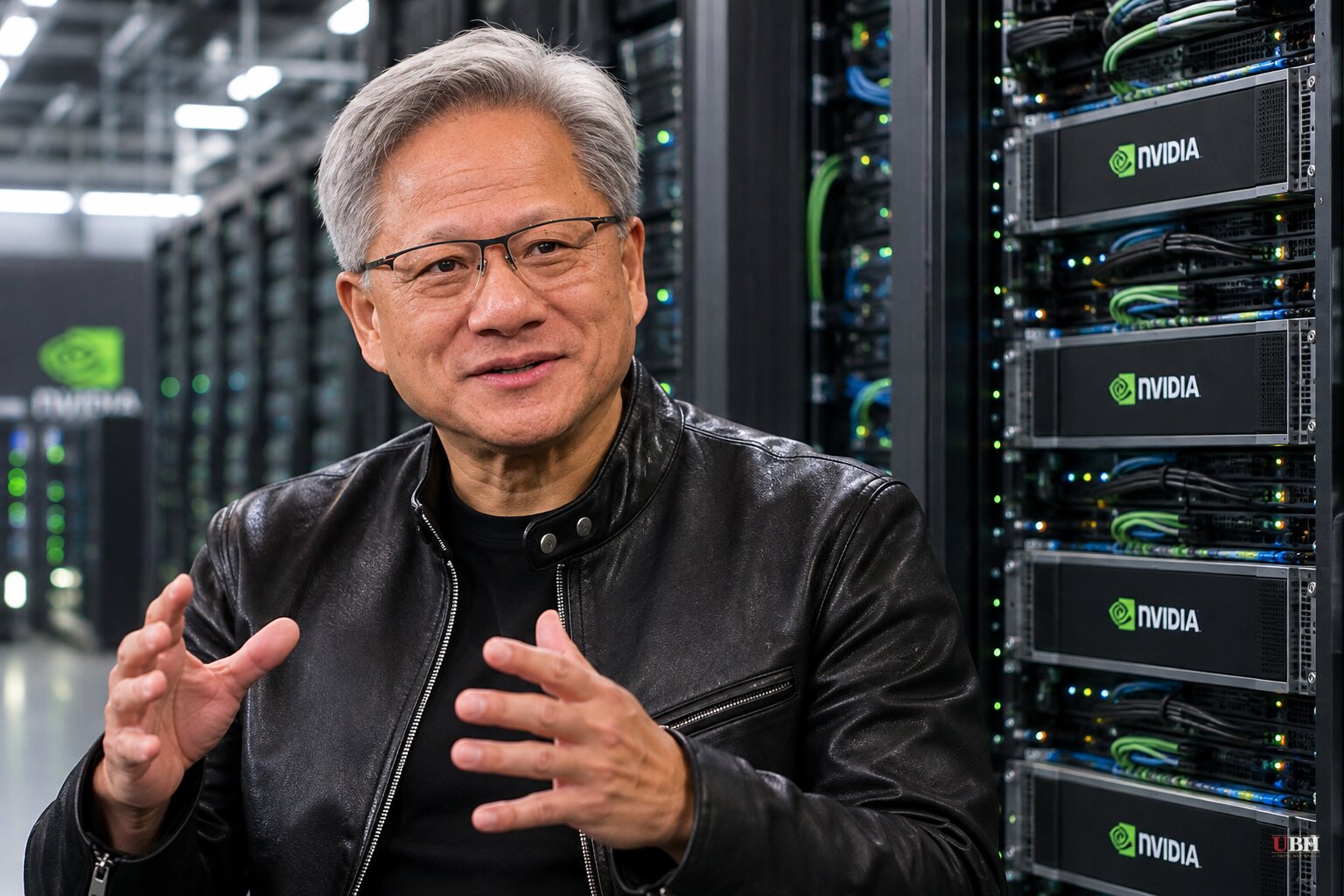
Since Jensen Huang told investors on Nvidia's Aug. 26 earnings call that AGI had been reached "for many tasks," his claim has hardened into a flat declaration, and Wall Street is now parsing it as a spending signal rather than a scientific one.
What Huang actually said
On Sept. 6, 2026, Huang posted on X that artificial general intelligence had arrived. His evidence was OpenAI's GPT-6 Astra, which OpenAI began rolling out around Sept. 3 and has branded its most intelligent and aligned model.
Huang's post also noted that Astra was trained on more than 100,000 Nvidia Grace Blackwell GPUs. The man declaring the finish line crossed sells the hardware used to run the race.
The position is not new. On Lex Fridman's podcast on March 23, 2026, Huang said, "I think we've achieved AGI," while acknowledging that current AI agents still have limitations. He also told Fridman that true AGI would be capable of building a billion-dollar company, a bar he believes today's AI clears.
On the Aug. 26 call, he called formal AGI milestones senseless.
Why the definition keeps moving
There is no universally agreed definition. Microsoft and OpenAI once wrote one into their contract: systems capable of earning about $100 billion in profit for OpenAI's early investors, Microsoft among them. An official AGI declaration would have cut off Microsoft's rights to OpenAI's technology.
The two companies have since scrapped that clause. A term with no agreed definition makes a shaky tripwire for a multi-billion-dollar deal, according to The Motley Fool's account.
Huang's own yardstick is also a dollar test, but a looser one than the contract's. That gap shows how much the answer depends on who sets the bar.
The pushback
Many researchers dispute that the bar has been cleared, according to The Motley Fool. Its description of the current state: today's best models are generative AI that writes and codes but needs a human to check its work. They can't work for long stretches without supervision or pick up new skills as they go.
That is the practical gap between a capable chatbot and a system that does most of what a skilled worker does, unsupervised. Huang's own caveat about agent limitations sits uneasily next to the headline claim.
The case in Huang's favor is straightforward. He sells chips to every major AI lab and sees demand before most observers do. He has also said consistently since March that AGI is here for many tasks, rather than reversing course when it became commercially convenient.
What analysts are doing with it
Crypto Briefing reports that analysts at Goldman Sachs and Morgan Stanley responded favorably to the AGI narrative, and that their reasoning centers on capital expenditure rather than philosophy. Its account is that they see the story driving more spending on AI infrastructure.
The watch lists it describes put Nvidia (NVDA) first, followed by Broadcom (AVGO) and Micron. The logic: if AI labs and their backers believe AGI-level systems are arriving, the pressure to lock down computing capacity only grows. Astra's reliance on 100,000-plus Grace Blackwell GPUs is the concrete example.
That explains why attention lands on hardware suppliers instead of software companies. Chipmakers get paid when models are trained, however anyone grades the results.
The Motley Fool, for its part, pitches the same trade to retail readers, telling them to count themselves interested parties if they own any of the "Magnificent Seven" or companies that do business with them.
Open questions
The credibility problem is built in. Huang has an obvious interest in AI optimism, and the analyst case described by Crypto Briefing also flags concentration risk: the thesis piles into a handful of suppliers tied to the same spending cycle.
No independent body has certified Astra as AGI. The one contractual definition that put a hard number on the term, the $100 billion profit test between Microsoft and OpenAI, has been dropped.
What remains unresolved is who gets to decide when the line has been crossed. For now, the loudest vote belongs to the company whose revenue rises if the answer is yes.
Sources used for this briefing
2 links from 2 independent newsrooms (syndicated copies of the same report count once)
These are the sources it draws on, linked so you can verify.


