
Unbiased headlines. Facts, not spin.
Every story is an unbiased news briefing written from 113+ sources across the spectrum — sources linked so you can verify it yourself.
 defense
Major Story (7/10)
Event date: September 22, 2026
defense
Major Story (7/10)
Event date: September 22, 2026
Houthis Grab Two More Red Sea Islands as China's Iran Arms Pipeline Draws Fresh Scrutiny
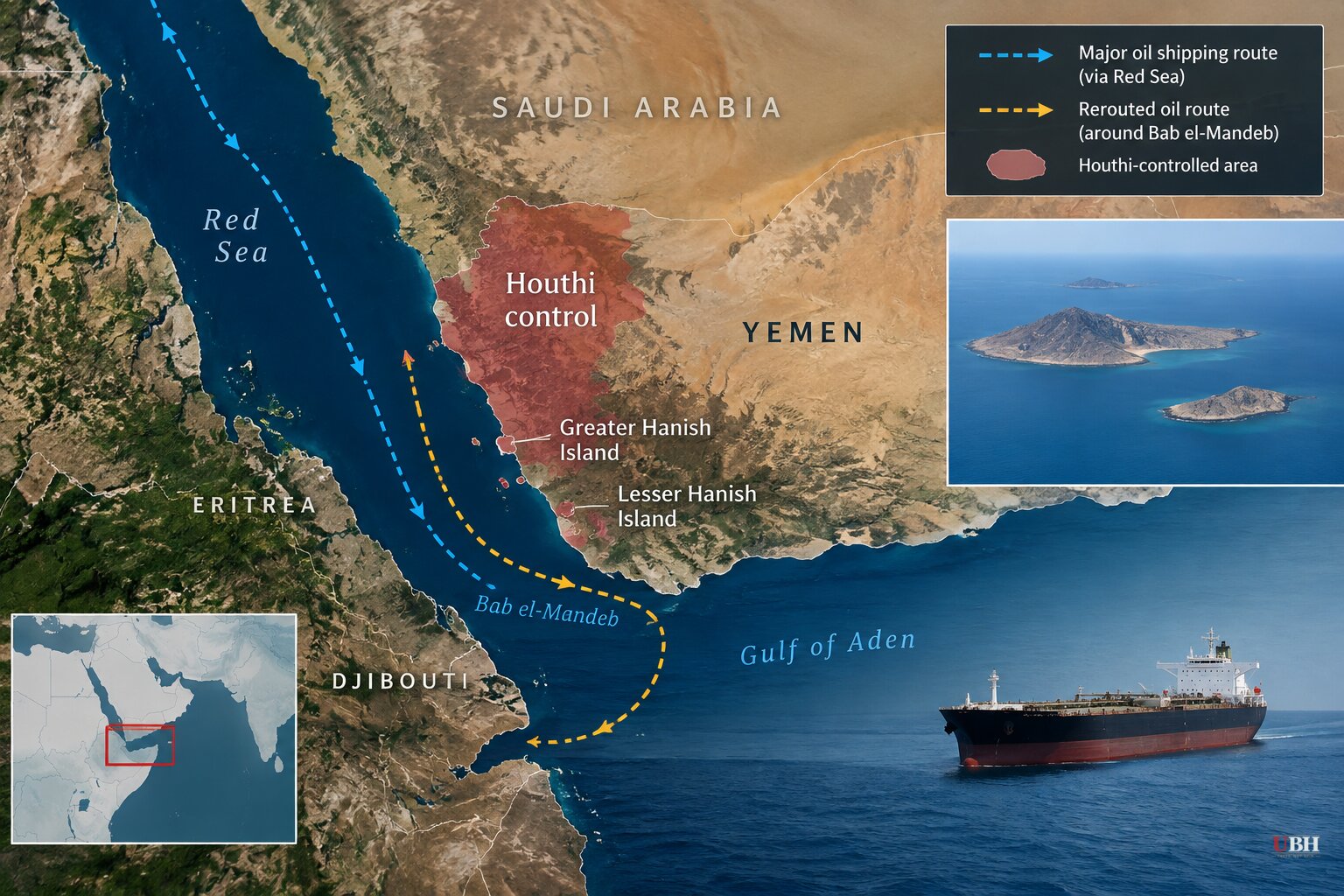
Since the Houthis captured the port of Mocha and split control of the Bab el-Mandeb Strait by seizing Perim Island last week, the Iran-backed group has kept advancing. Houthi officials said Monday they took Greater and Lesser Hanish, two islands in the southern Red Sea, as Saudi-backed government forces tried to claw back ground the rebels had already taken, according to Breitbart.
The islands sit near the shipping lanes Saudi Arabia has been using to move crude oil since Iran effectively closed the Strait of Hormuz in the opening days of the war. That means every new patch of coastline the Houthis take is another lever on the world's oil supply, not just Yemen's.
China Calls Houthi Attacks "Unacceptable," Keeps Arming Iran
China's Foreign Ministry spokesperson, Guo Jiakun, said Monday that Houthi attacks on Saudi energy infrastructure are "unacceptable" and that Beijing is "deeply concerned" about further escalation, according to Breitbart. Guo called for restraint and dialogue.
That statement conflicts with what The Wall Street Journal found in Iranian customs records covering January 2025 through June 2026. Chinese suppliers sent about 1,300 shipments of dual-use components to Iran's defense ministry in just the first half of 2026, the Journal reported, work cited by both Iran International and The Jerusalem Post. One delivery landed on June 17, the same day Washington and Tehran signed a 60-day truce that China was publicly promoting. More than a dozen follow-on shipments arrived two days later carrying over $6 million in drone-usable parts.
The Journal also reported that Chinese banks and front companies have funneled billions of dollars to Iran while helping it dodge U.S. sanctions, and that Iran has used a barter-like oil-for-goods mechanism with China to bypass sanctions entirely, according to Reuters reporting cited in the Jerusalem Post's account. CSIS researcher Kate Koren identified Chinese firms marketing sensitive electronics used in Shahed drones at trade fairs.
According to the Journal, President Trump told aides that preserving the relationship with Chinese President Xi Jinping is a priority, and Trump has been reluctant to publicly confront Beijing over the arms flow. Michigan Democratic Sen. Elissa Slotkin sent Trump a letter arguing there is "a large and growing body of evidence that Chinese companies are helping Iran target and kill American troops, keep Iran's drone and missile programs alive, and sustain Iran's economy." A Treasury Department spokesperson told the Journal the administration "has repeatedly targeted malign Iran-related activity that exploits or transits China's jurisdiction and will continue to do so."
Both things can be true at once: Treasury has issued sanctions actions against Iran-China networks, and the shipments have continued anyway. The underlying reasons are unclear from these sources. No new charges, indictments, or specific penalties tied to this batch of shipments have been announced.
The Oman Meeting That Didn't Happen
Separately, Iran says a planned meeting in Oman to discuss the Strait of Hormuz was scrapped because Saudi Arabia objected. Iranian Foreign Ministry spokesman Esmail Baghaei said Monday that Riyadh had demanded the meeting be postponed "for the time being," according to Breitbart. Baghaei said Iran and Oman have already finalized their own agreement on the strait, to be announced later.
A Gulf official familiar with the matter said Saudi Arabia submitted amendments over concerns the deal could have lasting implications for the strait that would hurt other Gulf Cooperation Council members. That leaves the region's most consequential oil chokepoint under an arrangement negotiated between Tehran and Muscat alone, with Riyadh on the outside pushing back.
How the Houthis Pay For All This
The islands and ports the Houthis keep taking aren't just symbolic. Adam Rousselle, founder of Between the Lines Research, told Fox News Digital the group runs "a very well-capitalized" financial network built on port fees, tariffs on rival-controlled trade routes, Iranian oil, hawala transfers, crypto exchanges, and facilitators in Russia, Turkey and Southeast Asia. Nadwa Al-Dawsari of the Middle East Institute told the House Foreign Affairs Committee on September 1 that the group's economic base is only getting stronger as it seizes more territory.
That financial resilience is part of why a senior Yemeni military source told CNN that Mocha fell despite repeated assurances from U.S. Central Command that Saudi air support was "watching the situation closely." Saudi Crown Prince Mohammed bin Salman personally called Trump twice urging strikes on the Houthis. Trump declined, according to a source familiar with the calls cited by CNN. The White House told CNN it is focused on "ensuring freedom of navigation in the Red Sea" while letting regional partners take the lead.
The open question heading into the U.S. midterms is whether that hands-off posture holds if the Houthis keep taking islands and the Bab el-Mandeb becomes as unreliable as Hormuz already is. Amr Al-Bidh of Yemen's Southern Transitional Council put it bluntly to CNN: the Houthis don't need advanced weapons to shut the strait down. "They can just use a cannon on a car," he said, "and they will keep it."
Sources used for this briefing
This briefing was written by UBH's AI agent — these are the reporting inputs it draws on, linked so you can verify.


