
Unbiased headlines. Facts, not spin.
Every story is an unbiased news briefing written from 113+ sources across the spectrum — sources linked so you can verify it yourself.
 defense
Major Story (7/10)
September 29, 2026 at 01:00 PM
defense
Major Story (7/10)
September 29, 2026 at 01:00 PM
Malaysia Deports Nearly 1,500 Myanmar Nationals in First Wave of a 5,000-Person Repatriation Plan
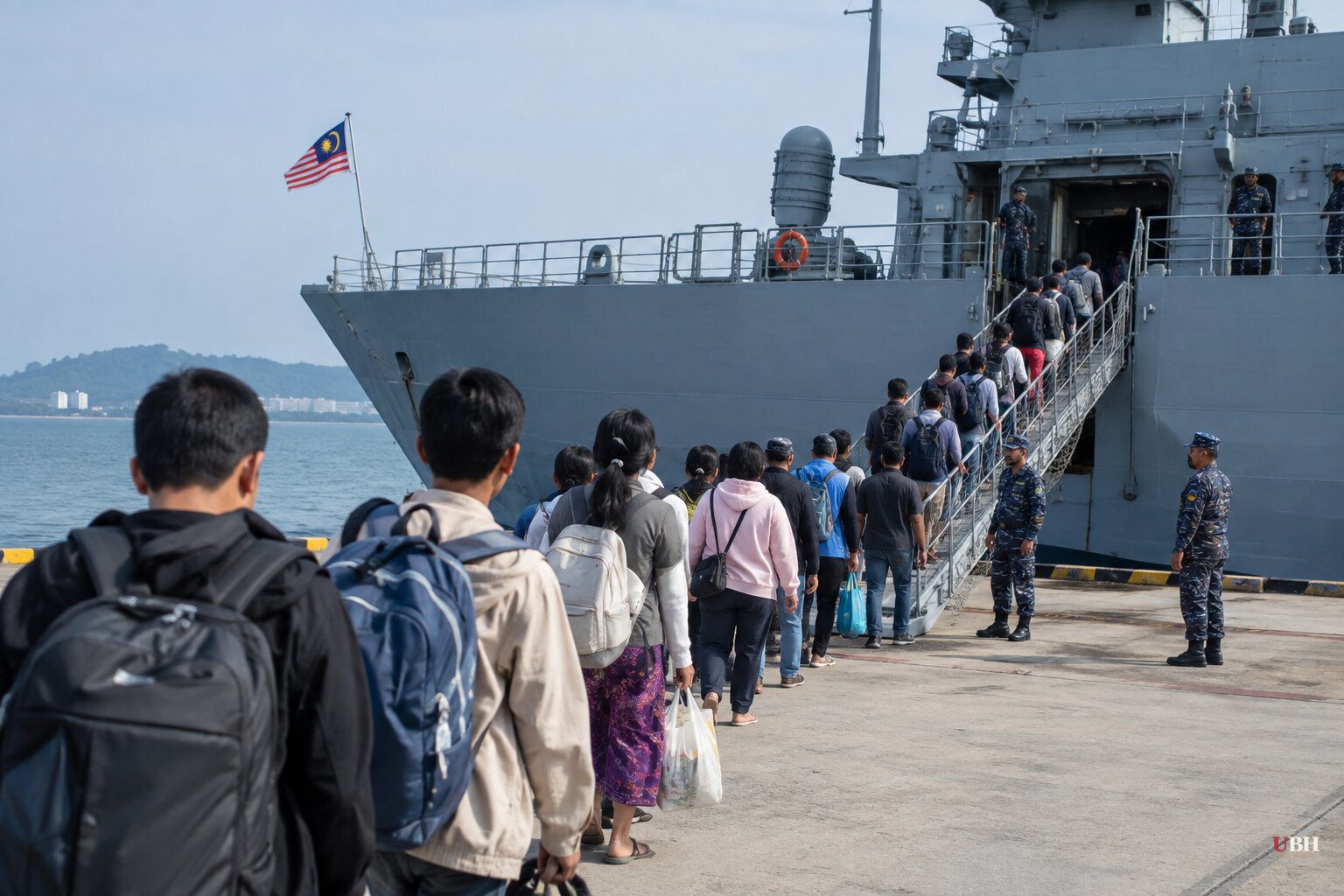
Malaysia began repatriating Myanmar nationals by ship on Tuesday, sending back 1,476 people in the first phase of an agreement that could eventually cover up to 5,000, according to Malaysia's Home Ministry.
Dozens of buses under police escort arrived at a stadium near the Lumut naval base in Perak state early Tuesday morning, then moved to the port where two Myanmar navy warships and a hospital ship were docked, according to Reuters. Al Jazeera reported that journalists were barred from the grounds during processing.
Home Ministry official Makhzan Mahyuddin told Bernama, Malaysia's state news agency, that the group being returned included 1,370 men, 79 women, 20 boys and 7 girls, ranging in age from 8 to 60. The ministry said the Myanmar government identified those on the list for repatriation and stressed the returns were voluntary.
Who exactly is being sent back is disputed
Coverage of the repatriations splits along an important line. Al Jazeera's headline and lead frame this specifically as "Rohingya refugees" being sent back. But Reuters' on-the-ground reporting, carried by multiple outlets including Internazionale and Thai PBS World, states plainly that the Home Ministry "did not provide details on the ethnicity of those being returned on Tuesday, their refugee status or whether Rohingya were among them." The Associated Press, in a report carried by WBAL, says the same. It's unclear if any of Tuesday's returnees were Rohingya. Malaysia hosts roughly 193,000 to 215,600 registered refugees from Myanmar, and about two-thirds of them are Rohingya, per UNHCR figures cited by Deutsche Welle and Reuters, but that doesn't establish who was on these specific buses. The ethnicity question remains unresolved based on what Malaysian authorities have released.
Malaysia's case
Malaysia is not a signatory to the 1951 Refugee Convention and treats refugees as undocumented migrants rather than a protected class, according to the Associated Press. As of August 15, more than 10,000 Myanmar nationals were held in immigration detention depots nationwide, the Home Ministry said.
The ministry's statement, quoted by Reuters, framed the issue in blunt terms: decades of unresolved migration "has led to a huge financial burden on the country, triggered a serious social crisis and introduced a real security threat." Prime Minister Anwar Ibrahim has defended the policy as a long-term diplomatic fix, arguing Malaysia cannot host refugees indefinitely and that Myanmar must take responsibility for its own citizens, according to the AP. Anwar said in July that Myanmar agreed to take back 5,000 people, and he has said he plans to invite Myanmar's military chief and self-installed president, Min Aung Hlaing, to Malaysia as part of the arrangement.
Malaysia has also seen a documented rise in anti-migrant sentiment. A wave of online hate speech and misinformation this year led to harassment of the Rohingya community and forced widespread school closures, Reuters reported. Ground News noted that authorities had earlier detained more than 100 Rohingya outside the UNHCR office in Kuala Lumpur.
The counter-argument
The UN High Commissioner for Refugees says it was not involved in identifying or vetting anyone on Tuesday's list and that current conditions in Myanmar "do not support the safe and sustainable return of refugees," a position it repeated to Reuters. The agency added that any return "must be voluntary, based on an informed decision, and take place in conditions of safety and dignity."
Myanmar has been at war with itself since a 2021 military coup, and the junta is fighting armed resistance groups on multiple fronts, per Deutsche Welle. Chin community leader James Bawi Thang Bik told Deutsche Welle and Ground News that past deportees have faced detention or forced conscription into the military. "We fear that they may be forced to fight on the frontlines of the conflict. For many it is akin to sending them to a death sentence in their own home," he said.
Rights advocates cited by Al Jazeera also raise a harder question: can people held inside immigration detention meaningfully consent to "voluntary" return? Myanmar's military does not recognize the Rohingya as citizens at all, instead labeling them as Bengali migrants, and the 2017 crackdown that drove hundreds of thousands from the country remains the subject of a genocide case at the International Court of Justice.
Myanmar's foreign ministry has said only that it is working with countries to facilitate "voluntary return of verified displaced persons in a safe and dignified manner," according to a state media report cited by Reuters. Neither a Myanmar government spokesperson nor its embassy in Kuala Lumpur responded to requests for comment on Tuesday's shipment.
Malaysia's Home Ministry said further phases will proceed "subject to identification, documentation and verification processes," leaving open how many of the remaining roughly 3,500 people covered by the deal will be moved, and on what timeline.
Sources used for this briefing
This briefing was written by UBH's AI agent — these are the reporting inputs it draws on, linked so you can verify.


