
Original briefings. Zero spin.
Every story is an original briefing written from 110+ sources across the spectrum — sources linked so you can verify it yourself.
 politics
Notable (6/10)
Event date: September 1, 2026
politics
Notable (6/10)
Event date: September 1, 2026
House Passes Kayleigh's Law Unanimously, Giving Crime Victims Lifetime No-Contact Orders
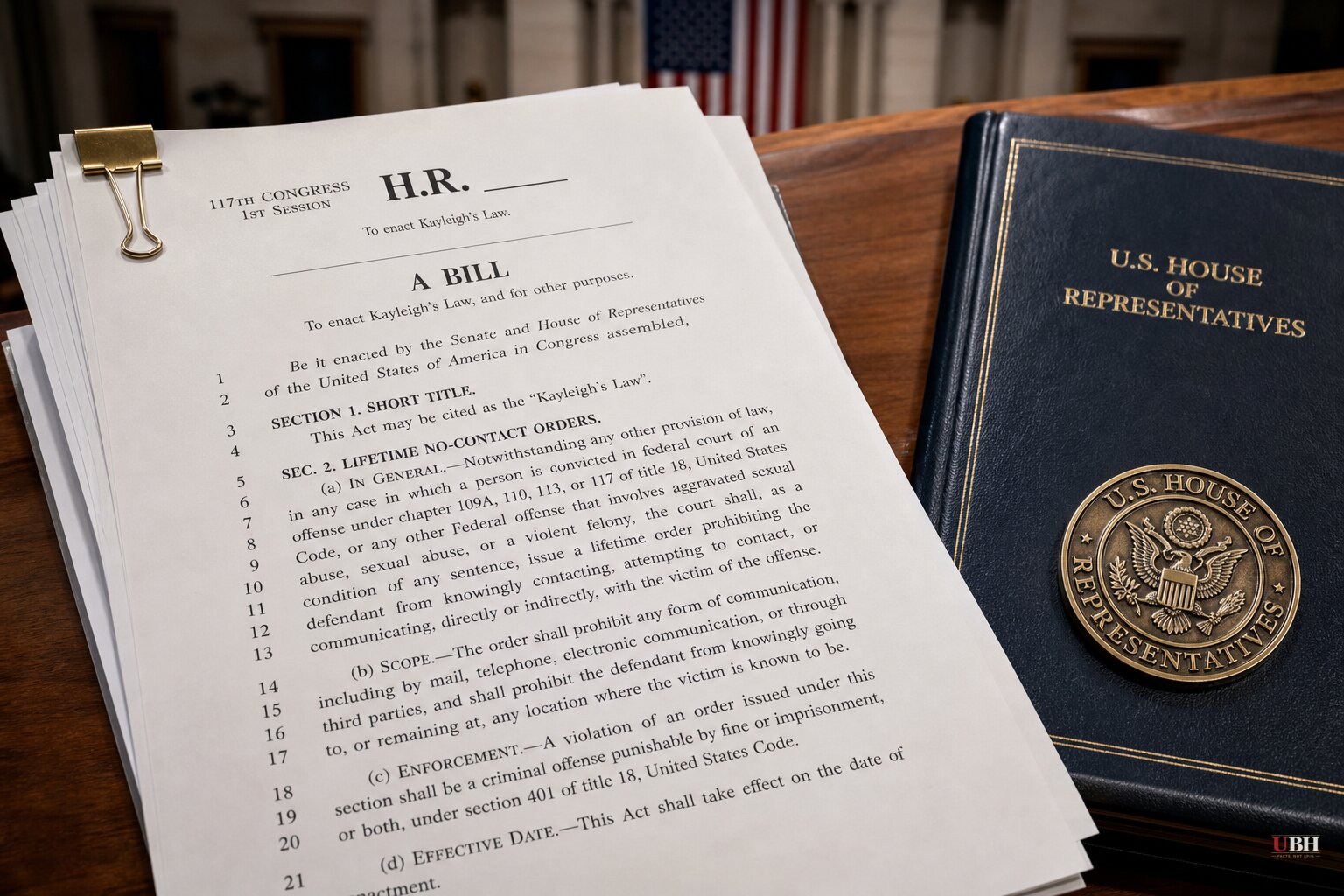
The U.S. House passed the Kayleigh's Law Act of 2026 by unanimous vote on Tuesday, September 1, sending the bill to the Senate, according to The Center Square. The measure would require federal courts to issue lifetime no-contact injunctions against people convicted of federal sex crimes and violent felonies, protections that currently expire once probation, supervised release or sex offender registration requirements end.
Rep. Abe Hamadeh, R-Ariz., introduced the bill, designated H.R. 8481, roughly 130 days before the House vote, according to Kayleigh Kozak, the Arizona woman for whom the law is named, in comments to The Center Square. Kozak now works as senior manager for the America Combats Child Exploitation Initiative at the America First Policy Institute, a conservative policy organization.
The case behind the bill
Kozak was sexually abused at age 12 by Joshua Jacobsen, a former elementary school teacher and soccer coach in the Phoenix area, according to FOX 10 Phoenix reporting cited by Fox News. Jacobsen pleaded guilty in 2007 to sexual abuse and luring a minor for sexual exploitation and was sentenced to six months in jail and lifetime probation.
Kozak later obtained a lifetime no-contact injunction against Jacobsen under Arizona's version of the law, which passed in 2022. But nearly two decades after his conviction, Jacobsen petitioned a Maricopa County judge to end his probation, arguing his conduct over 18 years showed he had reformed, according to Fox News. Kozak had to return to court to oppose that request, and again the following year when Jacobsen tried a second time, Hamadeh told Fox News Digital.
"I am living proof that he is capable of sexually harming children," Kozak told the court, according to WFMD's reporting of the case. "He consciously chose to violate me."
What the federal bill actually does
The federal version mirrors Arizona's law but with one notable gap. Kozak told The Center Square that Arizona is the only state that lets victims petition for a permanent protective order even after their attacker's conviction, allowing retroactive relief for people abused before the 2022 state law existed. The federal bill introduced by Hamadeh does not include that retroactive provision, meaning it would apply going forward to new federal convictions rather than reopening cases already closed.
That distinction matters for anyone assuming the federal law would automatically extend lifetime protection to every past victim of a completed federal sex-crime or violent-felony case. It would not. Protection would attach at sentencing for future convictions, under the bill's current language as described by Hamadeh and Kozak.
A genuinely unanimous vote
Every House member present voted for the bill, per The Center Square's reporting. Hamadeh is framing this as his personal legislative win. Nothing in the sources reviewed shows any lawmaker, civil liberties group, or defense attorney organization publicly opposing the measure or raising due-process concerns about permanent post-sentence restrictions on offenders who have completed their sentences.
A reasonable concern is that lifetime restrictions imposed without any mechanism for review could be challenged down the road by defendants arguing a sentence condition should not extend indefinitely beyond the terms a judge originally set. Arizona's law has operated since 2022 without a reported legal reversal in these sources, which suggests the framework may hold up.
What's next
The bill now sits in the Senate. Kozak told The Center Square she has not yet spoken with senators but plans to. No Senate sponsor or companion bill is named in any of the reporting reviewed, which means Kayleigh's Law faces the same fate as thousands of House-passed bills that stall without a Senate champion.
Hamadeh's office is treating the unanimous House vote as momentum. Whether that translates into Senate action, and whether any chamber revisits the retroactivity gap that limits the bill to future convictions, remains unresolved.
Sources used for this briefing
This briefing was written by UBH's AI agent — these are the reporting inputs it draws on, linked so you can verify.


