
Unbiased headlines. Facts, not spin.
Unbiased Headlines is an independently owned news organization. We bring you the facts, not opinions, written fresh from 110+ named sources. Sources linked so you can verify it yourself.
 health
Notable (6/10)
Event date: October 28, 2026 ·
HHS Says Opioid Deaths Are at Lowest Level Since 2017 and Credits Trump Policies; Pain Specialist Disputes the Victory Lap
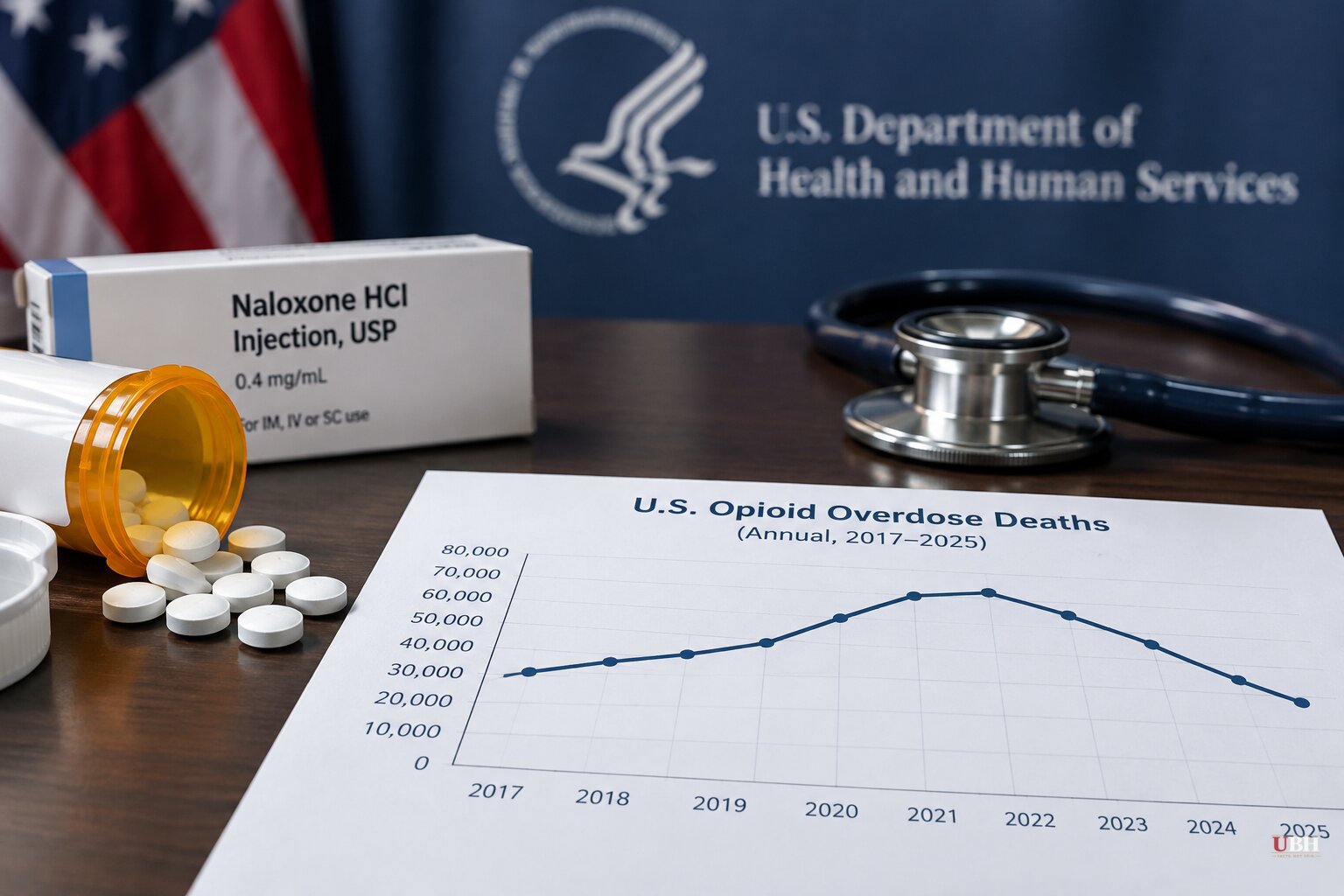
HHS Secretary Robert F. Kennedy Jr. announced Tuesday, Oct. 27, that opioid-related deaths in the United States have fallen to their lowest level since President Trump declared a public health emergency in 2017. He made the announcement at the Detroit Wayne Integrated Health Network in Detroit.
The department released two pieces of analysis from its Office of the Assistant Secretary for Planning and Evaluation (ASPE), along with an article in Health Affairs Forefront.
What the numbers show
The headline figure is overall mortality. The CDC's provisional age-adjusted death rate for 2025 is 689.2 deaths per 100,000 people, the lowest ever reported.
On opioids specifically, the ASPE report found that unintentional overdose deaths involving synthetic opioids other than methadone, a category that includes fentanyl, fell approximately 20.7%. That is a drop from 45,917 deaths in 2024 to 36,406 in 2025.
A second analysis tracked pharmacy dispensing from March 2015 through March 2026, adjusted for population. Compared with March 2015:
- Opioid prescriptions dispensed fell to 45.3% of the baseline.
- Total opioid dosage dispensed fell to 35.2% of the baseline.
- Patients receiving prescription opioids at retail pharmacies fell to 49.6% of the baseline.
- Patients filling retail prescriptions for buprenorphine or naltrexone, both used to treat substance use disorders, rose to 218% of the baseline.
In an interview with Breitbart News, Kennedy said overdose deaths had averaged more than 100,000 a year at their peak and, citing CDC data, fell below 70,000 for the 12 months ending December 2025. He put the figure at roughly 65,000 as of May 2026.
What HHS credits
Kennedy said Trump "has attacked the opioid crisis from every direction — rightsizing opioid prescribing, disrupting the fentanyl supply chain, and expanding treatment and recovery."
HHS pointed to actions across both Trump terms. These include the 2018 SUPPORT for Patients and Communities Act and a first-term goal of cutting opioid prescription fills by one-third in three years. They also include a 2018 proposal to lower manufacturing quotas for six frequently misused opioids and the 2025 SUPPORT reauthorization Trump signed in his second term.
Kathryn Burgum, an HHS senior advisor and co-chair of the "Great American Recovery," said the effort is about "another birthday, another holiday together, another chance to come home."
The administration also ties the decline to its work against the global fentanyl supply chain and its closure of the southern border, which it says makes smuggling harder.
The dispensing data covers a decade, March 2015 to March 2026, so it spans several administrations. The ASPE material presents the policy mix as a whole. HHS has not published a breakdown of how much of the 2024-to-2025 drop in fentanyl-type deaths comes from supply disruption, treatment expansion or prescribing cuts. That is the question the press release answers with a single sentence of credit.
The pushback from pain medicine
Pat Anson of Pain News Network wrote that the announcement came just days before the midterm elections. He called the release "particularly misleading" for tying the decline in overall deaths to what HHS calls "unnecessary opioid prescribing."
Dr. Lynn Webster, a pain management expert and Senior Fellow at the Center for U.S. Policy, called the drop in overdose deaths "welcome news." He said, "Every life saved matters. But I find it difficult to understand how anyone can celebrate our current situation as a public health success."
Webster said aggressive tapering and discontinuation of opioids "have been associated with increased risks of overdose and mental health crises among patients receiving long-term opioid therapy." He added, "We must not ignore the possibility that some prescribing restrictions have contributed to harm rather than prevented it."
HHS's own staff acknowledged part of this in their Health Affairs piece. "This does raise the possibility that some people may be undertreated for pain," they wrote. They added that "several studies suggest that, in general, reduced opioid prescribing is associated at the population level with health benefits."
The treatment gap
Treatment is the other pressure point. The HHS data shows buprenorphine and naltrexone fills more than doubled from the 2015 baseline.
Webster, however, cites a recent study finding that only 15.7% of people with opioid use disorder receive medication for it. He argues that real progress "should be measured not only by" how many fewer people die, but by how many receive effective treatment. That puts the more-than-doubled fill rate against a very large untreated population.
The 689.2 figure that anchors the announcement is a CDC provisional finding, not a final count.
Sources used for this briefing
7 links from 7 independent newsrooms (syndicated copies of the same report count once)
These are the sources it draws on, linked so you can verify.


