
Unbiased headlines. Facts, not spin.
Unbiased Headlines is an independently owned news organization. We bring you the facts, not opinions, written fresh from 110+ named sources. Sources linked so you can verify it yourself.
 health
Major Story (7/10)
Event date: October 29, 2026 ·
HHS Peptide Draft Is a Non-Enforcement Notice, Not an Approval. Public Citizen Objects, Analyst Calls It a 'Yellow Light'
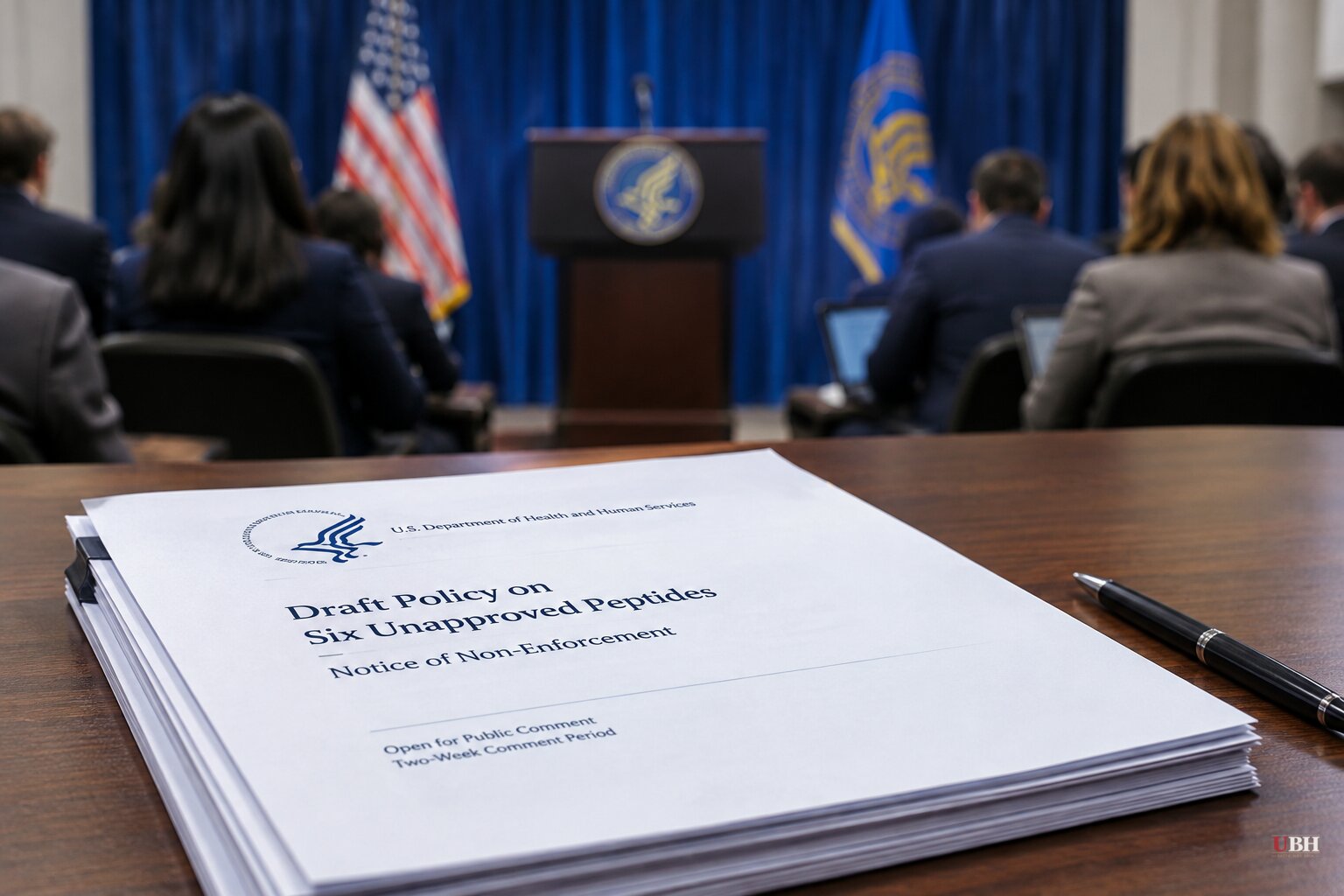
Since HHS posted its draft policy on Wednesday, Oct. 28, directing the FDA not to act against pharmacies that compound six unapproved peptides, the argument has shifted from the headline to the fine print. The fine print is narrower than much of the reaction suggests.
What the document does and does not do
The notice covers BPC-157, Epitalon, KPV, MOTS-c, Semax and TB-500. It says HHS "did not intend to take action" against licensed pharmacies or physicians that compound a drug using a peptide bulk substance that is not a component of an FDA-approved product.
It is a statement of enforcement discretion. It is not an approval and it is not a regulation. An HHS spokeswoman said so directly in an Oct. 29 email: "The policy does not grant FDA approval or establish clinical safety and effectiveness."
The government is taking comments on the draft for two weeks from its posting.
The draft sets conditions. According to HHS, it requires patient-specific prescriptions, traceable ingredients, quality testing and safety reporting. Compounders must use an FDA-registered ingredient maker, obtain a lab certificate for raw ingredients, and report serious side effects.
Why HHS took this route
According to two people who described the drafting to the Associated Press, HHS first wanted the FDA to write a formal regulation adding BPC-157 and other peptides to the list of substances compounders may use. FDA officials warned that agency scientists had major safety concerns and would not back a rule deeming them safe.
HHS switched to non-enforcement, which does not require the agency to make that finding. Six people familiar with the process told the AP that most FDA drug staff opposed the effort and had limited input. The AP's sources said FDA staffers ultimately provided technical help, including guardrails meant to improve safety.
The Epoch Times reported that the interim policy went to the White House earlier in October before it was made public.
Kennedy's stated rationale, per the notice, is that the policy "advances patient choice and freedom while appropriately protecting patient safety." It also says it is meant to discourage continued use of research-use-only peptides from foreign manufacturers that pose a safety risk. An HHS official told the AP the policy offers "a more controlled alternative through licensed U.S. compounders."
The July advisory committee vote is the document's main support. The panel narrowly voted to recommend the six peptides for compounding, and voted against a seventh, emideltide, which is not in the policy. That vote went against the assessment of the FDA's own scientists, who said evidence on safety and effectiveness was insufficient for each of the six.
Critics and supporters
Robert Steinbrook, health research group director at Public Citizen, said Kennedy "has acted recklessly and unilaterally to put Americans in danger" and "has undermined the FDA and threatened public health."
Fred Mills, chief policy officer for Americans for Safe & Effective Medicines, argued a legal pathway does not fix the underlying problems. "A legal pathway does not resolve problems with untested products, safety risks, questionable ingredients, or misleading claims," he said. He added that the group expects "the harms from mass compounding" to worsen for lack of oversight.
On the other side, Lee Rosebush of the American Academy of Peptide Medicine called it "a huge step for patient and provider medical freedom." His group represents people who prescribe or sell peptides and is not a medical professional organization.
The unregulated market is a documented fact on all sides. Peptides are already sold through online sellers and, according to the AP, are promoted by wellness influencers without clinical trial data on safety or effectiveness. The dispute is whether a prescription-and-testing channel shrinks that market or legitimizes it.
The money
Telehealth firms are watching. Hims & Hers recently announced plans to offer wellness peptides once the government changed its policy. Leerink Partners analyst Michael Cherny had estimated the peptide telehealth market at $1.1 billion to $2.2 billion a year.
He was not ready to declare victory. Cherny called the notice a "yellow light" in a note to clients and wrote that the proposal "theoretically pulls forward the opportunity on these six peptides by several months at least." It is unclear whether the notice will be enough to draw major telemedicine players.
A draft that can be revised after comments is a thin foundation for a business model. A rule would be harder to undo; a non-enforcement notice rests on who holds the policy decision at HHS and the FDA.
What comes next
The two-week comment window runs into mid-November. Whether the FDA's reviewers, who opposed the shift, keep pressing their safety objections on the record will show up in the final version. The final text will also settle how much of the safeguard language, including ingredient sourcing and adverse-event reporting, survives intact. Neither HHS nor the FDA has said when it will finalize.
Sources used for this briefing
7 links from 7 independent newsrooms (syndicated copies of the same report count once)
These are the sources it draws on, linked so you can verify.


