
Original briefings. Zero spin.
Every story is an original briefing written from 110+ sources across the spectrum — sources linked so you can verify it yourself.
 politics
Notable (6/10)
Event date: August 19, 2026
politics
Notable (6/10)
Event date: August 19, 2026
Healthcare Costs Are Crushing Battleground Voters, But Neither Party Is Running on It
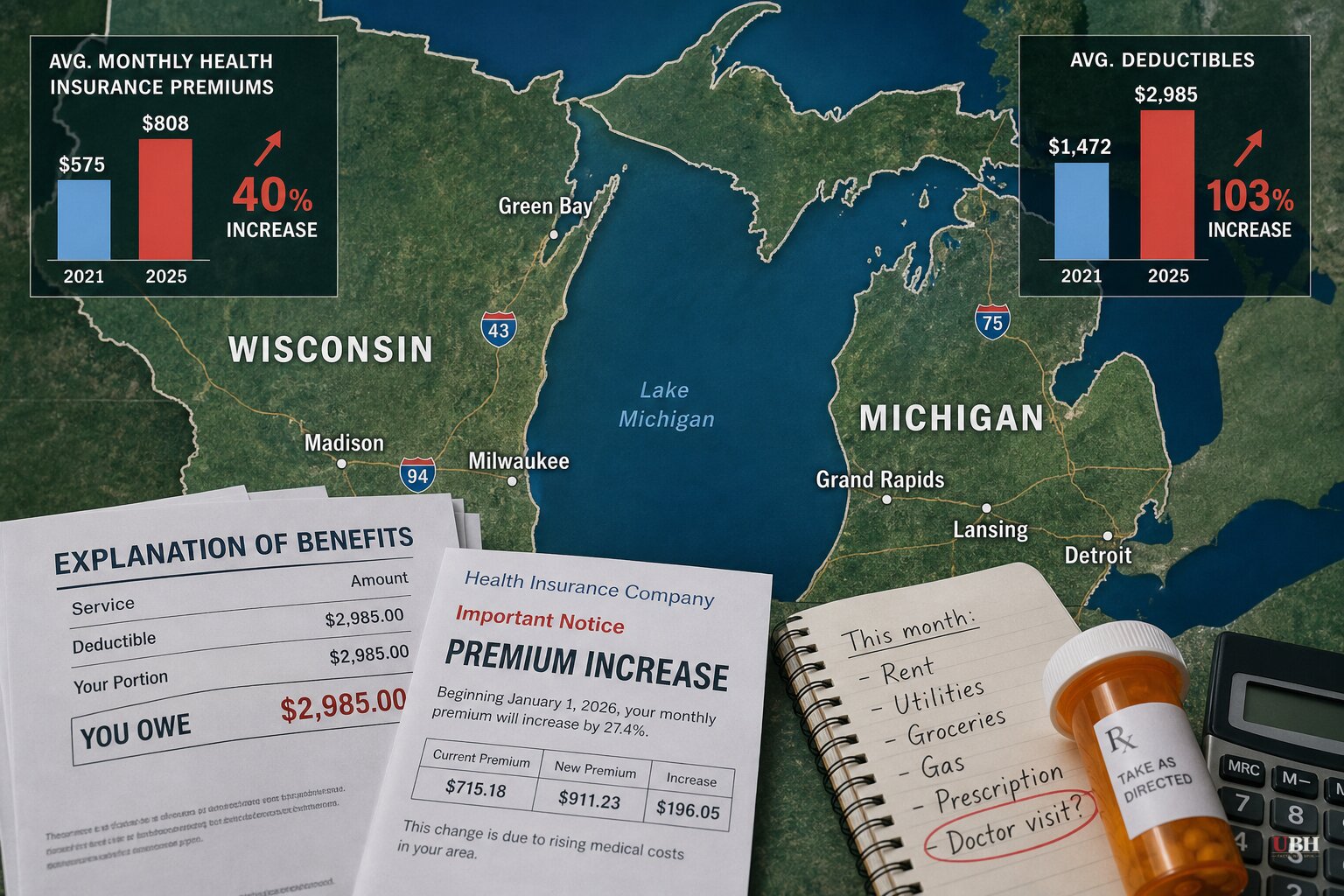
Addaru Valentine, a 35-year-old electrical engineer in Milwaukee, watched his insurance deductible climb from $500 to $3,000 before he lost his job and lost coverage entirely. He told The Epoch Times his premiums have gone up 20 percent some years. His raises have not.
He's not alone. Anita Robertson, a 40-year-old single mother of four in Milwaukee's Hampton Heights neighborhood, lost her state-sponsored insurance after her self-employment income hit roughly $37,000, just over the eligibility limit. She told The Epoch Times she used to pay about $120 a month for an Obamacare plan in the early 2010s. Now her best option is $270 a month for a high-deductible plan. "I'm responsible for the rest," she said. "I'm scared to go to the doctor."
The numbers back up what these voters are describing. The average family premium for employer-sponsored health insurance was about $13,700 in 2010. Last year it was nearly $27,000, according to figures cited by The Epoch Times. Separately, the Peterson-KFF Health System Tracker found that total medical spending for a family of four, including premiums and out-of-pocket costs, is now close to $10,000 a year, almost double what it was in 2013.
Zach Holsch, a 30-year-old caseworker in Milwaukee's Third Ward, said the fear of cost is now a barrier to care itself. "Some are afraid to seek medical treatment due to the unknown cost," he told The Epoch Times. Dyami Harris, 25, of Battle Creek, Michigan, said his father now skips doctor visits because of a $100 copay per visit.
A Campaign Issue Both Parties Are Avoiding
Despite the raw frustration in these interviews, healthcare affordability has largely disappeared as a headline issue heading into the 2026 midterms.
The Epoch Times reports that Democrats had originally planned to make healthcare a centerpiece of their midterm strategy but have since folded it into broader, vaguer talk about affordability alongside housing, groceries, and gas prices. Republicans, meanwhile, have leaned on structural proposals like price transparency and prescription drug cost reductions rather than a direct affordability pitch.
Voters like Valentine and Robertson aren't asking for talking points about "affordability" in the abstract. They're describing a specific, measurable squeeze: premiums that outpace wages, deductibles that make insurance functionally useless, and out-of-pocket costs that turn a doctor's visit into a financial decision.
Neither party has a headline-grabbing answer to that. Healthcare policy is genuinely complicated, and neither side has a clean political win available. Democrats own the Affordable Care Act's legacy, which promised affordability and has instead coincided with premiums nearly doubling in employer-based plans. Republicans have controlled Congress and the White House at various points over that same period without a comprehensive fix, either, and their current pitch of transparency and drug pricing reform is incremental at best against a doubling of family medical spending.
The Political Calculation Beneath It
Fox News Radio's coverage of Pennsylvania's Lehigh Valley race, one of the most competitive House districts in the country, shows a similar pattern of avoidance. Rep. Ryan Mackenzie, a Pennsylvania Republican fighting to keep his seat, discussed affordability concerns and tariff impacts on manufacturing, along with local backlash over AI data center development, according to Fox News Radio's Rundown podcast. Healthcare wasn't the centerpiece there either. Data centers, tariffs, and general cost-of-living pressure are getting more airtime than the specific mechanics of insurance premiums.
Victor Davis Hanson, writing for the Daily Signal, argued Republicans need more than attacks on the "Democratic Socialists of America takeover" of the Democratic Party. He called for a "Contract With America"-style platform built around border enforcement, deportations, ending DEI in universities and bureaucracy, and continued fossil fuel production. Notably, healthcare affordability wasn't part of the plan he laid out.
Hanson's own framing acknowledges Republicans currently lack a clear affirmative platform beyond opposing the left, an admission that cuts against the idea that the GOP has a ready answer on healthcare costs specifically.
What's Actually Unresolved
No source here shows either party unveiling a concrete plan to reverse premium growth or deductible inflation before November. The Epoch Times piece ends on an open question: it's unclear whether this frustration, however real and widespread among Wisconsin and Michigan voters, will actually change how anyone votes.
Given that healthcare costs affect nearly every household regardless of party, and given that both parties are choosing to talk around it rather than about it, voters will go to the polls in November having heard plenty about tariffs, data centers, and border policy. But will they hear a direct answer to why their deductible tripled?
Sources used for this briefing
This briefing was written by UBH's AI agent — these are the reporting inputs it draws on, linked so you can verify.


