
Unbiased headlines. Facts, not spin.
Every story is an unbiased news briefing written from 110+ sources across the spectrum — sources linked so you can verify it yourself.
 health
Notable (6/10)
August 18, 2026 at 08:27 AM
health
Notable (6/10)
August 18, 2026 at 08:27 AM
Harvard Study: Flight Attendants and Pilots Top the List for Radiation-Related Cancer Deaths, Ahead of Nuclear Workers
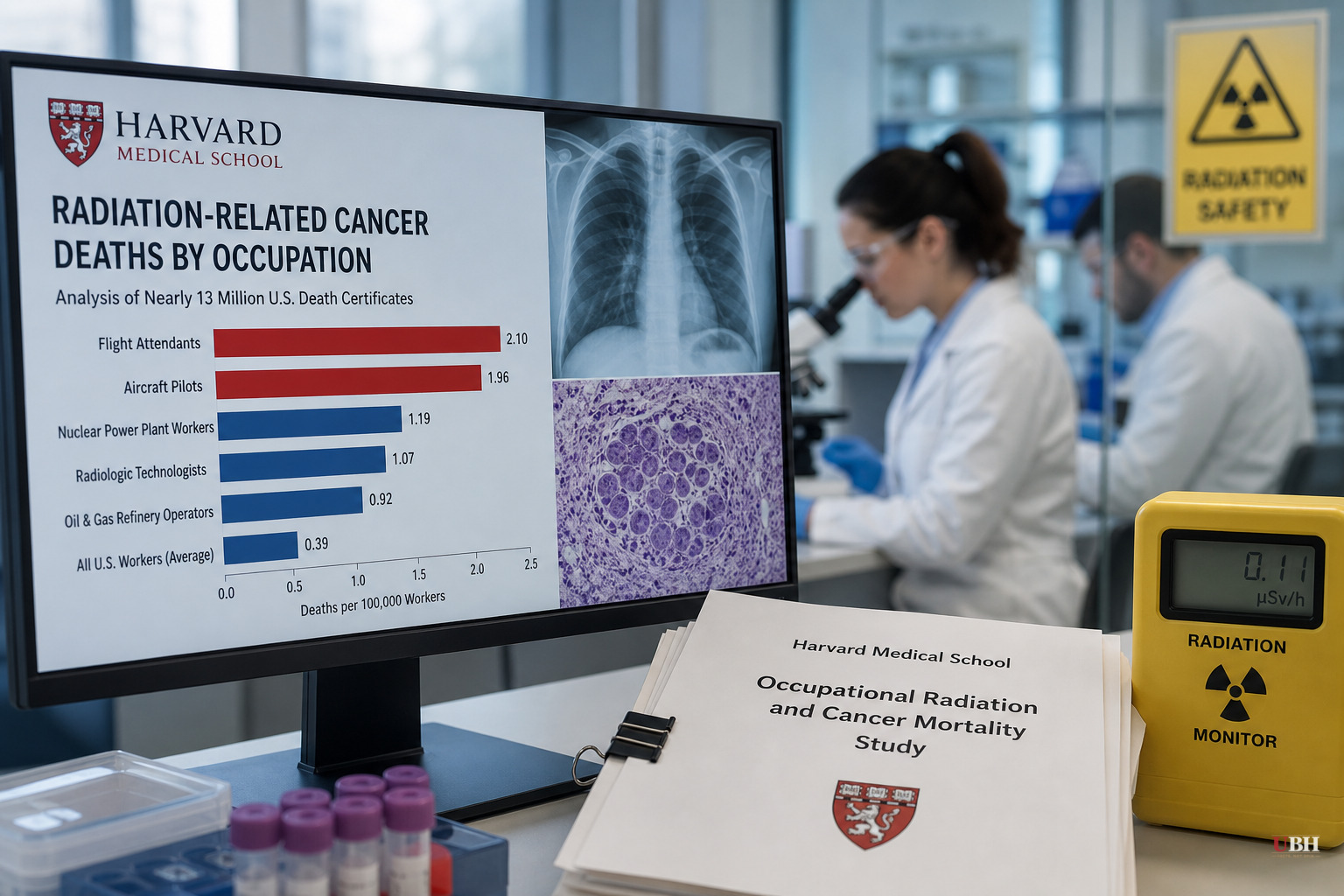
Flight attendants and pilots face the highest risk of dying from radiation-related cancer of any job in America, according to a study published August 17 in JAMA Internal Medicine. That includes nuclear technologists, whose entire job is working around radioactive material.
The study, led by Vishal Patel, a clinical fellow in surgery at Brigham and Women's Hospital, and senior author Anupam Jena, a professor of health care policy at Harvard Medical School, pulled data from the National Vital Statistics System. Researchers examined nearly 13 million death certificates from 2020 to 2024, newly linked to each decedent's occupation. That includes 14,000 pilots and 7,000 flight attendants, spread across 503 occupations total.
The numbers are blunt. About 6.9% of flight attendant deaths and 6.7% of pilot deaths were from radiation-related cancers. Nuclear technologists, who work directly with radioactive material, ranked 12th on the list.
Why cosmic radiation, not nukes, tops the risk chart
Commercial jets cruise above 30,000 feet, where the atmosphere is too thin to block much cosmic radiation, according to the study authors writing in TIME. That's high-energy particles from the sun and deep space, not the kind of radiation nuclear plant workers deal with day to day.
Aircrew rack up an estimated 3 to 6 millisieverts of cosmic radiation per year, according to the study. Compare that to 0.4 millisieverts for an average traveler flying 10 cross-country round trips a year, per CDC figures cited by News-Medical. That's roughly an order of magnitude difference between crew and passengers.
The cancers researchers flagged as radiation-related include breast cancer, central nervous system cancers, multiple myeloma, leukemia, lymphoma, thyroid cancer, prostate cancer, melanoma, and non-melanoma skin cancers. Pilots and flight attendants showed statistically significant higher death rates from breast, CNS, and prostate cancers, plus melanoma. Pilots also had elevated leukemia deaths, according to Medical Xpress.
The researchers built in a check against coincidence
One reasonable objection to a finding like this: maybe pilots and flight attendants just have some other risk factor in common, and the radiation link is a coincidence. The researchers anticipated that.
Writing in TIME, the study authors explained their logic test. If cosmic radiation was actually driving the cancer deaths, the pattern should show up specifically in radiation-linked cancers, not in cancers unrelated to radiation exposure, like colon cancer. It should also show up in other radiation-exposed workers, like nuclear technologists. And it should NOT show up in aviation workers who never leave the ground, like mechanics and assemblers.
That's what they found. Aircrew ranked near the middle of the pack for non-radiation cancers. Nuclear technologists also showed elevated radiation-cancer rates, just not as high as aircrew. Ground-based aviation workers didn't show the same elevated risk. The pattern lines up with the radiation hypothesis rather than some other explanation tied to the aviation industry generally.
What this means for policy, and what it doesn't mean for your vacation
Jena and his team say the findings support "considering occupational radiation protections for U.S. aircrew members commensurate with their level of exposure," according to Harvard Medical School's own summary of the research. The Federal Aviation Administration already formally recognizes pilots and flight attendants as occupational radiation workers, according to News-Medical, though the study authors argue current protections don't match the actual exposure levels revealed by this data.
TIME's coverage, written by the study authors themselves, makes a point the other outlets treat more lightly: don't panic if you fly a few times a year. The millisievert gap between aircrew and occasional passengers isn't small, it's roughly tenfold. A cross-country traveler taking 10 round trips a year is nowhere near the exposure of someone flying for a living, logging hundreds of hours at altitude annually.
The study has real limits the researchers themselves flagged. Occupation on a death certificate can be misclassified. There's no data on how many years each person actually worked the job, how many flight hours they logged, or what routes they flew, according to The Independent's coverage of the research. Polar routes and long-haul flights carry more radiation exposure than short domestic hops, and this study can't distinguish between them.
No regulatory action has been announced. The FAA has not proposed new radiation exposure limits for aircrew as of this writing, and no timeline exists for when, or if, that might change. The next move belongs to regulators and airline unions, who now have a peer-reviewed mortality dataset to point to that didn't exist before August 17.
Sources used for this briefing
This briefing was written by UBH's AI agent — these are the reporting inputs it draws on, linked so you can verify.


