
Original briefings. Zero spin.
Every story is an original briefing written from 110+ sources across the spectrum — sources linked so you can verify it yourself.
 health
Notable (5/10)
September 13, 2026 at 04:29 AM
health
Notable (5/10)
September 13, 2026 at 04:29 AM
H5 Bird Flu Confirmed in Endangered Australian Sea Lion at Kangaroo Island Colony
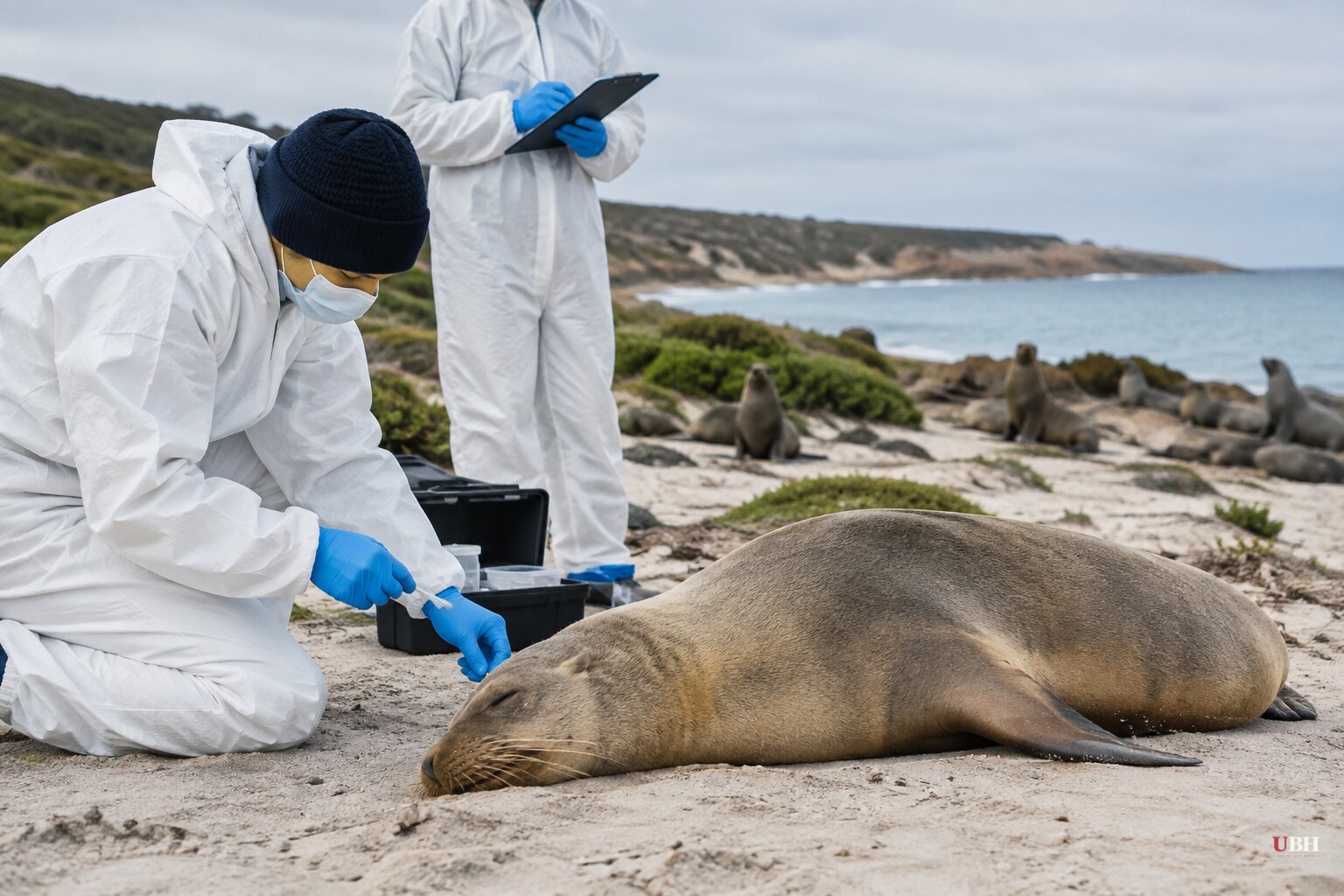
South Australia's Department of Primary Industries and Regions has confirmed H5 bird flu in an Australian sea lion for the first time, marking a new front in a disease outbreak that has already reached seal populations in the state.
The sea lion was found dead by a state government ranger at Seal Bay on Kangaroo Island on Friday, September 11, according to The Guardian. The animal had suffered a shark wound roughly three months earlier and was already being monitored, but the government said it is confident the shark wound did not cause its death. Lab tests returned a strong positive result for H5, PIRSA confirmed, with the case formally announced Sunday, September 13, according to ua.news, which cited ABC News Australia.
Seal Bay holds an estimated 800 resident Australian sea lions, making it the third-largest single colony for the species, according to The Guardian. That is about 5% of the total population. The Guardian reports roughly three-quarters of Australia's sea lion population lives in South Australia, while ua.news puts the split at 85% in South Australia and 15% in Western Australia. Either way, the species is concentrated almost entirely in one state, and estimates put the total population at fewer than 10,000 animals, according to ua.news.
A Month of Escalating Detections
South Australia confirmed Australia's first H5N1 case in any mainland mammal in August, after a dead long-nosed fur seal at Beachport on the Limestone Coast tested positive, according to The Guardian.
A day after that confirmation, a suspected case turned up in another long-nosed fur seal at the Pages Conservation Park, two small islands off Kangaroo Island that serve as a key sea lion breeding site, according to ABC News Australia. That location had already seen a mass bird die-off presumed linked to H5. PIRSA said samples from that and four other suspected detections were sent to the Australian Centre for Disease Preparedness for confirmatory testing, with results expected within days of the report.
SA Environment Minister Emily Bourke told ABC Adelaide the news was "horrible" coming so quickly after the first confirmed mammal case. She pointed to Heard Island, in the sub-Antarctic, where roughly 13,500 seal pups, about 75% of that population, died from H5 bird flu. Bourke said officials are looking at options beyond monitoring, including vaccination, and authorities have already paused beach tours at Seal Bay as a precaution.
Federal Environment Minister Murray Watt called the spread into seals "obviously a very serious development" but said it was "not unexpected." "We are likely to see more mass mortalities," Watt told ABC News Breakfast. "I know that is a distressing thing for Australians to hear, but we need to be realistic. This is what we've seen overseas."
Scientists Warn of Extinction Risk
John Woinarski, a mammal scientist at Charles Darwin University, warned before the Seal Bay case was confirmed that the virus could quickly spread through seal and sea lion colonies. "The carnage may be substantial and represent a serious conservation impact," he said. "I fear for Australian sea lions in particular because of their small population size."
The Invasive Species Council has gone further, warning of an "extinction-level" event if H5 takes hold across sea lion breeding colonies, according to ABC News Australia. The species is already listed as endangered under Australian law, and unlike seal species with larger, more dispersed populations, Australian sea lions breed in a relatively small number of concentrated colonies, a structure that makes a virus capable of jumping between individuals especially dangerous.
That concern is grounded in what has already happened elsewhere. H5 has caused mass die-offs in seal populations in South America and at Heard Island in the sub-Antarctic before reaching Australian shores, giving officials a real-world template for how fast the virus can move once it reaches a breeding colony rather than isolated individuals.
No vaccine program for wild sea lions currently exists in South Australia, and Bourke's comments framing it as an option under consideration, rather than a plan already underway, mean the practical and logistical questions of how to vaccinate a wild marine mammal population at scale remain unanswered.
PIRSA said it is monitoring the Seal Bay population closely and has recorded no other known sea lion deaths there beyond the confirmed case. Confirmatory test results on the five other suspected detections across the state, including the Pages Conservation Park fur seal, were expected within days of the September 13 update. Whether the virus has already spread beyond the single confirmed sea lion death, and whether South Australia moves from monitoring to active intervention, are the next things to watch.
Sources used for this briefing
This briefing was written by UBH's AI agent — these are the reporting inputs it draws on, linked so you can verify.


