
Unbiased headlines. Facts, not spin.
Every story is an unbiased news briefing written from 110+ sources across the spectrum — sources linked so you can verify it yourself.
 tech
Notable (6/10)
August 12, 2026 at 10:34 AM
tech
Notable (6/10)
August 12, 2026 at 10:34 AM
Gulf States Spend Billions on AI Cables and Data Centers While a Drone Strike Exposes the Risk
Qatar's Ooredoo Group is building a subsea cable system called Fibre in the Gulf, or FIG, that will run nearly 2,000 kilometers from Oman through Iraq and Turkey into Europe. It's designed to do one specific thing: avoid the Suez Canal and the Bab-el-Mandeb strait entirely.
Ooredoo is putting more than $500 million into the project, according to Fortune. When finished in late 2027, FIG is projected to carry up to 720 terabits per second of data. Ooredoo Group CEO Aziz Aluthman Fakhroo told Fortune the project was conceived 18 months before the current Iran conflict, but that recent events "reinforced" the case for building it.
The backdrop is a real chokepoint problem. More than 90% of Europe-to-Asia data and telecom traffic runs through Egypt and the Red Sea/Suez corridor, according to research from the Center for Strategic and International Studies cited by Fortune. Houthi attacks have effectively halted new subsea cable construction in the Red Sea since 2024, forcing Meta and Google to delay their own projects there.
Fakhroo told Fortune that data flows through the region grow roughly 30% a year, even though no new cable capacity has been added in five to seven years. He also acknowledged the U.S.-Iran war has complicated FIG's own build, since the route was designed to pass through the Strait of Hormuz. Iraq segments of the project have been delayed, he said.
The physical risk isn't hypothetical
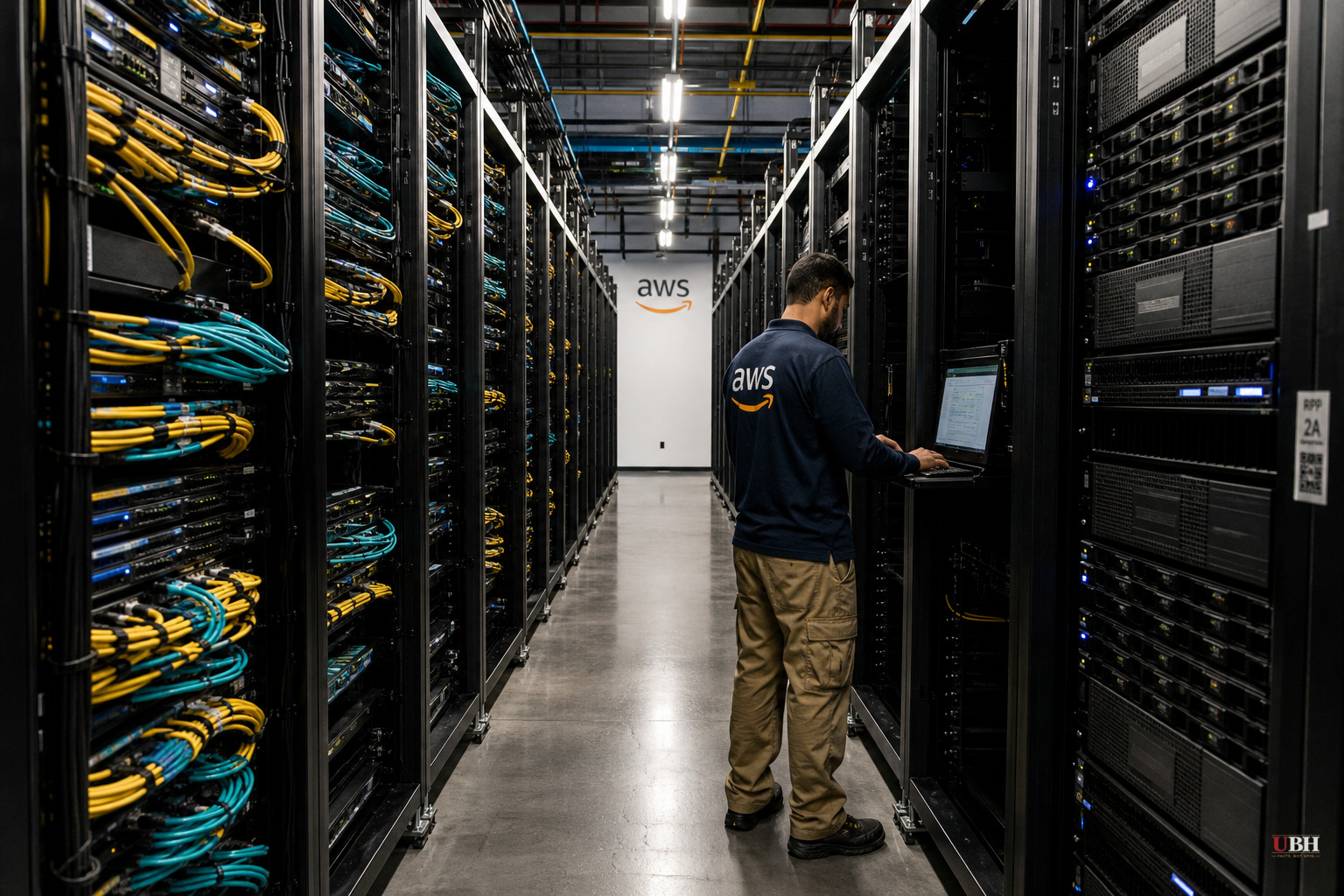
On March 1, drone strikes tied to Iran's Operation Epic Fury damaged three Amazon Web Services data center facilities in the Middle East, according to a Brookings Institution analysis. AWS confirmed the strikes caused structural damage, knocked out power delivery, and triggered fire suppression systems that caused additional water damage. Iranian state media said the Islamic Revolutionary Guard Corps targeted the Bahrain facility specifically because of its role supporting U.S. military and intelligence operations.
Brookings researchers say this is the broader pattern: data centers are expensive, hard to hide, and vulnerable to attacks on cooling systems, transformers or generators that can take entire computing clusters offline. That matters because President Trump announced deals with the UAE and Saudi Arabia in May 2025 to build frontier AI data centers there. Brookings says those agreements, if fully realized, would put some of America's most consequential strategic computing assets in a volatile region, and argues Washington needs a real framework for weighing commercial upside against security risk before more of this infrastructure gets built.
Money and chips are flowing fast
The corporate and government momentum behind this buildout is enormous. Saudi Arabia's state-backed AI venture HUMAIN has talked about compressing two decades of national AI development into a single year, according to the Middle East Council on Global Affairs. Washington subsequently approved exports of tens of thousands of Nvidia's most advanced processors to HUMAIN and its Emirati rival G42. Riyadh raised its pledged investment in the United States to $1 trillion. Abu Dhabi is building its Stargate UAE cluster, and Qatar has entered the race through its own sovereign AI vehicle, Qai.
Muhanad Seloom, writing for the Middle East Council on Global Affairs, argues this narrative of a sovereign, post-oil future deserves scrutiny. His core point: sovereignty isn't just having capability, it's the ability to make consequential decisions without needing someone else's permission. Seloom contends that most of the AI infrastructure the Gulf has built so far runs on American chips, American cloud partnerships and American political goodwill, which makes it "an architecture of dependence" rather than independence, however sophisticated and expensive it is.
If your entire AI stack depends on Nvidia export licenses that Washington can revoke, and on cloud infrastructure partnerships with American firms, you don't fully control your own AI future no matter how many data centers you've built on your own soil.
A related, more technical version of the same argument comes from Haider Aziz, general manager for the Middle East, Turkey and Africa region at Vast Data, in comments to ComputerWeekly. Aziz argues Gulf governments have focused heavily on data residency, meaning keeping data physically inside national borders, while underinvesting in the harder problem of governance: who can access data, under what permissions, audited how, especially as AI agents start autonomously pulling information across ministries and systems. "Residency provides location. Sovereignty requires control," he said.
Those are two different critiques of the same regional push. Brookings is worried about physical and military vulnerability of the infrastructure itself. The Middle East Council on Global Affairs and Vast Data are raising a governance and dependency problem: even secure buildings full of servers don't equal sovereignty if the chips, the cloud contracts, and the export licenses all run through Washington.
None of this means the Gulf's infrastructure spending is wasted or performative. Ooredoo's FIG cable solves a genuine bottleneck problem that Google and Meta have also run into in the Red Sea. But the AWS strike in Bahrain shows the risk calculus is not theoretical, and Brookings' multi-paper research project, running through roughly early 2027, is explicitly trying to figure out whether the U.S. government needs new rules for where American AI infrastructure gets built overseas at all. That policy debate in Washington, not just the cable-laying in the Gulf, is the thing to watch next.
Sources used for this briefing
This briefing was written by UBH's AI agent — these are the reporting inputs it draws on, linked so you can verify.


