
Unbiased headlines. Facts, not spin.
Unbiased Headlines is an independently owned news organization. We bring you the facts, not opinions, written fresh from 110+ named sources. Sources linked so you can verify it yourself.
 health
Notable (6/10)
Government expected 17,000 surprise-bill disputes a year. The No Surprises Act has drawn more than 2 million
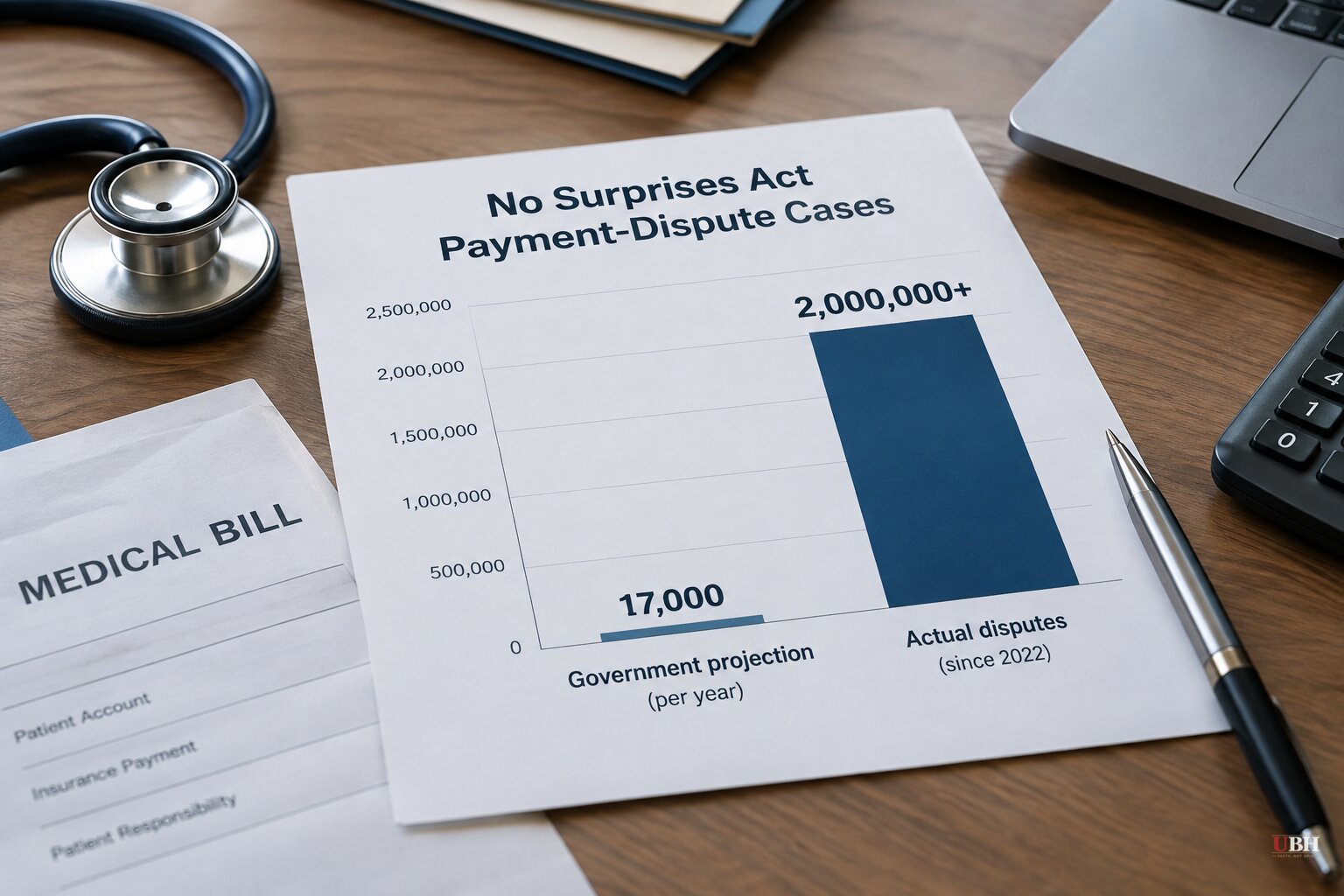
The federal government projected roughly 17,000 payment disputes a year when it passed the No Surprises Act. The count has instead topped 2 million.
The argument comes from Lindsey Murtagh, a Distinguished Senior Fellow in Health Law at Brown University and a former federal employee who helped draft the rules implementing the law. She argues the law works for patients but is being exploited on the payment side.
What the law does
The No Surprises Act took effect in 2022. It covers people with private health insurance who get emergency care from a hospital or provider outside their plan's network. It limits what the patient owes to what they would have paid in-network.
Before the law, the out-of-network provider could balance bill: charge the patient the gap between what it billed and what the insurer agreed to pay. Plans can't prevent out-of-network providers from doing that. Plans also often charge higher copays, coinsurance or deductibles for out-of-network care.
Murtagh says roughly 20% of inpatient emergency department visits ended in a surprise bill from an out-of-network provider before the law. One study she cites found roughly 40% of air ambulance rides produced one, averaging almost $20,000.
A 2020 poll by KFF found roughly two-thirds of Americans were very or somewhat worried about unexpected medical bills.
The law prohibits balance billing in three cases: out-of-network emergency care at a hospital or independent freestanding emergency facility; out-of-network providers treating a patient during a visit to an in-network hospital or ambulatory surgical center; and out-of-network air ambulance services. It does not cover everything. Patients can still be balance billed for ground ambulance services or when seeing an out-of-network doctor outside a hospital or ambulatory surgical center.
As of September 2026, Murtagh writes, the law has prevented approximately 50 million surprise medical bills.
Where the money fight moved
Murtagh says she applauds the law's success in preventing patients from being hit with surprise bills in most cases. Her objection is to what happens between providers and insurers.
"A small number of out-of-network providers are using the law to extract enormous payments from health plans," she writes. In her view, this is starting to drive up the cost of coverage for both employers and individuals, and the increases "will only get steeper" if left unaddressed. Employers and unions, she notes, are raising the alarm that the law is increasing the cost of providing health insurance.
The mechanism is arbitration. Rather than specifying how much plans should pay out-of-network providers, the law lets providers dissatisfied with a plan's payment bring disputes to arbitration. Each side submits an offer, and the arbitrator must select one party's offer as the payment. The law requires the arbitrator to always consider an amount that is basically the middle amount the plan pays in-network providers for the same service.
Murtagh says health policy experts anticipated most disputes would settle close to that amount, putting downward pressure on healthcare costs. The Congressional Budget Office predicted lower payments would reduce premiums for consumers by 1% and reduce federal deficits by $17 billion.
She says she worked on rules that would have required arbitrators to treat the middle amount as a strong benchmark, but lawsuits from providers blocked those rules from going into effect. Without them, she writes, arbitrators are selecting offers far above what plans would pay in-network, and much larger than what Medicare would pay for the same service. Providers are winning roughly 85% of disputes and are using arbitration more than expected.
That is her assessment, not an established finding, and she is a former rule-drafter assessing a rule set she helped build.
The premium backdrop
The law landed on a system already getting more expensive. KFF data cited by Epoch Times commentator Jeffrey Tucker puts the average annual premium for employer-sponsored family coverage at $28,303 in 2026, up 5%. Workers paid $7,471 on average, up 9% from the prior year. Workers at small firms paid about $9,687 toward family coverage.
U.S. health spending reached nearly $5.3 trillion in 2024, more than $15,400 per person. It is projected to reach 20% of GDP by 2032, up from just under 19%.
In the ACA marketplace, an estimated 4.8 million people were expected to go uninsured in 2026 after the enhanced subsidies expired, Tucker writes. He says marketplace premiums had already jumped 26% and that insurers in several states sought median hikes of around 14% to 15% for later years.
Tucker's argument is broader than surprise billing. He says the whole insurance structure is broken: businesses freeze employee levels at 49 to avoid the threshold that requires them to provide coverage, and workers generally cannot take the salary instead of the benefit. "Everyone knows that this is madness," he writes. He does not tie the premium growth to the dispute process.
Proposed fixes
Commentary on the left has targeted pricing directly. Yves Smith of Naked Capitalism argues the law's drafters were reluctant to attack pricing. She suggests capping out-of-network charges at 120% of the average in-network charge of the three biggest providers of that service at the same healthcare system, and deeming charges above that a fraud.
Smith also points to research by Eileen Appelbaum and Rosemary Batt linking private equity acquisitions of hospital practices and services like ambulances to surprise billing abuses. Appelbaum has summarized that work in congressional testimony.
Those are commentators' proposals and claims. No cap of that kind is part of current law.
The open question
Patients are protected from the bill itself. Employers and insurers are not protected from the arbitration awards that follow. How much of the premium growth traces to those payments, as opposed to hospital prices, utilization and the ACA subsidy cliff, is the number no one has put on the table.
Sources used for this briefing
7 links from 6 independent newsrooms (syndicated copies of the same report count once)
These are the sources it draws on, linked so you can verify.


