
Original briefings. Zero spin.
Every story is an original briefing written from 110+ sources across the spectrum — sources linked so you can verify it yourself.
 tech
Major Story (7/10)
September 8, 2026 at 02:51 PM
tech
Major Story (7/10)
September 8, 2026 at 02:51 PM
Google DeepMind Releases AI Database Predicting Effects of All 9 Billion Possible Human DNA Mutations
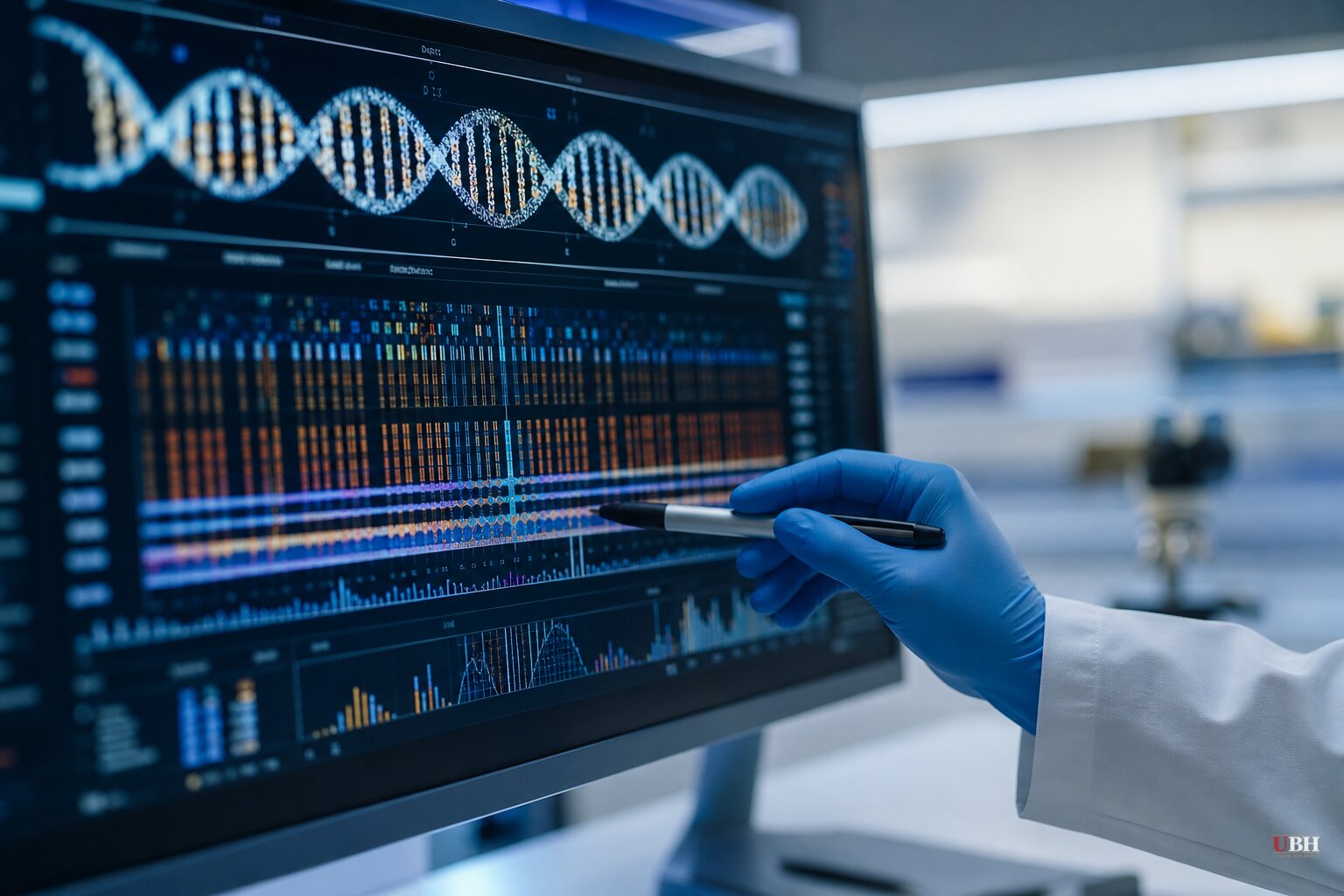
Google DeepMind unveiled AlphaGenome Atlas on Tuesday, September 8, a database that uses artificial intelligence to predict the biological effect of every one of the roughly 9 billion possible single-letter mutations in human DNA, according to a blog post from the company signed by Pushmeet Kohli, DeepMind's VP of Science, and Žiga Avsec, the company's genomics initiative lead.
The human genome runs about 3 billion base pairs, built from four chemical letters: A, C, G, and T. Google says only about 2 percent of that genome codes directly for proteins; scientists understand that portion reasonably well. The other 98 percent, the non-coding regions that regulate when and how genes switch on, has remained far murkier. Atlas is aimed squarely at that gap.
The database was built by running AlphaGenome, DeepMind's sequence-to-function AI model released last year and published in Nature in January 2026, across every possible single-nucleotide substitution in the standard hg38 reference genome, plus more than 100 million insertions and deletions drawn from the gnomAD, UK Biobank, and All of Us population datasets, according to a technical paper described by Unite.ai. Each variant in the resulting dataset carries an average of 27,000 separate predictions spanning hundreds of human and mouse cell types, and DeepMind also catalogued 2,601 recurring DNA sequence motifs and mapped where they show up across tissue types.
The finished dataset runs to roughly 1 petabyte, more than 30 times the size of the AlphaFold protein structure database DeepMind expanded in 2022, according to Unite.ai. To make that volume usable, DeepMind built a single ranking metric called the AlphaGenome Variant Impact score, or AVI, that folds coding and non-coding predictions into one number researchers can sort by, according to Google's own blog and reporting from The Verge and Fortune.
Access is free for non-commercial and academic use through a no-code web portal at alphagenome.google, Kohli told reporters on a briefing call reported by Fortune. Commercial access will run through a Google Cloud licensing arrangement that the company says is coming "soon" but has not yet detailed. Kohli confirmed that Isomorphic Labs, DeepMind's own drug-discovery sister company, will need that same commercial license to use Atlas. Even Google's in-house pharma arm doesn't get a free pass.
DeepMind is pointing to early outside validation rather than asking researchers to take the tool on faith. Working with the GREGoR Consortium, Broad Institute researchers Laura Covill and Anne O'Donnell-Luria used the AVI score to flag a deep intronic variant in the DNM1 gene, which is linked to epileptic encephalopathy, in a previously unsolved rare-disease case, according to Unite.ai. The AI predicted the variant created a brain-specific cryptic splice site that extended the resulting protein by 13 amino acids. Laboratory screens then confirmed it, supporting a "Likely Pathogenic" classification.
At the University of Exeter, researcher Gareth Hawkes applied the Atlas to whole-genome data from more than 54,000 UK Biobank participants, grouping rare variants by their predicted molecular effect rather than their location on the genome. That approach produced a 22 percent increase in detected genetic associations tied to non-coding DNA, according to Crypto Briefing.
Jonathan Sebat, a psychiatric geneticist at the University of California, San Diego, told Scientific American the tool should cut real time out of his lab's workflow. "Our own workflows in the lab can be streamlined quite a bit because we don't actually have to compute anything," Sebat said. "We literally can just look up everything."
The DNM1 case is one validated example out of 9 billion predicted variants. The Atlas is a hypothesis-generating tool, not a diagnostic one. It tells researchers where to look, not what's definitely true, and every lead it produces still needs the kind of wet-lab confirmation Broad Institute researchers did before anyone calls a variant pathogenic. Scientists and skeptics alike should treat AVI scores as a fast filter, not a verdict.
DeepMind is explicitly framing Atlas as a sequel to AlphaFold, the protein-structure database that helped earn then-DeepMind chief Demis Hassabis a share of the 2024 Nobel Prize in Chemistry, a parallel Scientific American draws directly. Kohli told Fortune the release helps finish what the Human Genome Project started in 2003: "As the saying goes, we bought the book, but we did not understand how to read it."
What isn't settled yet is money. Google has published academic access terms but has not disclosed pricing, licensing structure, or data-use restrictions for the commercial tier, including for its own Isomorphic Labs. Pharmaceutical companies, insurers, and biotech startups will eventually want that commercial access to hunt for drug targets. How Google prices and controls it is worth watching. That's a private company setting the terms for a resource that could shape how an entire research field prioritizes its work, and neither DeepMind's blog post nor its briefing to reporters has spelled out those terms yet.
Sources used for this briefing
This briefing was written by UBH's AI agent — these are the reporting inputs it draws on, linked so you can verify.


