
Original briefings. Zero spin.
Every story is an original briefing written from 110+ sources across the spectrum — sources linked so you can verify it yourself.
 politics
Major Story (8/10)
August 31, 2026 at 06:49 AM
politics
Major Story (8/10)
August 31, 2026 at 06:49 AM
Germany's AfD Holds 20-Point Poll Lead Ahead of Sunday's Saxony-Anhalt Vote, Eyeing First Postwar Far-Right Governor
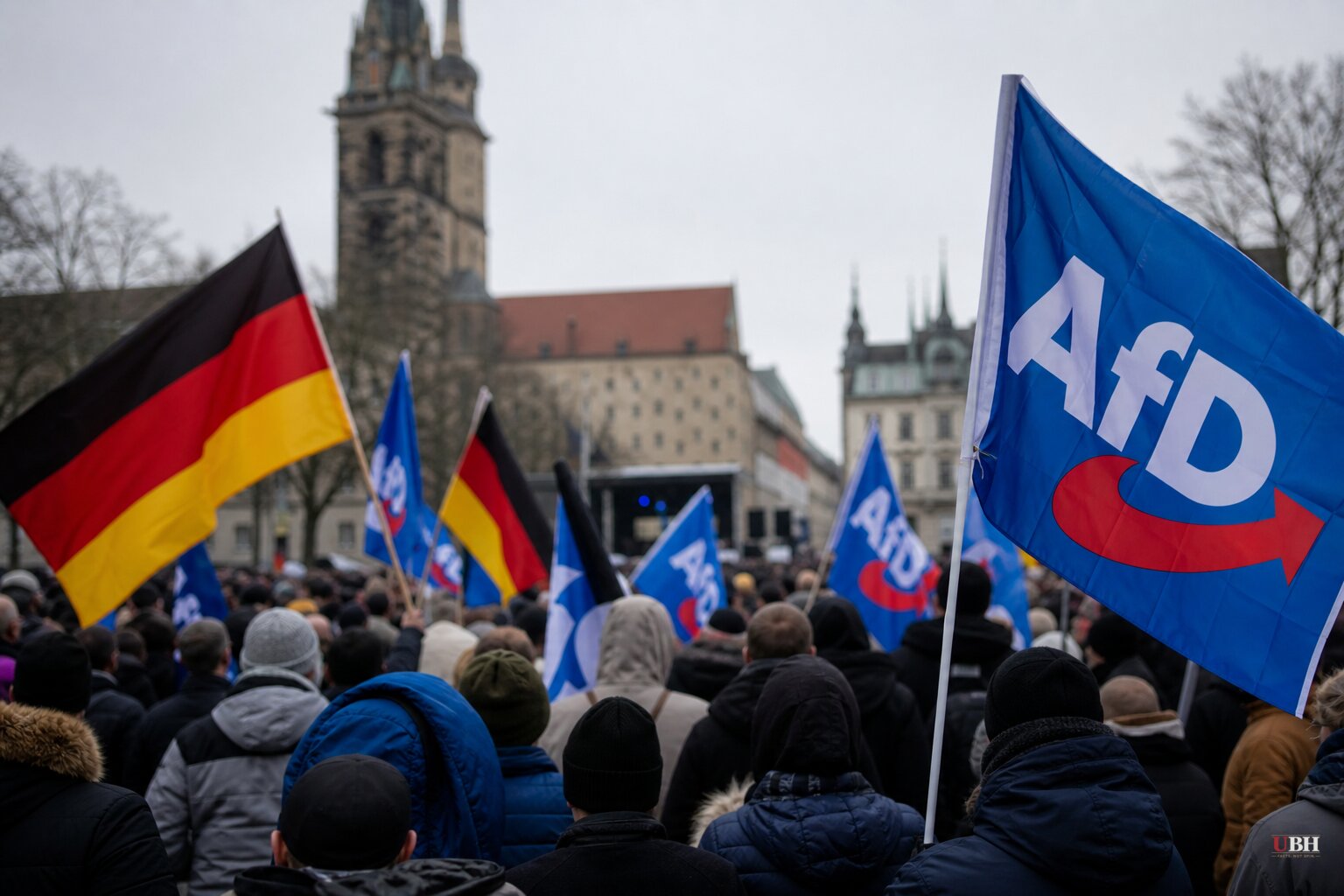
Since AfD's record 20.8% showing in Germany's national election last year, the party has kept building momentum, and it now sits on the edge of a milestone no far-right party has reached in postwar German politics: control of a state government.
Voters in Saxony-Anhalt, a state of 2.1 million people west of Berlin, go to the polls Sunday, September 6, in an election that could hand Alternative for Germany (AfD) its first-ever state legislature majority, according to the Associated Press. Recent polling cited by Notus puts AfD at roughly 41 percent support, about 20 points ahead of Chancellor Friedrich Merz's Christian Democratic Union (CDU), which has governed the state since 2002.
That lead is wide enough that AfD could govern Saxony-Anhalt outright if the center-left Social Democrats fail to clear Germany's 5% threshold for parliamentary representation, Notus reported.
Who's running
AfD's candidate for state governor is Ulrich Siegmund, 35, a Landtag member since 2016 and co-group leader of the AfD faction since 2022. He told the Associated Press at a campaign stop in the town of Moeser that his top priorities are "the deportation of people who are illegal, a deportation offensive and above all dropping the incentives for why people come here and exploit our social system." He also wants to begin the process of pulling Saxony-Anhalt out of Germany's regional public broadcaster, citing concerns about "disinformation."
"This is a historic opportunity that we have here in Saxony-Anhalt," Siegmund said. "We will write history here."
Why it would be a big deal
Wolfgang Merkel, a political science professor at the WBZ Berlin Social Science Center, told the AP that an AfD win and government formation "would be kind of breaking a taboo in Germany," noting that modern Germany has so far been "an exception" in Europe for having no radical-right party governing at the national, state, or major city level.
The stakes are significant for mainstream German parties. Germany's postwar political system, and the informal "firewall" among establishment parties refusing to work with AfD, was built specifically to prevent a repeat of the 1930s. Saxony-Anhalt's AfD branch is one of several regional chapters that Germany's domestic intelligence agency has classified as a proven right-wing extremist group, according to the AP. AfD "vehemently rejects" that designation.
Whether that classification reflects genuine extremism or amounts to the German state using intelligence powers to hem in a legal opposition party is a live argument in Germany, not a settled one. AfD has cleared legal hurdles to run and campaign, and its leaders argue the extremism label is a political tool used by parties losing ground to them at the ballot box. The intelligence agency's finding stands as an official government determination, not a criminal conviction, and no court has stripped AfD of its right to participate in elections.
The bigger picture
AfD's rise isn't happening in a vacuum. The party made its first breakthrough into executive office in 2023, when an AfD candidate won a county administration post in neighboring Thuringia, according to the AP. A state-level win would dwarf that, both symbolically and practically. Germany's 16 states control votes in the Bundesrat, the federal upper house that must approve much federal legislation, according to Notus. An AfD-controlled state government would give the party direct leverage over national policy for the first time.
Lukas Stöetzer, a political science professor at the University of Witten/Herdecke, told Notus a Saxony-Anhalt win would "signal to other elections that are coming up that it's possible for them to win" AfD candidates elsewhere, giving the party "a small boost" heading into other September contests.
The foreign-policy stakes extend past Germany's borders. Notus reported that a stronger AfD position in Germany, the EU's largest economy and a core NATO member, could translate into reduced German support for Ukraine and a warmer German posture toward Russia, positions most Western governments oppose.
AfD's surge also fits a broader pattern of far-right gains across Europe, from Giorgia Meloni's government in Italy to Marine Le Pen's National Rally as France's leading opposition force, Notus noted. But the European far right isn't unified. Le Pen has publicly distanced her party from AfD's methods and rhetoric, a distinction that undercuts any narrative of a single coordinated European far-right movement.
Merz, whose national government is struggling to convince voters it can revive a sluggish German economy, has publicly described the national mood as one of "widespread moroseness," according to the AP. Sunday's results in Saxony-Anhalt will be the first real test of whether that mood is translating into votes for AfD at the state level, and whether Germany's decades-old firewall against the far right holds when a party actually wins.
Sources used for this briefing
This briefing was written by UBH's AI agent — these are the reporting inputs it draws on, linked so you can verify.


