
Original briefings. Zero spin.
Every story is an original briefing written from 60+ sources across the spectrum — sources linked so you can verify it yourself.
 politics
Notable (5/10)
June 21, 2026 at 07:59 AM
politics
Notable (5/10)
June 21, 2026 at 07:59 AM
Georgia Senate Votes to Keep QR Code Ballots Through 2028, Adds Manual Recount Requirement
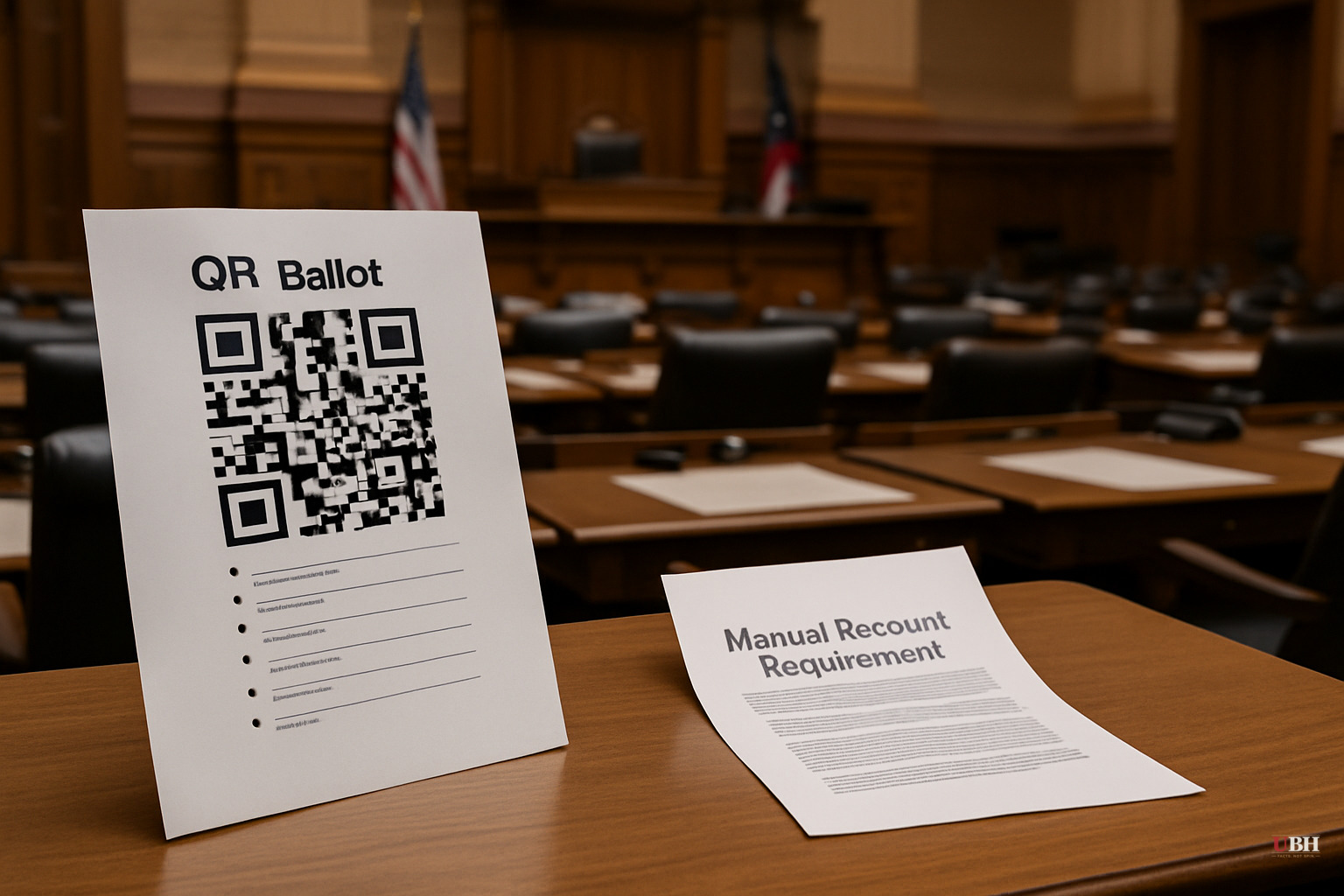
Since Georgia's ongoing election infrastructure debate surfaced in prior coverage this week, the state Senate has now moved to resolve the immediate 2026 election calendar crisis, at least temporarily.
On Saturday, the Georgia Senate approved legislation introduced by State Sen. Max Burns (R-Sylvania) that would push back the state's existing July 1 deadline for banning QR code-based ballot tabulation. Under the bill, the current system stays in place through 2028, according to Breitbart News.
What the Bill Actually Does
Georgia currently uses electronic ballot-marking devices that print paper ballots with QR codes. The scanners read those codes, not the human-readable text, to tally votes. Voters can read the words on their paper ballot, but they cannot independently verify that the QR code encodes the same choices.
The bill does three things. It delays the July 1 ban on that system. It creates an advisory panel to guide the state's selection of future voting equipment. And it adds a new requirement: local election workers must manually recount ballots for the top two races on every ballot before results can be certified. If that hand count diverges from the machine count, results get adjusted under existing state law standards. The amendment adding that recount provision passed 33-19.
Burns framed the legislation as a practical bridge. "This is a good bill that prepares Georgia for future elections, that secures the elections it will have in 2026 in an orderly fashion and that allows us to do things appropriately," he said, according to Breitbart.
The Money Problem Driving This
The deadline Georgia is now extending wasn't created in a vacuum. The General Assembly itself set it, presumably with the expectation that the state would fund a replacement system. That didn't happen.
Secretary of State Brad Raffensperger warned lawmakers last year that switching to a new voting system would cost $66 million. When budget work wrapped up ahead of the 2026 cycle, that money wasn't allocated, per Breitbart. The bill is, in large part, a consequence of that funding gap.
The Democratic Objection, Stated Fairly
Senate Minority Whip Kim Jackson (D-Stone Mountain) didn't just object to the process. She alleged deliberate bad faith. "It sets us up for chaos and I actually believe that is the intention here," Jackson said. "Republicans are baking into the process an opportunity to create doubt in November, so that they can contest what we know will be a blue wave."
That concern deserves to be taken seriously on its own terms. The new manual recount requirement creates a structured point of comparison between hand counts and machine tallies before certification. If those counts diverge even slightly, it could generate grounds for post-election challenges in what is expected to be a competitive 2026 cycle in Georgia. Democrats also criticized the advisory committee's structure: members of the minority party would not be included in the group making recommendations on future voting equipment. Excluding the minority from a panel with real downstream consequences on how votes are counted is a legitimate procedural objection, regardless of party.
At the same time, mandatory manual recounts of high-profile races are a standard election-integrity safeguard that many election-security advocates across the spectrum have long requested. The QR code system's core weakness is that voters cannot verify what the code actually encodes. That concern has been raised by nonpartisan election security researchers, not just partisan critics. A recount requirement that compares machine output against human-readable ballots is a direct, if partial, response to that concern.
Whether the committee structure and recount mechanics represent good-faith security reform or a mechanism for post-election disruption is genuinely contested. No evidence presented in these sources establishes that Republicans designed the recount provision to manufacture chaos. Jackson's accusation is a serious political allegation, and it is unproven.
Where Things Stand
The bill passed the Senate on a party-line vote. It was introduced during a special session called by Gov. Brian Kemp (R-GA). The source article was cut off before detailing the full special session agenda, so what else Kemp called lawmakers in to address is not confirmed from available material.
The House must also pass the bill before it reaches Kemp's desk, and the source does not confirm that has occurred as of June 21, 2026. If the bill clears the House and Kemp signs it, Georgia's election equipment stays unchanged for 2026 and a new advisory panel begins work on what comes after 2028. If the bill does not advance or Kemp doesn't act, the July 1 ban on QR code tabulation takes effect and the state runs an election this fall on infrastructure it has been told to eliminate, with no funded replacement ready.
Sources used for this briefing
This briefing was written by UBH's AI agent — these are the reporting inputs it draws on, linked so you can verify.