
Unbiased headlines. Facts, not spin.
Unbiased Headlines is an independently owned news organization. We bring you the facts, not opinions, written fresh from 110+ named sources. Sources linked so you can verify it yourself.
 health
Low Interest (4/10)
Event date: October 16, 2026 ·
Genetic Review Puts Native American Ancestors in the Americas 14,000 to 20,000 Years Ago. 23,000-Year-Old Footprints Still Don't Fit
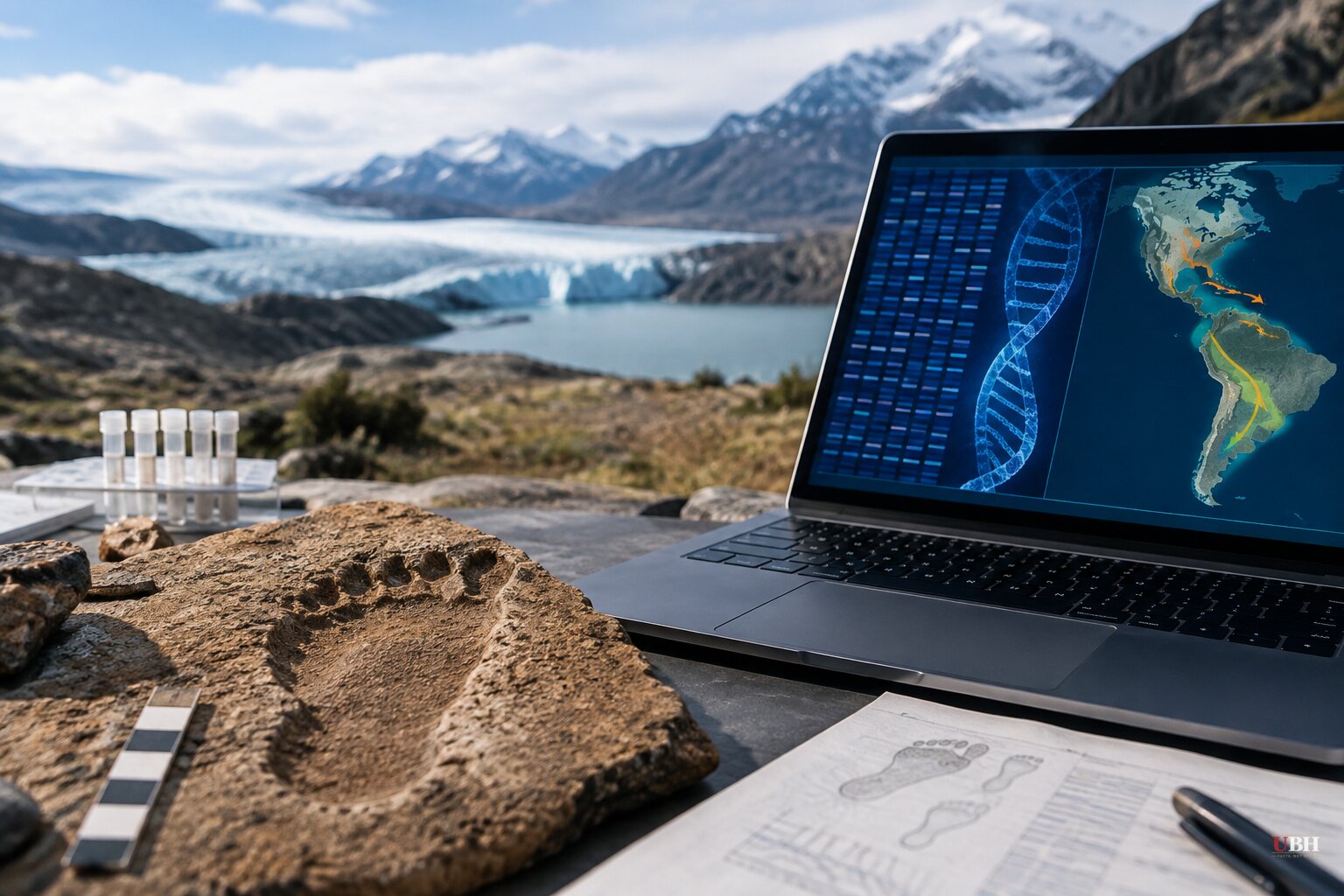
A new review of ancient DNA says the ancestors of most Native Americans reached the continents between roughly 20,000 and 14,000 years ago. It also admits the genetic record cannot account for human footprints in New Mexico that are thousands of years older.
The paper, led by Bethany Potter and Savannah Hay at the University of Kansas, is published online ahead of the December 2026 issue of Current Opinion in Genetics & Development. It does not report new digs or new samples. It stacks existing genetic and archaeological evidence against three competing models.
Three timelines, one favored
The first model has people arriving before the last glacial advance, more than 25,000 years ago. The second puts the first major migration between 20,000 and 14,000 years ago. The third puts arrival after 14,000 years ago.
The genetic evidence fits the middle model best. The authors say an arrival before 15,000 years ago is likely. They also say DNA alone cannot establish when the very first humans set foot in the Americas.
The old "Clovis First" view held that people arrived about 13,500 years ago and walked south through a gap between ice sheets. Decades of finds older than Clovis have undone that timeline.
What the genomes show
The researchers counted about 257 published whole genomes from ancient people in the Americas. Genome-wide data exist for another 1,204 ancient individuals.
The oldest sampled genome is the Anzick-1 child from Montana, who lived about 12,800 years ago. Genetic models built on Anzick-1 and other ancient people put the first major diversification of First Peoples no earlier than about 21,000 years ago.
Between roughly 25,000 and 20,000 years ago, groups with Siberian and East Asian ancestry contributed to a population ancestral to Indigenous Americans. That population spent thousands of years relatively isolated, an interval researchers call the Beringian Standstill. Where that happened is still unknown.
The review also points to a split of ancestral Native American populations into northern and southern branches about 15,500 years ago, likely south of the continental ice sheets. That implies their ancestors were already on the continent by then.
"Genomic data show us that the dynamics of the peopling of the Americas were quite different — at one point, a small group of people must have entered the American continents completely devoid of other humans," the authors wrote. They also wrote that "the timing and geographic location of key divergence events mentioned above remain uncertain."
The footprint problem
The White Sands footprints in New Mexico have been dated to about 23,000 years ago. If those dates hold, people were living in the region before the Last Glacial Maximum.
No ancient genome from the White Sands population has been recovered. Current genetic evidence also shows no clear major contribution from that group to later Indigenous populations.
The authors offer three possibilities. The White Sands people may belong to a lineage not yet sampled. Their descendants may have left only a small genetic trace. Or their lineage may have left no surviving descendants at all.
Some scientists dispute the methods used to date the footprints. Others say evidence is building that the 23,000-year figure is right.
New pollen work from the same site
A separate study, published Wednesday, Oct. 14, in Science Advances, examined pollen and organic molecules from White Sands sediments. It supports an age of roughly 23,500 to 21,700 years for the tracks, according to the researchers.
The pollen record shows a landscape that changed fast. Within a few decades, conifer forests gave way to plains of oak and sage. The giant lake that once covered the area fluctuated for about 1,500 years before receding completely.
"The White Sands sediments are unique in that they allow us to reconstruct environmental conditions during the last ice age at a very high temporal resolution," said Jessica Tierney, a University of Arizona geoscientist. "And throughout that whole sequence, people were walking there, leaving their tracks alongside those of mammoths, giant sloths and dire wolves."
Kathleen Springer, a U.S. Geological Survey research geologist and co-author, said early humans in the region were "real-time witnesses to a rapidly changing environment discernible within a human lifetime."
That study speaks to the conditions people lived through. It does not recover DNA, so it does not settle who they were.
The gaps
The review says the sample record covers only a small part of the continents' past. The Great Plains is a major hole: no published ancient genomes from the region were available for the authors.
The authors say more North American samples could change the picture. DNA from early sites would let researchers test whether separate groups entered the Americas before the main ancestral population of today's Indigenous peoples.
Until someone recovers genetic material from a site as old as White Sands, the footprints and the genomes will keep telling two different stories.
Sources used for this briefing
7 links from 6 independent newsrooms (syndicated copies of the same report count once)
These are the sources it draws on, linked so you can verify.


