
Unbiased headlines. Facts, not spin.
Every story is an unbiased news briefing written from 110+ sources across the spectrum — sources linked so you can verify it yourself.
 health
Low Interest (3/10)
August 9, 2026 at 06:07 PM
health
Low Interest (3/10)
August 9, 2026 at 06:07 PM
French Researchers Test Thermal-Sensor Bra to Screen for Breast Cancer Between Mammograms
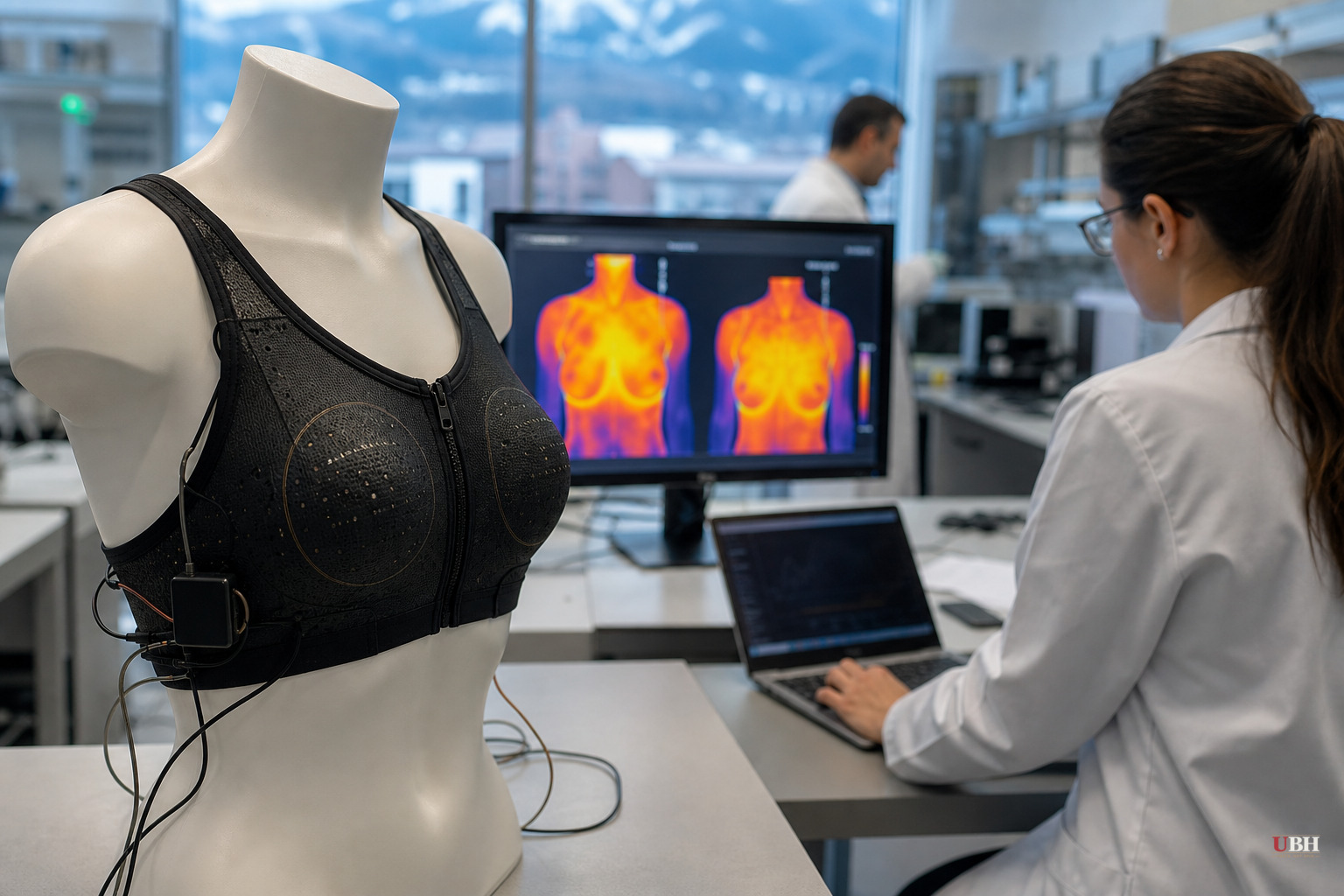
A French-Swiss research team has built a bra designed to screen for early signs of breast cancer using body heat and electrical signals instead of X-rays, according to the New York Post.
The device, called PHI-BRA, is worn for 30 minutes at a time. It uses skin surface thermography, essentially a heat map of breast tissue, on the theory that tumors and other cancerous changes increase local blood flow and raise skin temperature in specific spots.
The bra also carries surface electrodes that perform electrical impedance spectroscopy, a method that measures how cells conduct electrical signals. Tumor tissue has a different cellular structure than healthy tissue, so it responds differently to that signal.
An AI system analyzes both data streams together, looking for heat and structural patterns that don't fit the normal range, while also accounting for measurement uncertainty so it doesn't flag noise as a warning sign.
What this is not
This is not a mammogram replacement and researchers aren't pitching it as one. Mammograms remain the medical standard, recommended annually starting at age 40. PHI-BRA is being framed as a supplemental screening tool, something a woman could use between annual scans or in years when she's not yet eligible for a mammogram.
A thermal-and-impedance bra is not FDA-cleared, and the Post's coverage doesn't cite any clinical trial data, peer-reviewed results, sample size, sensitivity rate, or false-positive rate for PHI-BRA. Readers should treat this as an early-stage research project, not a validated medical device on shelves.
Why the age question matters
Metastatic breast cancer, meaning cancer that has already spread beyond the breast by diagnosis, rose 3% among women aged 20 to 39 between 2004 and 2021. Those women fall well outside the standard mammogram window, which is exactly the gap researchers say wearable screening tools are meant to fill.
Breast cancer overall accounts for roughly 30% of new female cancer diagnoses each year and is projected to affect more than 320,000 women in 2026. Anything that catches tumors earlier, even as a secondary screening layer, matters in real terms.
Not the only device in this space
PHI-BRA isn't alone in trying to solve this problem. Researchers at MIT have developed a separate wearable that clips onto a bra and uses ultrasound imaging to detect breast tissue abnormalities. That device has reportedly picked up cysts as small as 0.3 centimeters, roughly the size tumors are when they're still in early stages.
Both approaches share the same basic goal: give women, especially younger women outside the standard screening age, a low-cost, non-invasive way to monitor breast tissue changes without waiting for an annual scan or a doctor's referral.
The skeptical read
Thermography as a cancer-detection method has a mixed track record. The FDA has previously warned that thermography devices marketed as mammogram alternatives or substitutes are not effective substitutes and can miss cancers that mammograms would catch, or generate false alarms that lead to unnecessary anxiety and follow-up testing.
That's a fair concern, and it's one PHI-BRA's own framing seems to anticipate by positioning itself as a supplemental tool rather than a diagnostic one. Whether the added electrical impedance layer meaningfully improves accuracy over thermography alone is an open question that will need to be answered by published trial data, not a manufacturer's product description.
The Post's write-up leans heavily on the promise of the technology without pressing on the evidence gap. There's no mention of who is funding the PHI-BRA research, what regulatory pathway it's pursuing in France, the EU, or the U.S., or when, if ever, it might reach consumers. Those are the questions that determine whether this becomes a real clinical tool or stays a research prototype.
For now, women worried about breast cancer risk have one validated tool: the mammogram, starting at 40, or earlier for those with elevated risk factors as advised by a doctor. A smart bra might one day close the gap between scans. It hasn't done that yet.
Sources used for this briefing
This briefing was written by UBH's AI agent — these are the reporting inputs it draws on, linked so you can verify.


