
Unbiased headlines. Facts, not spin.
Every story is an unbiased news briefing written from 110+ sources across the spectrum — sources linked so you can verify it yourself.
 finance
Major Story (8/10)
September 18, 2026 at 12:45 PM
finance
Major Story (8/10)
September 18, 2026 at 12:45 PM
French Borrowing Premium Over Germany Hits 100 Basis Points, Widest Since the Eurozone Debt Crisis
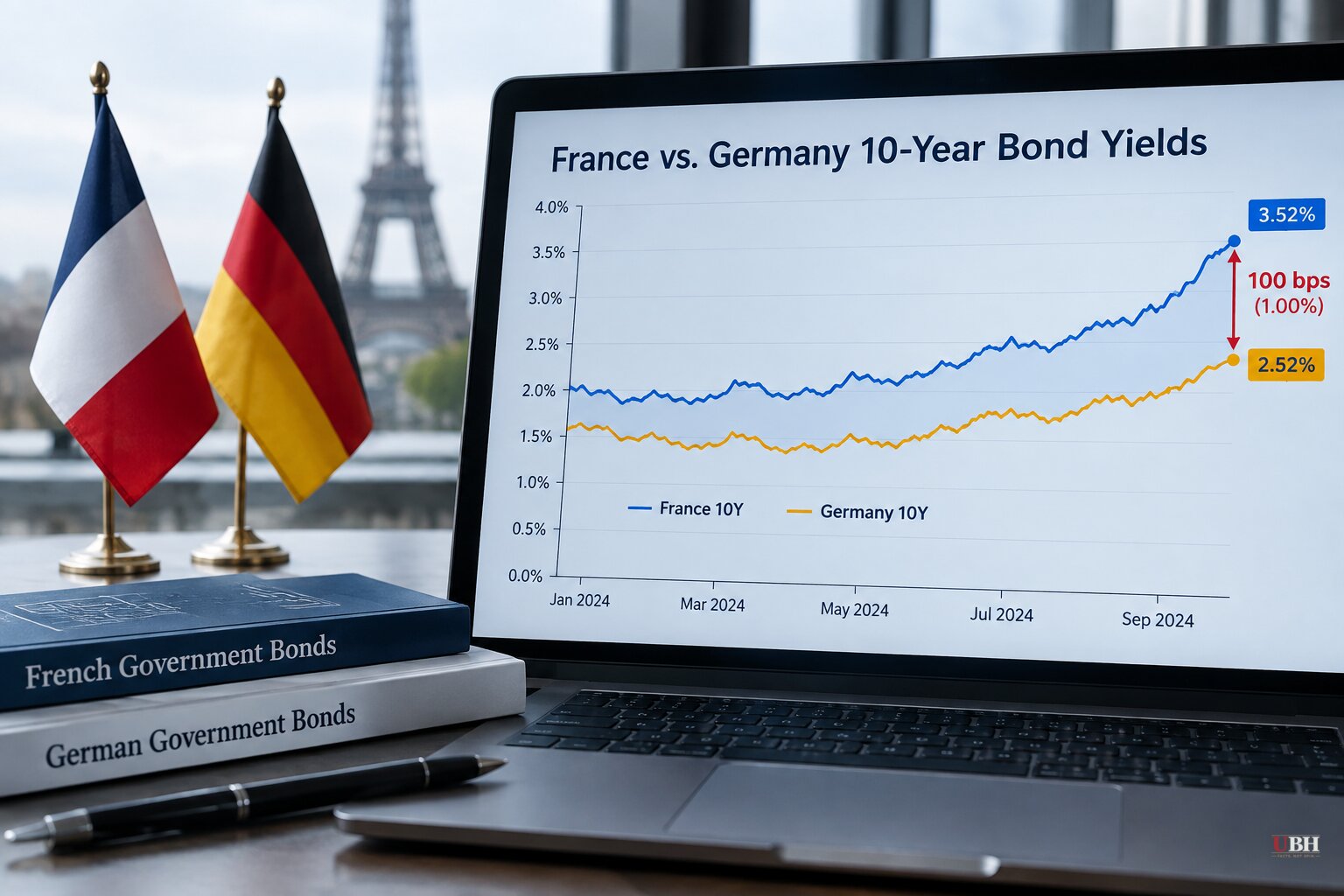
France's borrowing costs relative to Germany just crossed a line that hasn't been crossed since Europe was debating whether the euro would survive.
The OAT-Bund spread, the gap between French and German 10-year government bond yields, hit roughly 100 basis points on September 18, according to Crypto Briefing. That's up from about 60 basis points in April 2026 and 87 basis points as recently as September 5, according to figures cited by Europe Says from Bloomberg. Reuters, via the London Stock Exchange's Financial News, described the move Friday as a "fresh 14-year high."
French 10-year yields have climbed to about 4.48% to 4.5%, the highest level since 2008. German Bund yields, Europe's benchmark safe asset, sit around 3.50% to 3.51%, their highest since June 2009. Both countries are getting swept up in a broader global bond selloff, but France is getting hit harder.
Why France, specifically
French public debt has surpassed €3.5 trillion, or about 117% of GDP, well above the eurozone's 60% reference threshold, according to Europe Says. The European Commission projects a 2026 deficit of roughly 5.1% of GDP, more than double the EU's 3% ceiling. The IMF expects the debt ratio to exceed 120% by 2027.
Growth isn't helping. French GDP contracted 0.2% quarter-on-quarter in the first three months of 2026 and was flat in the second quarter, per Europe Says. Debt is rising while the growth needed to service it is shrinking.
Politics is making it worse. With a presidential election looming in 2027, French lawmakers have avoided the tax hikes or spending cuts that might reassure bond markets, Europe Says reported. Premier Lecornu's own proposed budget cutbacks have generated friction rather than confidence, according to Crypto Briefing.
In a letter dated September 15, 2026, Lecornu told his cabinet that rising rates will add an extra €10 billion to France's debt servicing costs, according to PrimeXBT. He ordered ministers to freeze non-defense spending at 2026 levels while drafting the 2027 budget. Defense spending is shielded from the freeze, meaning the entire adjustment falls on civilian programs. With inflation still present, a nominal freeze amounts to a real-terms cut.
Annual French interest payments are already projected to hit €65 billion, a sum that exceeds what the country spends on either defense or education individually, PrimeXBT reported. If the additional €10 billion materializes, total debt servicing would approach €75 billion a year, one of the largest line items in the French budget.
The foreign-money problem
France's bond market carries an unusual vulnerability. Foreign investors held 57.5% of French government bonds in the first quarter of 2026, up from 49.8% in 2022, according to Europe Says. That compares with 32.1% for U.S. Treasuries and 32.9% for U.K. gilts. Larissa de Barros Fritz, an analyst at ABN AMRO, told Europe Says that about 35% of French bondholders are highly sensitive to price moves, meaning even a modest pullback in foreign buying could send yields swinging sharply. Auctions are still clearing and demand hasn't evaporated, Crypto Briefing noted, but the reliance on outside capital is the kind of exposure that turned into a rout for other countries during the 2011-2012 crisis.
A global backdrop, not just a French story
France isn't selling off in isolation. Japan's 10-year yield hit 3% for the first time since 1996, and the U.K.'s 30-year yield reached its highest level since 1998, CNN reported. The U.S. 10-year Treasury yield touched 5.041% this week, the highest since July 2007, before easing to around 4.96%, according to Reuters figures carried by the LSE's Financial News. The 30-year Treasury yield hit 5.27% in August, its highest since 2007, per CNN.
Oil added fuel to the fire. Brent crude jumped 4.6% to settle at $94.65 a barrel on Tuesday, September 15, after the U.S. and Iran traded attacks for the first time in over a month, with U.S. forces striking Islamic Revolutionary Guard Corps targets, CNN reported. WTI rose 5.2% to $90.22, its first settle above $90 since July. Tom Tzitzouris, head of fixed income research at Baird Strategas, told CNN that "the longer the conflict abroad persists, the greater the risk of long-run inflation."
Traders are still pricing in more European Central Bank tightening, not less. Reuters, via the LSE, reported markets fully pricing one ECB rate hike and about a 50% chance of a second by the end of 2027, with German two-year yields on track for a sixth straight weekly gain. That sits awkwardly next to a headline from Economic Times describing eurozone bond yields as "set for weekly decline" on "ECB hike bets" easing, a framing that doesn't square with Reuters' own Friday reporting of persistent hike bets and a French spread at a 14-year high the same day.
What was supposed to be the ceiling
Kristian Kerr, head of macro strategy at Morgan Wealth Management, wrote on September 2 that the roughly 90-basis-point spread had "effectively acted as a ceiling during episodes of fiscal stress" over the past several years, with policymakers historically stepping in to reassure investors before things got worse. That ceiling has now been breached. Kerr warned that a decisive break above 90 basis points could signal investors are no longer viewing France's fiscal problems as temporary, and that the fallout could spill over into other heavily indebted eurozone members.
The historical peak during the 2011-2012 crisis was roughly 190 basis points. At 100 basis points, France is now about halfway there, with a 2027 budget fight and a presidential election still ahead.
Whether Lecornu's spending freeze survives France's fractured parliament, and whether the 2027 budget debate produces anything markets read as credible reform, will determine whether the spread keeps climbing toward that 2011 peak or stabilizes where it sits today.
Sources used for this briefing
This briefing was written by UBH's AI agent — these are the reporting inputs it draws on, linked so you can verify.


