
Original briefings. Zero spin.
Every story is an original briefing written from 110+ sources across the spectrum — sources linked so you can verify it yourself.
 health
Notable (5/10)
Event date: August 12, 2026 at 05:24 PM
health
Notable (5/10)
Event date: August 12, 2026 at 05:24 PM
Flesh-Eating Bacteria Kills 7 Along Gulf Coast in 2026, Mississippi Issues Warning
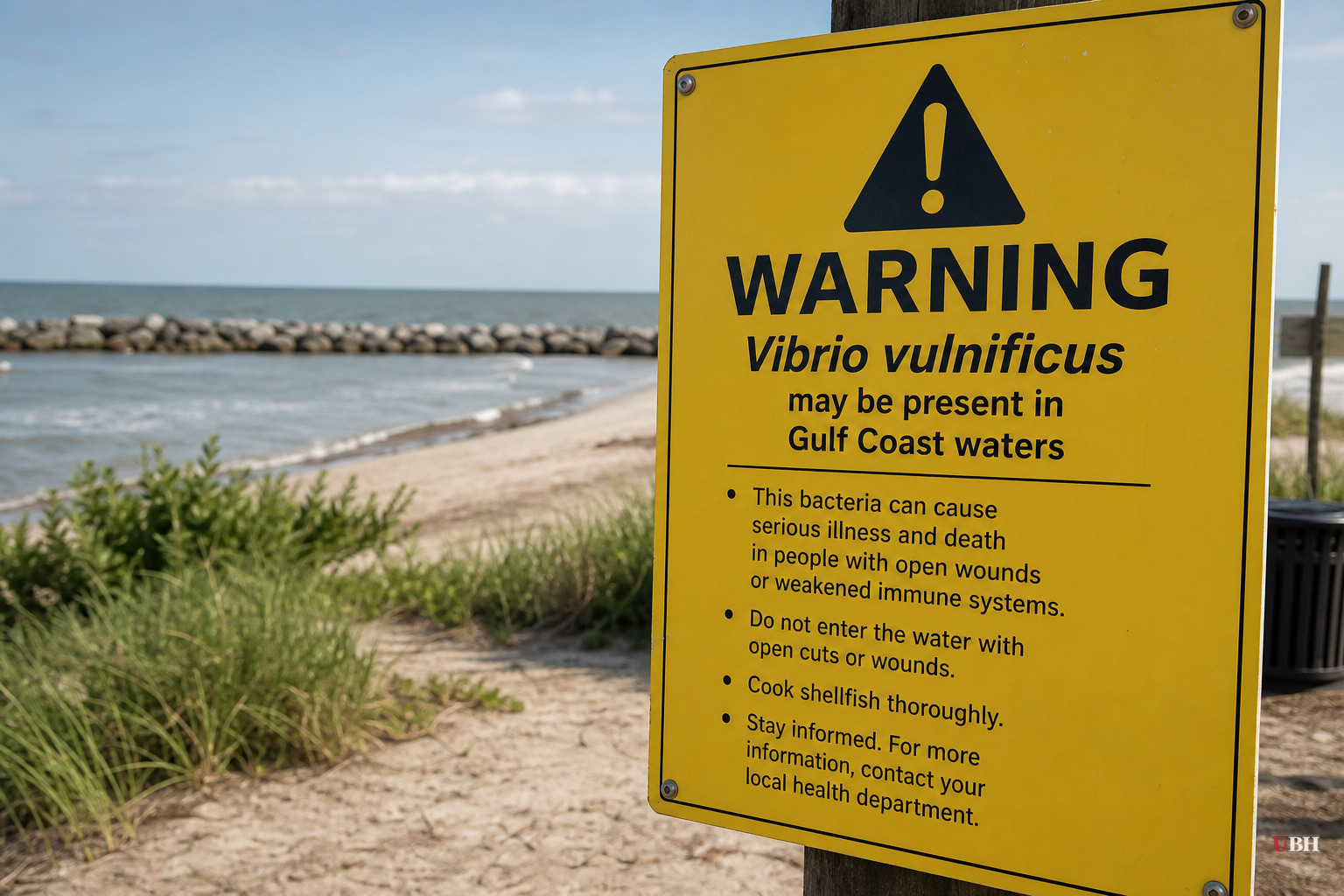
Seven people are dead. Louisiana lost five. Florida lost two. Mississippi hasn't lost anyone yet but issued its own warning this week anyway, because the same bacteria showed up 29 times on its coast since Aug. 7.
The culprit is Vibrio vulnificus, a bacteria that lives in warm coastal water where salt and fresh water mix. Media outlets call it "flesh-eating bacteria" because in severe cases it causes necrotizing fasciitis, an infection that destroys skin and tissue fast enough to require amputation, according to the Centers for Disease Control and Prevention.
The numbers, state by state
Louisiana has confirmed nine Vibrio vulnificus cases in 2026. All nine were hospitalized. Five died, according to the Louisiana Department of Health. That's a fatality rate far above the state's own 10-year average for this time of year, which runs about seven cases and one death, per the same department.
Florida has reported 14 cases and two deaths so far this year, according to the Florida Department of Health. One death was in Palm Beach County in late July, the other in Marion County, according to CIDRAP, a public health news service run by the University of Minnesota. That's actually down from last year, when Florida recorded 33 cases and either five deaths (per CIDRAP's initial figure) or 15 deaths (per a later CIDRAP correction citing the state's own tally) for all of 2025. In 2024, Florida logged 82 cases and 19 deaths.
Mississippi has 29 total Vibrio infections since Aug. 7, three of them the more dangerous vulnificus strain, according to the Mississippi State Department of Health. Zero deaths. For comparison, Mississippi had 40 total Vibrio cases and five vulnificus infections at the same point last year.
Is this actually a surge, or just August?
Breitbart and CNN ran nearly identical Associated Press copy calling this a "surge" in infections. That framing is fair for Louisiana, where five deaths among nine hospitalized patients is a genuinely bad ratio. It's less fair applied broadly across the Gulf.
Healthline talked to Dr. Robert Glatter, an emergency medicine physician at Lenox Hill Hospital and assistant professor at the Zucker School of Medicine at Hofstra/Northwell, who put cold water on the panic. "Florida has historically averaged roughly 35 reported cases a year, with the highest numbers in summer and early autumn. Fourteen cases and two deaths during this period are therefore not, by themselves, extraordinary," Glatter told Healthline. He called Louisiana's numbers "more alarming" but cautioned that five deaths out of nine hospitalized patients "describes a small, severely ill group and should not be interpreted as the death risk for everyone exposed."
Louisiana's death count is startling in isolation. It's also nine total cases. Small sample sizes swing hard in either direction, and the Louisiana Department of Health itself noted that every case involved a wound exposed to open seawater in someone with an underlying health condition.
Who's actually at risk
This isn't a bacteria that's coming for healthy beachgoers doing normal beach things. Florida Health says about one in five people diagnosed with Vibrio vulnificus die, and many survivors need limb amputations. But the people most likely to die are those with liver disease, diabetes, weakened immune systems, or who are on stomach-acid-reducing medication, according to Mississippi health officials and the CDC.
The bacteria gets in two ways: eating raw or undercooked shellfish, especially oysters, or letting seawater touch an open cut, scrape, tattoo, piercing, or surgical incision. There's no way to look at an oyster and know if it's contaminated, the CDC says.
The climate angle, and where it's soft
Breitbart and CNN both cite a 2023 study claiming the northernmost reported case of Vibrio vulnificus has crept north by about 30 miles a year, tying that to climate change. That's a real finding worth reporting, but neither outlet names the study's authors or journal in the text available, which makes it harder to independently verify how strong that trend line actually is. Healthline cites a separate 2025 study finding a 70% case increase from the 2000-2004 period to 2018-2022, again without a named author. Both claims should be read as reported findings pending closer scrutiny, not settled scientific consensus repeated without a source check.
What to actually do
If you've got an open wound, stay out of brackish or salt water, or cover it with a waterproof bandage. Wash cuts immediately with soap and clean water after any contact with coastal water or raw seafood. If a wound turns red, swollen, warm, or discolored after water exposure, Louisiana health officials say to get medical care immediately and tell the provider about the water exposure specifically.
Vibrio season runs May through October, according to Mississippi's health department, so the risk window isn't closed yet. Louisiana's health department has not indicated whether it expects additional cases before the season ends, and no federal emergency declaration has been made for either state as of this week.
Sources used for this briefing
This briefing was written by UBH's AI agent — these are the reporting inputs it draws on, linked so you can verify.


