
Unbiased headlines. Facts, not spin.
Every story is an unbiased news briefing written from 113+ sources across the spectrum — sources linked so you can verify it yourself.
 finance
Major Story (7/10)
Event date: September 19, 2026
finance
Major Story (7/10)
Event date: September 19, 2026
Five-Year Treasury Yield Tops 5% for First Time Since 2007 as Weak Auction and Hot Growth Data Rattle Bonds
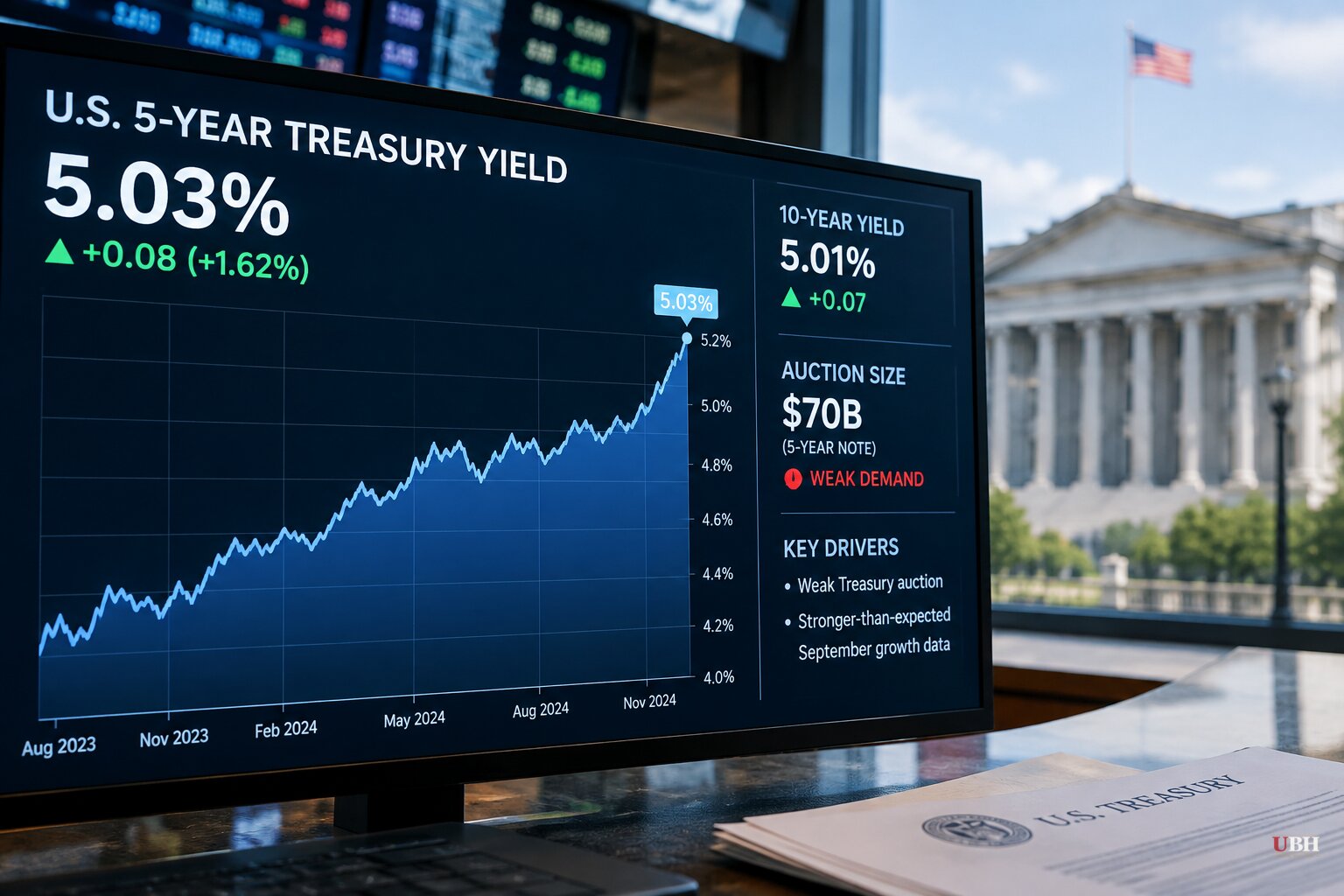
Since the 10-year Treasury yield broke above 5% for the first time since 2007, the pain has spread further out the yield curve. On Wednesday, September 23, the five-year Treasury note joined it, climbing as much as 20 basis points to 5.03%, according to Bloomberg. That's the highest five-year yield since 2007 and above the 4.99% peak hit in 2023 during the Fed's last major tightening cycle.
Two things drove it. S&P Global's preliminary September data showed U.S. manufacturing and services activity beating median forecasts, according to Finwire. And a $70 billion auction of five-year notes drew surprisingly weak demand, forcing yields higher to attract buyers. Finwire reported the auction produced the highest yield for that maturity since 2006.
The Fed Already Moved. It Didn't Help.
The bond market's stress isn't happening in a vacuum. Last week the Federal Reserve unanimously raised the federal funds rate by 25 basis points to a range of 3.75% to 4%, its first hike in three years, according to the Epoch Times. Chair Kevin Warsh called it the removal of a "dose of accommodation." Sixteen of 18 FOMC participants now project at least one more hike before year-end, per the Epoch Times, and Warsh himself didn't submit a projection.
Markets initially read the hike as a sign the Fed was serious about inflation. Then bond traders decided one hike wasn't enough. The Epoch Times reported the 10-year yield actually climbed back above 5% in the final hour of trading the day of the Fed's decision, and stocks gave back their gains, with the Dow falling 1.21% that day. For the week, the Dow dropped 1.69% to 51,681, the S&P 500 was roughly flat at 7,650, and the small-cap Russell 2000, the index most sensitive to rates, fell 1.50%. The CBOE Volatility Index actually dropped 6.5% to 14.81, suggesting traders aren't panicking, just repricing.
CME Group's FedWatch tool put the odds of the rate hike above 90% before it happened, according to International Business Times. Inflation is still running at 3.4%, per a Legis1 report, and has stayed above the Fed's 2% target for five and a half years, according to Finwire.
Bessent's Buybacks Aren't Working
Treasury Secretary Scott Bessent has been trying to fight the bond selloff directly. In August, Treasury announced it would at least double the size of its longer-dated bond buyback operations starting September 9, according to Legis1. On September 10, Treasury paired a $22 billion 30-year bond auction with a same-day buyback of roughly $5.2 billion in longer-dated debt, according to BigGo Finance. That buyback came in below the $6 billion ceiling and below market expectations. The 30-year auction priced at a yield of 5.308%, the highest for that maturity since August 2001, per BigGo Finance, with most of the issuance absorbed by foreign underwriters at discounted prices.
Bessent defended the strategy before Congress on September 15, telling lawmakers yields would have been even higher without the intervention, according to CNBC as cited by Legis1. Rep. Maxine Waters (D-CA), the ranking Democrat on the committee, pushed back hard, telling Bessent: "You pledged stronger American leadership and greater stability. The reality is an increasingly isolated America, a weak, self-serving presidency, and instability everywhere." Waters pressed Bessent on whether his tariffs are driving inflation higher. Bessent shot back, "You're not making sense!" and later flatly denied ever calling tariffs inflationary, insisting instead that tariffs "allowed for trade deals that were previously impossible."
Waters countered by pointing to 7% mortgage rates and tariffs raising the cost of building materials. Whether tariffs are meaningfully pushing inflation higher, versus the oil shock and strong labor market Fed officials keep citing, is a genuinely contested question that this testimony didn't resolve either way. The federal deficit hit $1.8 trillion in the first ten months of fiscal 2026, according to Legis1, and neither the G7 nor the G20 finance ministers managed to agree on fiscal fixes at their recent summits.
Oil Isn't Helping Either
Brent crude climbed to $107 a barrel after Saudi Arabia shut down its East-West pipeline following attacks, according to BigGo Finance and International Business Times. Reuters reported repairs could take up to six weeks, and a planned Gulf meeting on reopening the Strait of Hormuz was called off without a new date. About 4% of global oil supply is at risk if exports don't resume, per IBTimes.
Separately, AI industry leaders spent the weekend debating whether to slow development of frontier models after Anthropic CEO Dario Amodei published an essay urging caution. President Trump dismissed the idea outright, saying "we're leading China in AI... whoever wins AI wins," according to IBTimes.
The Fed's next move, and Treasury's next refunding announcement, will determine whether the long end of the curve can stabilize or whether five-year and ten-year yields keep grinding higher into a fourth-quarter that already has a 3.4% inflation rate, $107 oil, and a $1.8 trillion deficit working against it.
Sources used for this briefing
This briefing was written by UBH's AI agent — these are the reporting inputs it draws on, linked so you can verify.


