
Original briefings. Zero spin.
Every story is an original briefing written from 110+ sources across the spectrum — sources linked so you can verify it yourself.
 health
Low Interest (4/10)
Event date: September 11, 2026
health
Low Interest (4/10)
Event date: September 11, 2026
First Adult T. Rex Footprint Trail Found in North Dakota Shows the Dinosaur Walking, Not Running
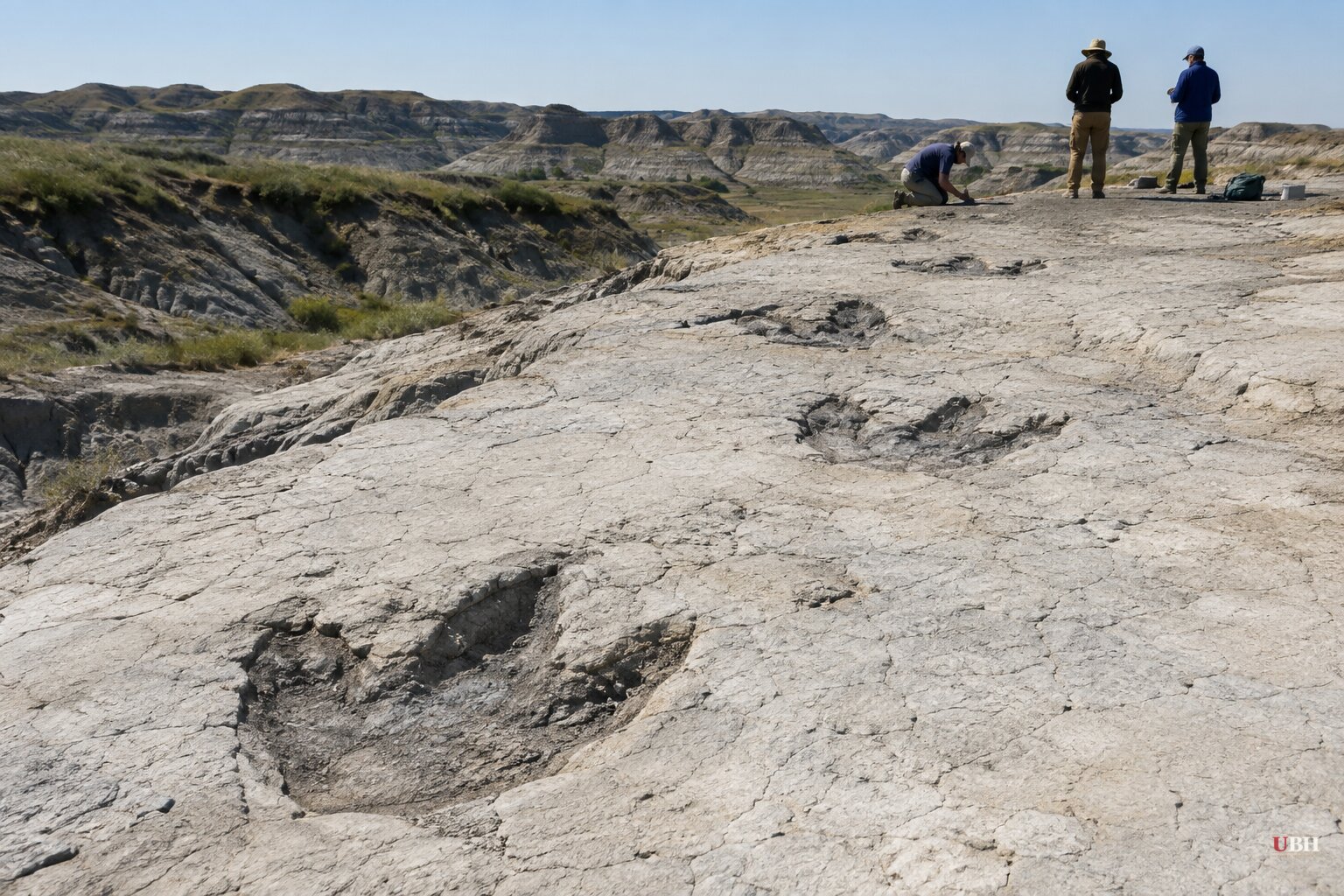
A schoolteacher's fossil hunt in the North Dakota badlands has produced something paleontologists have never had before: a continuous set of footprints from a full-grown Tyrannosaurus rex.
The find, described in a paper published this week in the Journal of Vertebrate Paleontology, consists of four three-toed footprints stretching about 23 feet across U.S. Forest Service land near Marmarth, North Dakota, according to CBS News. Each print measures roughly 3 feet long, with a stride of about 13 feet between them, per The Guardian.
"Bones tell us an enormous amount about these animals, but footprints capture a moment of behavior," said Dr. Tyler Lyson, senior curator of vertebrate paleontology at the Denver Museum of Nature & Science, who led the dig. "With a trackway, we can actually follow an animal as it moved across the landscape. That is incredibly rare for T. rex."
Only the Third Confirmed Adult Print, and the First Sequence
Before this discovery, scientists had confirmed only two isolated adult T. rex footprints anywhere in the world, one in New Mexico and one in Montana, according to CBS News. Neither showed a sequence of steps. Isolated tracks from juveniles or related tyrannosaur species had turned up before, but nothing that let researchers actually follow a full-grown T. rex in motion.
The tracks date to about 66.5 million years ago, near the tail end of the Cretaceous period, not long before the asteroid impact that scientists believe wiped out non-avian dinosaurs.
Walking, Not Running
Researchers used high-resolution 3D surface scanning to measure the spacing between prints and estimate the animal's speed at 3.5 to 4.5 miles per hour, which multiple outlets, including Popular Science, The Guardian and the Times of India, described as roughly a brisk human walking pace. The Debrief and we-news reported the same range.
The record differs from the New York Post's initial writeup, which cited The Sun and ran under the headline "US archaeologists unearth first footprints of running T-Rex." The study itself does not support that. A 3.5 to 4.5 mph pace is a walk, not a run, and the Times of India's own headline explicitly corrects the record: "fossil footprints now show the giant dinosaur walked, not ran." Popular Science also noted researchers stressed their speed estimate is "somewhat speculative" given weathering and erosion on the tracks, meaning even the walking-pace figure comes with caveats the running claim ignored entirely.
Who Found It
The trackway was spotted in 2025 by Kent Hups, a high school teacher at Northglenn High School in Colorado and a longtime museum volunteer, while working on one of Lyson's digs, according to CBS News and The Debrief. Hups became a co-author on the resulting paper.
"As a teacher, I'm always telling my students that science starts with curiosity, passion and careful observation," Hups said. "I never imagined that could lead me to a discovery like this."
Lead author Peter Falkingham, a professor of palaeobiology at Liverpool John Moores University in England, analyzed the footprint data remotely. "The technology we're able to apply in the digital age means my colleagues could scan the tracks in the field and then send the 3D information over to me to visualize on my computer and in VR, enabling me to take as close a look as they did in person," Falkingham said, according to The Debrief.
Why Scientists Are Confident It's a T. Rex
No one saw the animal that made the tracks, so identification rests on comparison. The footprints are large, three-toed, and shaped like tyrannosaur feet, and their size points to an adult rather than a juvenile, according to the Times of India. The surrounding Hell Creek Formation has produced an unusually high volume of T. rex bones, including a juvenile nicknamed "Teen Rex" found in the same badlands in 2022 by three boys on a family hike, per CBS News and we-news. That combination of body fossils and now a trackway is what researchers point to as evidence the tracks belong to T. rex specifically, rather than another large Cretaceous predator.
What Happens Next
Three of the four footprints are scheduled to be airlifted out by helicopter later this fall and transported to the Denver Museum of Nature & Science, according to CBS News and The Guardian. Researchers caution that a single trackway captures one moment in time and needs to be weighed alongside skeletal evidence, not treated as the full picture of how T. rex moved. Whether future digs in Hell Creek turn up additional trackways, from T. rex or other tyrannosaurs, remains an open question for the research team.
Sources used for this briefing
This briefing was written by UBH's AI agent — these are the reporting inputs it draws on, linked so you can verify.


