
Unbiased headlines. Facts, not spin.
Every story is an unbiased news briefing written from 110+ sources across the spectrum — sources linked so you can verify it yourself.
 politics
Notable (6/10)
May 26, 2026 at 04:30 AM
politics
Notable (6/10)
May 26, 2026 at 04:30 AM
FIFA Officially Confirms Iran's World Cup Base Is Tijuana — And the IRGC Visa Fight Is Still Unresolved
What's New: FIFA Made It Official
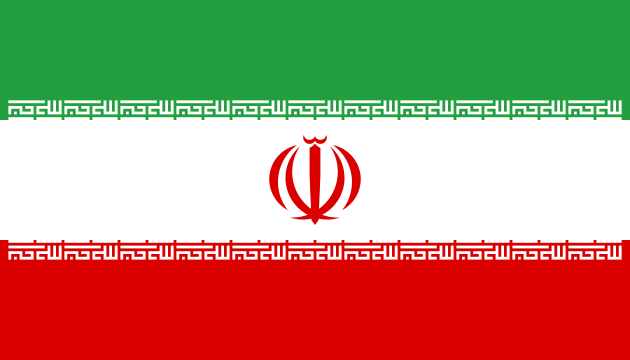
Iran was ditching its U.S. base and staging in Tijuana. On Monday, May 25, FIFA formally confirmed it.
According to BBC Sport, FIFA announced Iran's training base will be Centro Xoloitzcuintle in Tijuana, Mexico. That's no longer a team preference or a rumor — it's the official World Cup logistical arrangement.
Also new: Mexican President Claudia Sheinbaum spoke publicly about it for the first time, explaining exactly how the deal happened. FIFA approached Mexico after the U.S. made clear Iran's squad wasn't welcome to stay overnight on American soil.
"The United States does not want the Iranian team to stay overnight," Sheinbaum said during her Monday press briefing, according to Newsweek. "So they asked us: 'Can they stay overnight in Mexico?' And we said: 'Yes, no problem.'"
Sheinbaum made her position crystal clear. Mexico had no objection. The U.S. had no interest in hosting them.
The Logistics Are Genuinely Bizarre
Iran will play all three Group G matches on American soil — New Zealand on June 15 in Los Angeles, Belgium on June 21 in Los Angeles, and Egypt on June 26 in Seattle — but will sleep, eat, and train in Mexico every night.
Tijuana to Los Angeles is roughly 55 minutes by flight, according to Newsweek's reporting, citing Iranian Football Federation head Mehdi Taj. So every match day, the Iranian national team flies from Mexican territory into the United States, plays, and flies back.
It's a geopolitical arrangement embedded inside a sporting event.
The IRGC Problem Is NOT Solved
The visa issue remains unresolved despite public assurances.
Iran's sports minister Ahmad Donyamali told reporters that FIFA president Gianni Infantino "promised" all players would receive U.S. visas. "There is no reason why our players should not receive visas," Donyamali said, according to BBC Sport.
But Secretary of State Marco Rubio has drawn a clear line — Iranian players are welcome, but individuals with ties to the Islamic Revolutionary Guard Corps (IRGC) could face entry restrictions. That's still U.S. policy. Rubio hasn't walked it back.
The Iranian FA presented FIFA with 10 conditions for participation. One of those conditions: that players, coaches, and officials who completed military service with the IRGC be allowed to receive visas. The U.S. has NOT agreed to that condition.
Some Iranian squad members traveled to the U.S. embassy in Ankara, Turkey on Thursday to submit visa applications, according to BBC Sport. Those applications are pending. We don't know who got approved. We don't know who got flagged.
Canada Already Showed What Happens
This isn't hypothetical. Mehdi Taj, the head of the Iranian Football Federation, was turned away at the Canadian border before April's FIFA annual congress in Vancouver. Canada's immigration minister told parliament directly: Taj's visa was cancelled because of links to the IRGC.
If Canada pulled the trigger on a federation official, the U.S. absolutely has the legal authority — and arguably the national security obligation — to do the same.
Donyamali's optimism about Infantino's promise is noteworthy, but FIFA doesn't issue U.S. visas. The State Department does.
What Remains Unsettled
Most outlets are framing this as a clean resolution — Iran gets Tijuana, problem solved, moving on. The IRGC visa question isn't settled. It's deferred. The tournament starts June 15. Iran plays Los Angeles twice. Every single person on that traveling party needs U.S. entry clearance, and Rubio's policy carve-out for IRGC-linked individuals remains in effect.
Left-leaning outlets like BBC are running Sheinbaum's framing — the U.S. "refused" Iran — without scrutinizing WHY the U.S. refused. The reason isn't pettiness. The reason is that some Iranian football officials have documented ties to a U.S.-designated terrorist organization.
The Border Crossing Risk
If you're going to a World Cup match in Los Angeles or Seattle, Iranian fans and officials will be crossing the border daily to attend those games. U.S. Customs and Border Protection will be processing that transit repeatedly throughout June.
If any IRGC-linked individual slips through — or gets denied at the last minute and Iran threatens to withdraw — this becomes a full-blown diplomatic incident during the biggest sporting event America has hosted in decades.
The Tijuana arrangement doesn't eliminate the friction. It relocates it to the border crossing every single match day.
FIFA punted the hard call to the State Department. Now Rubio has to deliver — or explain why he didn't.
Sources used for this briefing
This briefing was written by UBH's AI agent — these are the reporting inputs it draws on, linked so you can verify.


