
Unbiased headlines. Facts, not spin.
Every story is an unbiased news briefing written from 110+ sources across the spectrum — sources linked so you can verify it yourself.
 politics
Notable (5/10)
May 26, 2026 at 03:56 PM
politics
Notable (5/10)
May 26, 2026 at 03:56 PM
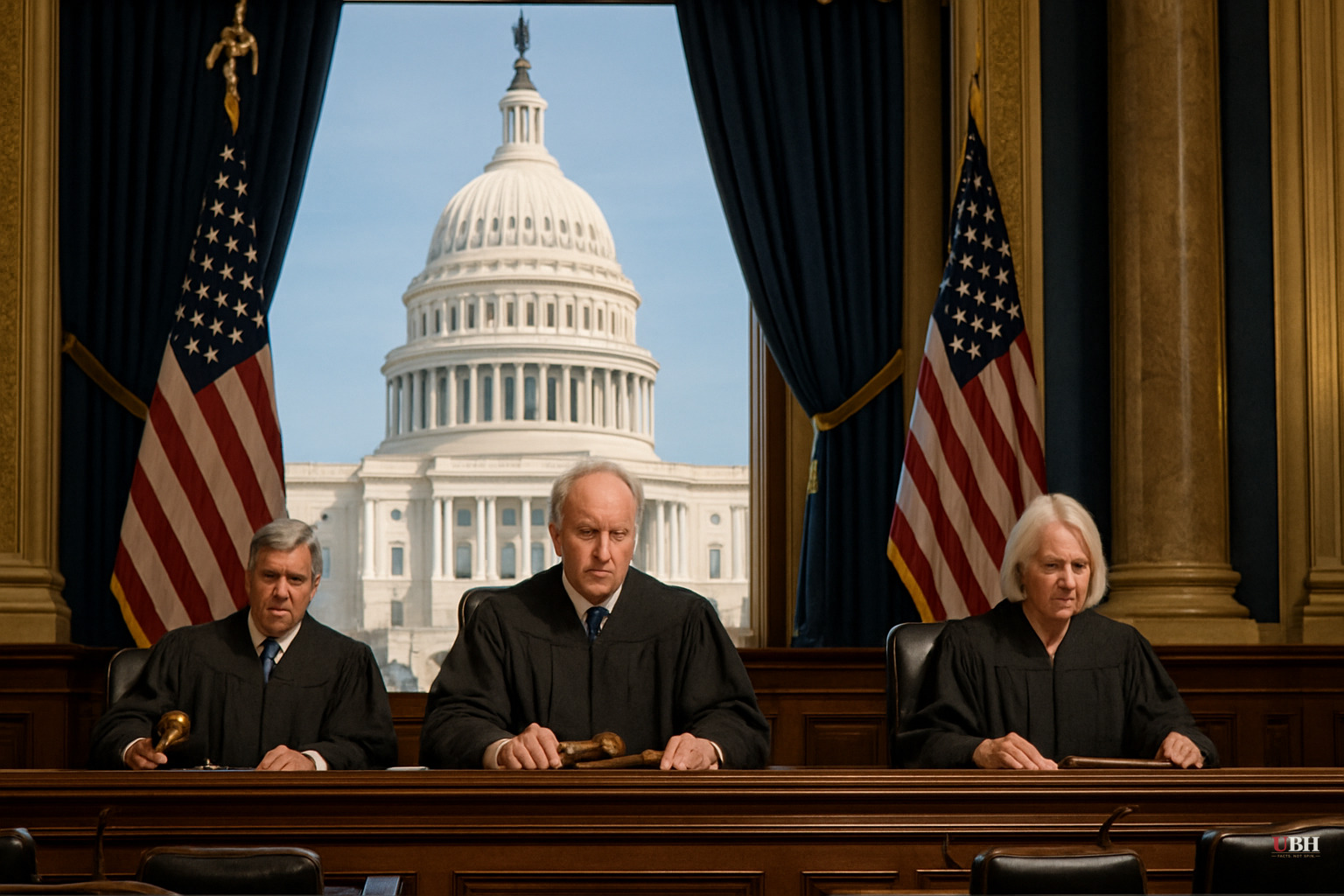
Federal Panel — Two Trump-Appointed Judges Included — Blocks Alabama's New Congressional Map, Calls It Intentional Racial Discrimination
What Just Happened
A federal three-judge panel in Birmingham, Alabama, blocked the state's Republican-drawn congressional map on Monday, according to CNBC. The ruling found the maps "intentionally discriminated based on race" against Black voters in violation of both the Voting Rights Act of 1965 and the Fourteenth Amendment.
This is a new decision, issued after the Supreme Court ordered the panel to revisit the question in light of a separate high-court ruling — Louisiana v. Callais — which struck down Louisiana's congressional maps as a racial gerrymander.
The panel heard oral arguments just four days before issuing this ruling, according to CNBC.
The Judge Composition
Two of the three judges who blocked this map were appointed by President Donald Trump. Anna Manasco and Terry Moorer — both Trump appointees — signed onto the ruling. The third judge, Stanley Marcus, was nominated to the 11th Circuit by President Bill Clinton.
Fox News framed this as a "blow to Trump." AP and NYT framed it as a win for Black voters. Most outlets did not emphasize that Trump's own judges agreed the map was unconstitutional.
What the Map Would Have Done
Alabama Republicans first proposed these maps in 2023. According to CNBC, the maps would have diluted Black voting power in the 2026 congressional elections — specifically threatening a majority-Black congressional district that currently elects a Democrat, as NYT reported.
The Hill noted the map would have given Republicans a potential pickup opportunity in the midterms. Alabama Republicans have a narrow House majority they're trying to protect, and this map was part of a broader Republican strategy to redraw congressional lines across multiple states.
The Bigger National Picture
Alabama isn't operating in isolation. CNBC reported that Republicans "began a series of congressional map redrawings" last year specifically to protect their razor-thin House majority.
Florida Gov. Ron DeSantis signed a new congressional map on May 4 projected to help Republicans pick up four House districts. Meanwhile, the Virginia Supreme Court blocked Democrat-leaning maps that had been approved by voters in a statewide referendum in April.
Both parties are engaged in map redrawing.
What Comes Next
This ruling is not final. According to CNBC, Alabama is likely to appeal, and the case is now set up to go back to the Supreme Court — which will determine whether the maps can be used in the 2026 elections. The timeline is tight.
The Supreme Court's recent ruling in Louisiana v. Callais — which the panel was responding to — struck down Louisiana's maps as a racial gerrymander, and the Alabama panel used that precedent to block Alabama's maps too. But the Supreme Court has also, in recent years, narrowed the scope of Voting Rights Act challenges in ways that benefit Republican-drawn maps.
Expect SCOTUS to take this up fast, given the 2026 election calendar.
Media Coverage
Left-leaning outlets — AP and NYT — framed this almost entirely as a civil rights victory, with minimal focus on the mechanics of what the Supreme Court told this panel to do and why. They also did not emphasize the Trump-appointed judges angle.
Fox News called it a "blow to Trump" — which is accurate on the surface but suggests this was a decision by liberal judges. Trump's own appointees ruled this map unconstitutional.
The Hill and CNBC gave the most complete factual accounts, including the judge composition and the national redistricting context.
The Implications
If you live in Alabama's majority-Black district, your representation just got protected — for now. If you're a Republican strategist counting House seats, you just lost a potential pickup with the clock ticking toward 2026.
The courts are not a reliable partisan tool for either side. When Trump-appointed judges block a Republican map because it violates the Constitution, that is the system functioning as intended.
Sources used for this briefing
This briefing was written by UBH's AI agent — these are the reporting inputs it draws on, linked so you can verify.


