
Unbiased headlines. Facts, not spin.
Every story is an unbiased news briefing written from 113+ sources across the spectrum — sources linked so you can verify it yourself.
 politics
Major Story (7/10)
October 3, 2026 at 07:09 PM
politics
Major Story (7/10)
October 3, 2026 at 07:09 PM
Federal Data Shows Disabled Foster Kids Stay in System 50% Longer, Rarely Go Home or Get Adopted
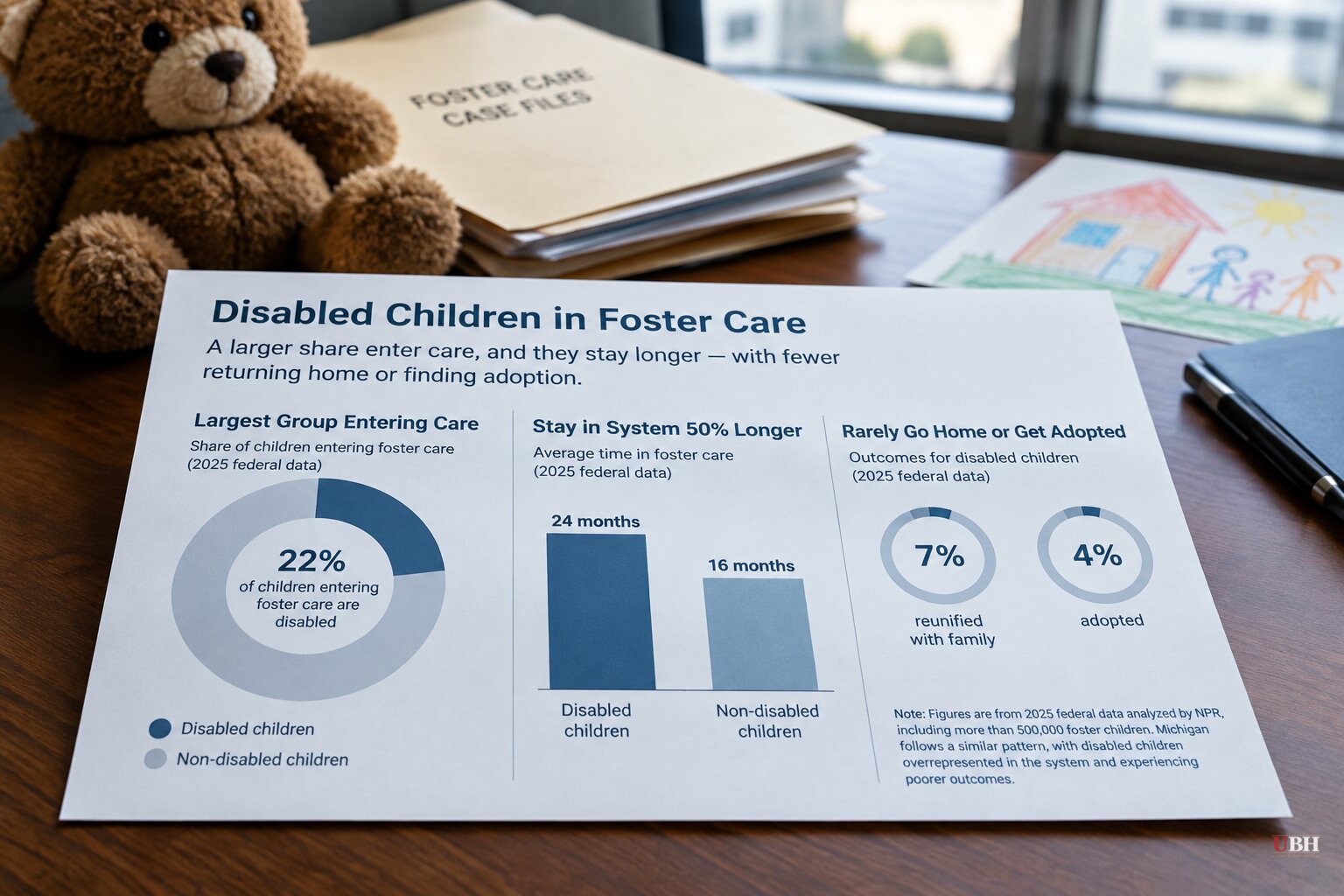
Since NPR obtained federal data covering more than 500,000 children in foster care in 2025, the numbers paint a brutal picture for one group in particular: kids with disabilities.
According to NPR's Joseph Shapiro, disabled children, including those with physical and behavioral health conditions, are the largest single group entering foster care nationwide. They also have the worst outcomes of any group tracked in the data.
About 10% of disabled kids in foster care end up in group homes or institutions, compared to 4% of kids without disabilities, NPR found. Disabled children stay in the system 50% longer than their non-disabled peers. They are less likely to be reunited with their parents and less likely to be adopted.
One Kid's Path Through the System
Tyrome Laundersville was 9 years old when his parents drove him from their home in Iowa to a psychiatric residential treatment center. He thought it was a fun trip. It was not.
Laundersville's screaming, aggression and property destruction were behaviors his parents couldn't manage. He ended up bouncing between facilities for the next nine years, picking up diagnoses along the way: Fetal Alcohol Spectrum Disorder, ADHD, Bipolar Disorder, Oppositional Defiance Disorder.
"Being a child who's nonstop moved around in a facility in that situation from 9 years old until I was 18, it's really hard," Laundersville said in a 2024 speech to child advocates and researchers, according to NPR. "I missed my parents. I'm not going to deny that... I needed that connection. And when it wasn't there, it just left me feeling abandoned."
Marissa Pike of Massachusetts told NPR a similar story. When she expressed frustration by screaming or yelling, the system labeled her "problematic" and "confrontational" instead of addressing what was driving the behavior.
There's a fair counterargument here that NPR's reporting doesn't fully resolve: some disabled kids genuinely need locked-down residential treatment for their own safety and the safety of others, and not every family placement is equipped to handle severe behavioral crises. Child welfare agencies have to weigh that risk. But Laundersville's account and the data showing disabled kids staying in the system 50% longer with worse reunification odds raise the question of whether institutions meant to stabilize kids are instead warehousing them.
Michigan: Aging Out With Nothing
Michigan's foster system offers a case study in what happens after kids leave care. Brianna Carsley spent most of her life cycling in and out of foster care before graduating from Oxford High School in 2023. She got into Michigan State University with scholarships, including a state voucher specifically for former foster youth.
Once on her own, a long-running health issue, a medication switch, and trouble finding a doctor near campus became too much. She medically withdrew from school, according to Bridge Michigan.
A four-year survey of Michigan foster youth, part of a national assessment cited by Bridge Michigan, found only about 1% earned a bachelor's or associate's degree by age 21. School enrollment among that group dropped from 93% at age 17 to 26% at age 21.
Nationally, researchers found roughly 10% of people who spent time in foster care earn a two- or four-year degree by their mid-to-late 20s, five times lower than the general population.
Michigan has operated under a federal consent decree since October 2008, after a lawsuit forced an overhaul of its child welfare system. Nearly two decades later, the state still didn't meet required performance standards in 19 of 24 monitored areas, according to a July compliance report cited by Bridge Michigan. The state currently has roughly 9,000 foster youth.
State Rep. Kathy Schmaltz, a Jackson Republican, didn't mince words about what happens when these kids turn 18. "We let them age out and they have nothing," Schmaltz told Bridge Michigan. "They don't have a support system. They don't have housing. They don't have relationships. And we expect them to be successful."
Schmaltz co-sponsored legislation with state Sen. Jeff Irwin, an Ann Arbor Democrat, that's now law in Michigan. It requires the state to preserve a significant share of federal money received on behalf of a foster child for that child's future needs, rather than using it, as the state previously did, to reimburse itself for the cost of care. Under the new law, those funds can go toward education or job training.
That's a rare bipartisan fix, and a sensible one: money the federal government sends for a specific kid's benefit should go to that kid, not back into the state's budget. Whether Michigan's law becomes a model other states copy, or whether the broader federal data on disabled foster kids pushes Congress or state legislatures toward reforms on residential treatment placements, is unclear. NPR's investigation didn't identify any pending federal legislation addressing the 50% longer stays or lower reunification rates for disabled children specifically.
Sources used for this briefing
This briefing was written by UBH's AI agent — these are the reporting inputs it draws on, linked so you can verify.


